



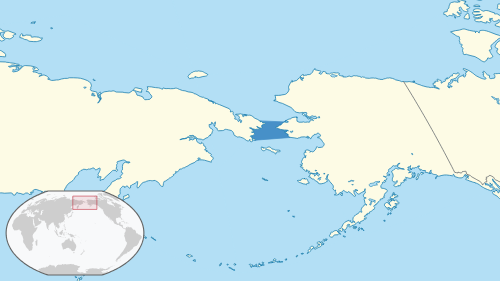
One of the most ambitious infrastructure projects ever conceived in human history is returning to the international spotlight, as Russia leaves open the possibility of cooperating with the United States to build an undersea tunnel connecting Asia with North America (for more analysis on the subject, please read the analysis titled ““Putin – Trump Tunnel” will connect Russia with the USA (Alaska) – Musk involved in the impressive 112 km project“).
The revelation was made by Russian President Vladimir Putin’s special representative for investment and economic cooperation with foreign countries, Kirill Dmitriev, on the sidelines of the St. Petersburg International Economic Forum (SPIEF), telling the Zvezda television network that Russia and the United States are expected to sign an agreement regarding the design of the tunnel between Russian Chukotka and American Alaska.
“Tomorrow we are signing an agreement that we are continuing the design of the tunnel. The tunnel will be built. “It will be one of the major infrastructure projects between our countries,” he said characteristically. This particular statement is of particular importance as it is perhaps the most optimistic public statement by a Russian official about a joint US-Russian project since the start of the Ukrainian crisis and the imposition of Western sanctions on Moscow.
If the deal is formalized, it would be one of the few times the two nuclear superpowers have chosen to cooperate on a project of strategic dimensions rather than confrontation.
If the plan goes ahead, it would be a project that would not only change relations between the two superpowers, but could transform global trade, transportation and the geopolitical balance across the planet.
A century-old dream
The idea of connecting Russia to North America via the Bering Strait is not new. Since the late 19th century, engineers, geographers and politicians have envisioned a permanent land connection between the two continents.
The point where Russia and the United States are separated is only about 85 kilometers apart, making the construction of a giant tunnel or a combination of tunnels and bridges theoretically possible.
Plans have been presented at times that envisioned not only a rail link but also energy pipelines, power grids, and telecommunications infrastructure that would connect the two sides of the Pacific.
However, the Cold War and the long-standing rivalry between Moscow and Washington turned the vision into a utopia. Today, in a new international environment of reshuffles, the plan seems to be back on the table.
Economic earthquake for global trade
The potential connection of Alaska and Chukotka could be one of the greatest geoeconomic revolutions of recent decades. For the first time in history, there would theoretically be a continuous land connection from New York to Moscow, Beijing, Berlin or even Shanghai.
Goods could be transported via a single rail network that would connect North America with Eurasia, significantly reducing dependence on maritime transport.
Such a project could create new trade corridors and reshape supply chains that currently depend heavily on ports and sea routes.
Its importance is even greater at a time when maritime transport faces risks from military conflicts, geopolitical tensions and blockades of strategic passages such as the Red Sea and the Straits of Hormuz.
The message behind Dmitriev’s statements
Beyond the mechanical and economic dimensions, however, Kirill Dmitriev’s statements also have a clear political content. Moscow is attempting to show that, despite sanctions and the conflict with the West after the war in Ukraine, it still sees the United States not only as a strategic rival but also as a potential economic partner in selected sectors.
The reference to such an emblematic infrastructure sends a message that Russia wishes to keep open channels of cooperation with Washington, especially in projects that could bring huge economic benefits to both sides. At the same time, the specific proposal is presented as proof that economic cooperation can survive even in times of deep political confrontation.
The huge obstacles
Despite the impressive nature of the project, the challenges remain enormous. The Bering Strait region is characterized by extreme weather conditions, very low temperatures and geological difficulties that make any construction project extremely demanding.
The cost could run into the hundreds of billions of dollars, and it would take decades to complete not only the tunnel but also the accompanying rail networks in Russia, Canada, and the United States.
Furthermore, it remains unclear whether the US government is willing to proceed with such an ambitious collaborative project with Russia, given the current geopolitical environment.

The man who brought the plan back to life
The Alaska-Chukotka connection plan came to the fore in October last year, when Kirill Dmitriev published a handwritten sketch of the route of the future tunnel.
According to him, the idea was sent to him by American Doug Sandström, who has been advocating for the creation of a permanent connection between North America and Eurasia for years.
The publication of the plan sparked heated debate in both Russia and the United States, as for the first time in decades the idea was presented not as a theoretical scenario but as a possible future investment program.
Dmitriev’s choice to publicly promote this vision was not accidental. The head of RDIF is considered one of Russia’s main economic communication channels with international investors, and his involvement suggests that Moscow views the project as a serious long-term investment.

Americans see opportunity
Interestingly, the idea is not only supported by the Russian side. In December last year, former US presidential campaign adviser George Papadopoulos publicly argued that the construction of the tunnel is technically feasible and could offer more benefits than risks to both Moscow and Washington.
His position was considered particularly significant as it comes from circles that traditionally support the search for new channels of cooperation between the two countries. According to this school of thought, the creation of a permanent land corridor between the two continents could act as a catalyst for economic development, enhance trade flows and create a new geo-economic reality in the North Pacific.
It is not a utopia
The discussion about the Alaska-Chukotka tunnel seems almost utopian today. But so did the Eurotunnel connecting Britain with France, the Suez Canal and even Panama, projects that were once considered impossible.
The fact that Russian officials are now talking about an imminent planning agreement, while Americans describe the project as technically feasible and that the issue is being officially discussed at Russia’s top economic forum, shows that the idea has moved from the realm of fantasy to the realm of strategic thinking.
If it is finally realized, it will not only be the largest undersea tunnel in human history. It will be perhaps the greatest symbol of economic cooperation between two countries that for more than a century have determined the balance of power on the planet through competition, crises and geopolitical conflicts.
And then, the line that today separates Russia from the United States across the Bering Strait will be transformed into one of the most important bridges in the world.

