




The sheer size of the numbers is simply mind-boggling: 12 American companies have a market value of $30 trillion? Note that the U.S. GDP is about $30.8 trillion in nominal terms for 2025, according to IMF forecasts.
There are only so many trillions of dollars that can disappear from investors’ portfolios before a recession is triggered.
The trillions of dollars are now passing us by so quickly that it is difficult to comprehend. The “dirty little secret” of today’s American financial system is that central banks cannot create jobs, raise incomes, or even generate economic growth.
All they can do is control the price of debt/credit, which inflates asset prices (stocks/real estate), making people feel richer so they keep spending money. That’s all.
- Why do this?
- Why not stop printing money, devaluing the US dollar, and allowing stocks to trade on fundamentals?
Because a bull market in the stock market is now a matter of national security. About 58% of American households have exposure to the stock market. In terms of real wealth, 45% of household wealth is invested in stocks. That is, almost half of the wealth Americans own is tied to the stock market. Only in this context does a major bear market or stock market crash become a matter of national security in terms of economic impact.
It’s the equivalent of an economic nuclear weapon. But wait, because this relationship goes even deeper than most people realize. The stock market is now actually the economy itself.
The rich are getting richer
We are in a “K-shaped” economy, where the top 10% of income or otherwise of consumers account for almost all of the consumer spending and economic growth, while the bottom 90% of income/consumers struggle with the increased cost of living due to inflation.
The top 10% of households, that is, the people who essentially drive the economy through consumption, own over 90% of the stocks.
In this context, a falling stock market would cause a huge reduction in consumer spending. And since consumption represents 70% of GDP, this would immediately lead to a recession. This is no exaggeration.
We got a taste of this during the trade war and tariff crisis in March/April 2025, when stocks plunged 18% in four weeks, wiping out $11 trillion in wealth.
During that time, many companies — from Southwest Airlines to Chipotle to PepsiCo — warned that they were seeing a decline in consumer spending to recession levels. That’s why policymakers, including the President and his inner circle, always intervene to prop up the stock market.
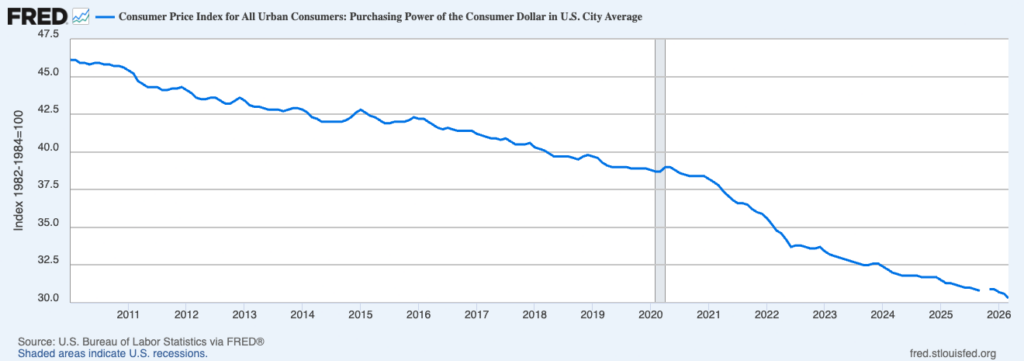
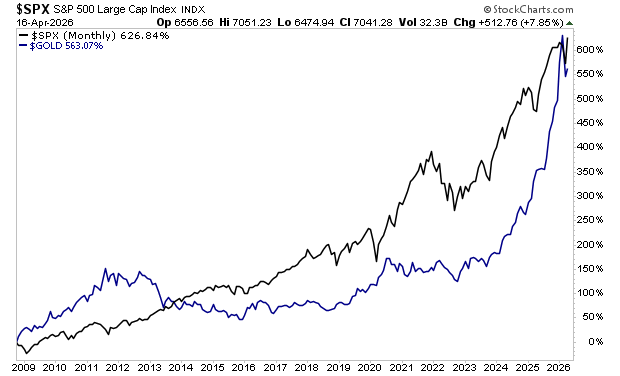
That’s why the market is manipulated both through statements and through direct injections of newly printed money by the Fed. This depreciation will force capital to flow into higher-risk assets, such as stocks, real estate, and “hard” assets like gold. It is no coincidence that both stocks and gold have skyrocketed during the same period.
The truth of the numbers
Today, twelve American companies have a market value of more than $1 trillion. Their total capitalization reaches $29 trillion.
Walmart had already entered the “1 trillion club” for a few weeks, albeit marginally, but recently fell below this threshold. If it were added to the list again, then the 12 American companies would have a total capitalization of about $30 trillion.
This amount corresponds to about 43% of the total market value of all companies in the S&P 500 index. During the small correction that occurred from January 28 to March 6 of this year, the total value of these 12 companies decreased by $1.8 trillion.
In the 58 sessions that followed, their value increased by $4.9 trillion. Over the past six years, their total market capitalization has skyrocketed from about $6 trillion to $30 trillion. These are returns that have guided an entire generation of investors.
The Case of Micron
The latest company to join the “trillion-dollar club” is Micron Technology. Since its low on April 3, 2025, its stock has surged 1,315%. Its market value has increased from $72 billion to over $1 trillion.
Most impressively, the second half of this journey — from $500 billion to $1 trillion — was accomplished in just 48 sessions, a record-breaking feat.
The 12 U.S. companies in the “trillion-dollar club”
- NVIDIA: $5.11 trillion
- Apple: $4.58 trillion
- Alphabet (Google): $4.57 trillion
- Microsoft: $3.34 trillion
- Amazon: $2.91 trillion dollars
- Broadcom: $2.12 trillion
- Tesla: $1.64 trillion
- Meta Platforms: $1.61 trillion
- Micron Technology: $1.09 trillion
- Eli Lilly: $1.04 trillion
- Berkshire Hathaway: $1.02 trillion
- Walmart follows with about $922 billion.
Eli Lilly is in danger of falling below the trillion mark, while Micron is also quite close to that possibility. Even a normal daily fluctuation could be enough. These stocks are now considered highly volatile.
$30 Trillion Isn’t What It Used to Be…
$30 trillion was once considered an unimaginable sum. Just four years ago, the total national debt of the United States was about $30 trillion. Today, it’s $39 trillion.
Not because it’s gotten any bigger, but because it’s still growing. And more companies worth more than $1 trillion. There are three more companies with a market capitalization of more than $1 trillion, but they’re not American:
- South Korea’s SK Hynix,
- Taiwan Semiconductor Manufacturing Company (TSMC),
- and Saudi Aramco.
What happens if there’s a major correction?
Every small drop in the combined value of these 12 companies means trillions of dollars disappearing from investment portfolios. Every small rise creates trillions of dollars “on paper.”
If there were even a 20% drop, about $6 trillion in market value would disappear. Once, $6 trillion was considered a huge amount. Today, it could be lost simply by the correction of a dozen stocks.
Recession risk
A classic tech stock crash, similar to those seen in the past after periods of excessive gains, could lead the US economy into recession.
According to Trust Economics, there are limits to how much trillions can be lost from household and business portfolios without affecting their financial decisions.
When losses become too great, consumers and businesses cut back on spending and investment, slowing economic growth.
The example of the dot-com bubble
A similar situation occurred during the dotcom bust. A year after the crash began, in March 2001, the United States entered a recession. The recession lasted until November of that year.
However, the stock market crash continued until October 2002. By then, the Nasdaq Composite had lost about 78% of its value.
The crisis particularly affected areas with a large concentration of technology, telecommunications, software, hardware, and biotechnology companies, such as:
- Silicon Valley,
- San Francisco,
- Seattle,
- and Boston.
In these areas, the situation resembled more of an economic depression than a simple recession. However, much of the rest of the country was much less affected.
The overall recession turned out to be relatively mild compared to the much deeper crisis that followed a few years later, when the collapse of the housing bubble coincided with an over-indebted and dangerously interconnected banking system.
A stock market crash is not imminent. The concentration of enormous value in just 11–12 companies has reached historically extreme levels.
If these companies undergo a serious correction, the loss of wealth will be so great that it could affect consumption, investment, and ultimately the growth of the American economy.
The comparison is mainly to the tech bubble of 2000, although it is recognized that today’s tech giants are much more profitable and powerful than most companies of the dot-com era.


