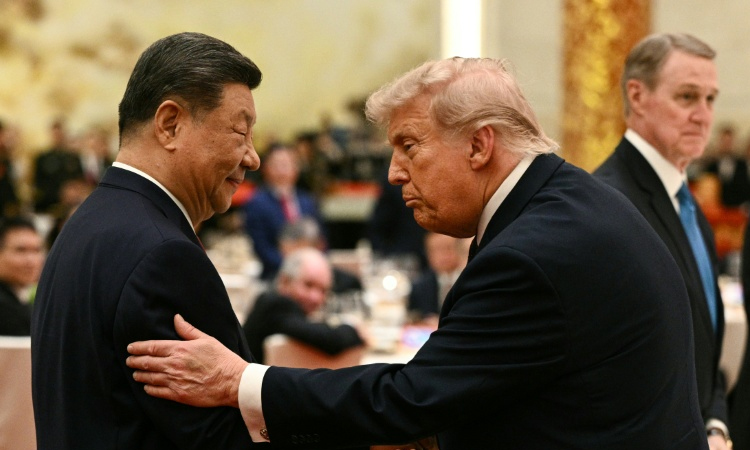
In November 2017, Xi Jinping “gifted” Donald Trump the Forbidden City. A private dinner in the Hall of the Incarnation of Virtue, a procession through Tiananmen, a glittering ceremony in the Great Hall of the People, and he won $250 billion in trade deals. Xi understood exactly what he was dealing with: a man who needed to feel great, who could be manipulated by spectacles, the way a restless child is manipulated by pageants. Feed him grandeur, let him tweet about it on the return flight, and Beijing would keep its real influence intact. It cost China nothing structural. Trump left satisfied, which says everything about the depth of his satisfaction.
Nine years later, the same man lands in Beijing on May 14, carrying a war with Iran he can’t end, a tariff regime his own Supreme Court weakened before it even took off from the runway, and seventeen CEOs who are there, in the simplest terms possible, to beg. Elon Musk, Tim Cook, Larry Fink, Steven Schwartzman, David Solomon, Boeing’s Kelly Ortberg, and the heads of Meta, Citi, Visa, and Qualcomm didn’t push to join this mission out of patriotic solidarity with their president’s trade strategy. They pushed to participate because they have been watching their supply chains buckle for fourteen months and need someone in the room when Xi decides what “crumbs” to offer. The White House calls it a “showcase of American industrial power.” It’s a hostage convoy where the hostages paid for their own plane tickets.
How did Xi bend him? Twice
On April 4, 2025, the same morning that Trump announced the “Liberation Day” tariffs, Beijing’s Commerce Ministry restricted exports of seven heavy rare earths and permanent magnets. These materials are used in fighter jet components, missile guidance systems, semiconductor manufacturing, and electric vehicle motors. Between 2020 and 2023, the United States sourced about 70% of its rare earth compounds from China. Within weeks, auto assembly lines in the U.S., Germany, and Japan reported shortages so severe that they threatened to shut down factories by the summer.
Trump backed down. His administration negotiated a 90-day truce, restarting exports and allowing the president to claim a deal. The truce lasted until the summer. Then, in October 2025, just days before a scheduled Trump-Xi meeting in South Korea, China reimposed tighter restrictions, timing the pressure with the precision of a surgeon who already knows where it hurts. Trump backed down again, accepting the same terms a second time.
What followed was Beijing’s real message. China resumed deliveries of finished permanent magnets while continuing to withhold the rare-earth raw materials needed to build domestic American processing capacity—the capacity the administration had publicly named as the main goal of the entire exercise. The finished products arrived on time. Control of the processing remained in Chinese hands. Chinese state monopolies now control about 89% of global rare earth refining, and the Trump administration’s two rounds of tough measures have not changed that figure by a single percentage point.
The customs data then made the strategy frighteningly clear. After China eased restrictions in November 2025, magnet exports to Europe rose 60% year-on-year. U.S. imports fell 11%. American manufacturers were under constant supply disruption, while European industrial interests received preferential treatment as Beijing simultaneously cultivated Europe as a counterweight to American pressure. The trade war that Trump launched to reassert economic dominance produced, in effect, a global reordering of supply chains at the expense of the United States. Now he arrives for the third round of this negotiation having lost the first and second, flanked by the same corporate class that spent these fourteen months quietly calling on everyone they knew in Washington to stop the chaos.
Seventeen Hostages, One Check
Each executive on the mission is there for a specific and humbling reason.
Apple’s manufacturing infrastructure in China took two decades and hundreds of billions of dollars to build. Relocating it is a project measured in years, and the government’s timelines for domestic semiconductors have been repeatedly delayed. Tim Cook can’t move those factories because a president decided a trade war was “easy.” Tesla’s second-largest market was China before the tariff war pulverized cross-border trade trust. Elon Musk, who spent most of the past two years publicly demonstrating faith in Trump’s political project, now needs Xi Jinping’s goodwill for the company that actually pays his bills. BlackRock and Blackstone need access to Chinese capital markets on a scale that no alternative market can replace. Qualcomm can’t unravel a decade of semiconductor interdependence because Washington has decided to treat trade as a war.
These people are not advising Trump from a position of power. They are accompanying him because someone with direct exposure to the ruins had to be there when the terms were being set. Their presence tells Xi exactly what he needs to know about the American negotiating position before a word is spoken in the Great Hall.
In 2017, Xi organized a “state visit-plus” for Trump: pomp, ceremony, the full theatricality of Chinese statecraft in the service of managing an easily manageable man. In 2026, both sides arrive with modest expectations — diplomatic language for two governments that know one of them will leave with less than it wanted and hope to hide the shortfall in the joint statement. The difference between the two visits is not protocol. It’s a map of where the power has gone.
The War That Started and Can’t End
Trump rejected Iran’s latest ceasefire proposal this week. He called the document “a piece of junk” and publicly confirmed that he hadn’t finished reading it. The war has been going on for ten weeks. The Strait of Hormuz, through which about a third of the world’s oil passes, has been blocked. The IMF has warned that the turmoil is approaching the brink of a global recession. Iran says it has asked for nothing beyond its “legal rights.” The White House has not stated, in any public forum, what terms it would actually accept to end the conflict.
He is heading to a summit with the only government with a working relationship with the country whose war it cannot end. Iranian Foreign Minister Abbas Araqchi visited Beijing ahead of the summit, and China has been positioned as a potential conduit for any final settlement. Beijing has publicly warned Washington not to interfere in its trade and energy deals with Tehran. When Trump sits across from Xi on May 14, the man looking at him will have influence not only over rare earths and capital markets but also over the way out of an armed war that the US president started and has now publicly called unresolved.
China has also been better insulated from the crisis in Hormuz than any US ally, with large strategic reserves and onshore pipeline infrastructure built over years precisely to reduce exposure to maritime bottlenecks. The energy disruption is raising costs for Chinese manufacturing, but it remains manageable. For Vietnam, South Korea, Japan and Singapore, it is immediate and punitive without any “cushion”. (For more analysis on the subject please read the article “The truth that is not told publicly, about the possible destruction of the economies of the EU, Japan, USA“). Beijing can watch the crisis without urgency. Washington created the crisis and does not have that luxury.
Trump’s failed power theory
Trump’s theory of power has always been the same: pressure creates leverage, leverage produces deals, deals make people right. What China has proven throughout 2025 is that the theory has one condition: the other side must have no viable countermeasures. Beijing identified the specific inputs that the American economy cannot replace in the short term, restricted them with surgical precision, and negotiated settlements that looked like American victories until the tariff data came in. The superficial victories were real. The underlying influence was not shifted.
The seventeen CEOs on this trip are living proof of what the second term has produced. Apple can’t move its factories. Tesla can’t replace its Chinese consumers. BlackRock can’t find another market of this scale. Qualcomm can’t unravel a decade of semiconductor interdependence because a president decided a trade war was easy to win. They’re not with Trump because the strategy worked. They’re with him because it failed, and they need to be there when Xi decides what to offer the man who tried to bend him and is now asking for help.