



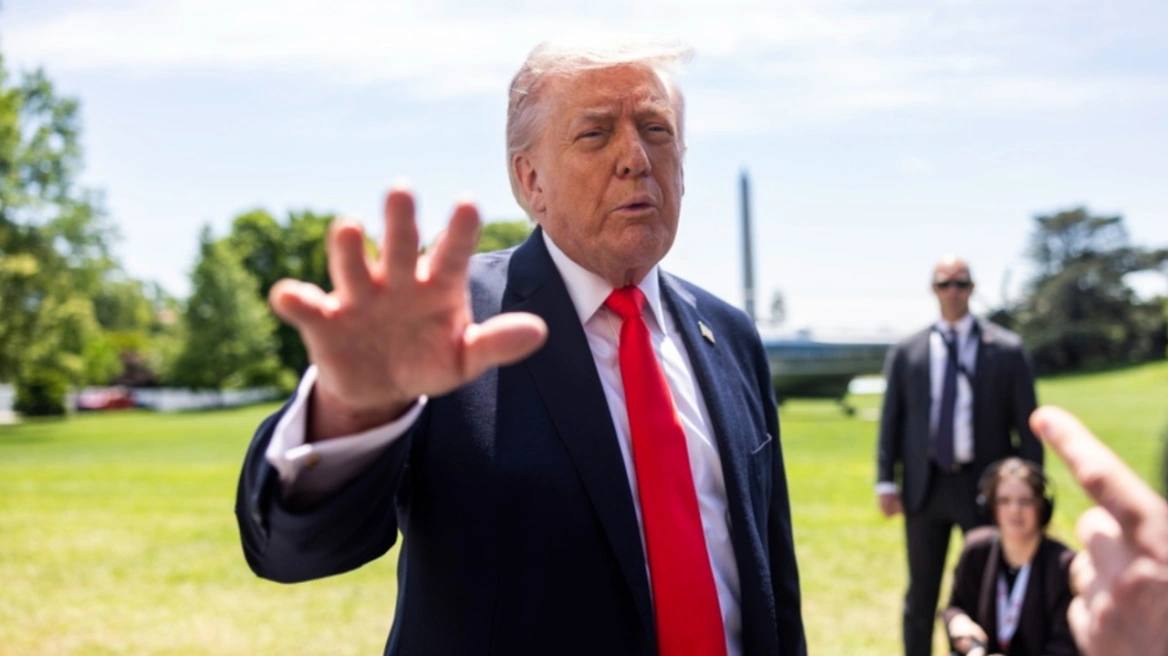
Trump seems trapped and desperately wants the Straits to open, but the Iranians are torturing him and not agreeing to his proposals, despite the pressure he is exerting on them, preventing the transport of Iranian oil through the naval blockade he has imposed.
As long as the Straits remain closed, the consequences for Western economies – mainly European but also American – are great. And these consequences create great pressure on Trump himself because they affect the American voter a few months before the American midterm elections. This translates into great political pressure on him, because for Americans the price of gasoline over 4 dollars a gallon is an unthinkable situation.
Yesterday Rubio said that we are now at the stage where we have Project Freedom in force. Trump is now saying the end of this specific project and we are looking for an agreement. They are not talking to each other to say the same thing on this either. Agreement with whom and why? Who are the representatives of Iran? Behind this strange situation that prevails around the President’s officials, lurks the information to President Trump that the “operation” – Project Freedom of Mark Rubio is on the verge of a coup (for more information on this issue please read the analysis titled “Rubio: the military-industrial complex’s favorite to run for US president, not Vance“). The two months specified by the US Constitution and which operation must pass through Congress have passed. (For more information on the subject, please read the analysis titled “Iran: Trump’s Vietnam – Congress Prepares to ‘Bury’ Him for Defeat by the Mullahs“). Changing names in the naming of the operation is elementary school level.
The good scenario
Trump, therefore, is under great pressure to find a way to disengage and open the Straits. Since Iran, despite the regime’s stubbornness, is also being economically pressured by the naval blockade, ultimately both sides have an interest in de-escalating the situation. All that remains is to find a way for both to say that they won. That is, for Trump to say that we achieved our goal, weakened Iran, deprived it of the ability to build nuclear weapons, and exhausted its arsenal, and for Iran to say that we expelled the American and Israeli invaders and proved our strength. So everyone will have won, so the Straits will open.
This is the good scenario, and this is what the markets believe, since we see stock prices rise, gold and silver fall, and corporate profits increase.
The behavior of the markets shows that they are optimistic and see that a solution will soon be found. Possibly their optimism is also related to a possible reduction in Trump’s power in the midterm elections in November, which would initiate developments for his future replacement and thus limit the disruption and instability that he causes in the geopolitical and economic balances.
All of this makes up the optimistic scenario. Which, although it is optimistic, does not mean that it is pleasant, since oil and natural gas prices will not de-escalate easily and quickly. And this is because in addition to the cost of transporting fuel and products, which will return to lower levels when the Straits open, there is also the cost caused by limiting production from the region. Oil and gas production has been severely damaged by the destruction of factories, refineries, natural gas liquefaction plants, ship loading stations, pipelines and other critical infrastructure.
These damages are estimated to be very large and for production to return to pre-war levels, investments of several billions and at least two years of repairs are needed.
Both this war and the Russia-Ukraine war have important lessons for the Western world, the most important of which is that it must strive for energy sufficiency. And this, given that Europe has neither oil nor natural gas, will be pursued through alternative energy sources, from photovoltaic and wind power, but also from nuclear reactors if this is accepted by European societies.
Alternative sources, which until now were used for environmental reasons, are now considered necessary for reasons of energy shielding of Europe.
The questions that need answers
The big question now is whether and when the Straits of Hormuz will open and whether there will be peace and stability in the region.
The answer is not easy of course – perhaps the opening of the Straits, if not accompanied by conditions of real peace, will not be enough to restore balance to Western economies. And the consequences of this war are significant for the West, but also for the global economy. Both for the real economy, agricultural production, industry, processing, as well as for technology and services, and even for the intangible, but very energy-intensive world of Artificial Intelligence.
The intangible world has experienced a leapfrog development in recent decades, with an astronomical acceleration in recent years, as supercomputers and Artificial Intelligence have entered the game. The material world of industry, manufacturing, and agricultural production has lost its luster because it does not offer the returns that technology companies offer on international stock markets.
But the war in Iran has a cost for both the material world of production and the intangible world of Artificial Intelligence.
The Straits of Hormuz is a key point for international trade. It is the gateway for trade in essential raw materials.
According to figures recently published by the Financial Times:
- 50% of the world’s seaborne sulfur trade passes through the Strait.
- It also handles 34% of crude oil trade, 29% of liquefied petroleum gas (LPG),
- 19% of liquefied natural gas (LNG),
- 19% of refined petroleum products,
- 13% of chemicals – including fertilizers,
- and almost 10% of aluminum.
All of this forms the basis of global production, not only of all industrial products, but also of food production. And of course, it is the basis on which technology rests. And because of the materials it uses, but mainly because of the energy required to operate supercomputers and Artificial Intelligence.
So even if the Straits are opened, it will take time to repair the damage to infrastructure and production.
The pessimistic scenario
And here comes the pessimistic scenario – which is not currently favored by the markets – that the crisis will last for years and will be much deeper than we currently estimate. In this pessimistic scenario, Europe’s economy will have a chronic problem, inflation will be high for years, economies may enter a recession and the very unpleasant situation of stagflation will prevail. A situation in which the two greatest enemies of prosperity, high inflation and recession, coexist.
This means poverty for a growing part of the population and serious economic difficulties for the vast majority of Europeans.
Fortunately, this is not the most likely scenario, but it is a scenario that international organizations are examining and leaderships are taking into account when planning ways to cope.

