



A historic geopolitical chain that could shatter the petrodollar doctrine and seal the end of American hegemony is likely to be triggered by the United Arab Emirates’ bombshell withdrawal from OPEC.
Trust Economics warns in its analysis of a possible impending global collapse, as dedollarization is now turning into a violent reality that is leading to an unprecedented explosion in the price of gold. In a world where the “weaponized” US debt is collapsing, a return to precious metals seems like the only lifeline against the coming stagflation.
In particular, as noted in a report by the Greek economic research and consulting firm, the United Arab Emirates’ surprise withdrawal from OPEC last week has now made the case for precious metals almost too obvious. In fact, the Greek firm reports that the crucial dollar-petrodollar-gold triangle has just sent us one of the most important signals for gold in over 50 years. And for anyone following developments, this should come as no surprise.
The beginning was in 2022
As early as 2022, that is, from the first day of US sanctions against Russia – this particular event marked the greatest macroeconomic turning point to hit the world since Nixon delinked the dollar from gold in 1971, we warned that confidence in a more “weaponized” global reserve currency would decrease, creating a scenario in which the BRICS+ countries would gradually begin to dedollarize, thus weakening the hegemony of the US dollar in general and of the US itself in particular.
In the years that immediately followed, dedollarization became an indisputable trend, the dynamics of which we have been analyzing and highlighting with consistency and conviction ever since.
The Importance of the Petrodollar
Furthermore, Trust Economics reports that there will be gradual and then inevitable threats to the petrodollar, a key pillar of the dollar’s hegemony. After all, forcing the world to buy oil in US dollars (and oil producers to use their revenues to buy US government bonds) is indeed an “excessive privilege”.
The 1974 petrodollar system essentially created a global “sponge” for overproduced/overspent dollars, which explains why the US could so easily export its inflation to the rest of the world for decades without consequences. But if this “sponge” weakens, then the dollar’s dominance will also weaken.
It cannot be stressed enough how crucial the Petrodollar is—or was—to the dollar as a currency and to the US as a financial hegemon. This is precisely why we are watching the cracks in the Petrodollar after 2022 in many places and analyses. In short: The Petrodollar matters, it really matters enormously.
The Cracks
Ever since the US weaponized its already over-indebted and increasingly weak dollar in 2022, we’ve argued that even its OPEC oil “allies” would eventually reconsider their 1974 agreement to sell oil exclusively in dollars.
With China openly seeking a non-dollar oil solution, it was only a matter of time and circumstance before OPEC nations turned away from the dollar and eastward toward the yuan. And as of this week, it now appears that each of those warnings is gradually beginning to come true.
Pain for the Petrodollar
The United Arab Emirates, one of America’s biggest allies, has just ended its membership in OPEC, while simultaneously telling the US Treasury that it may start selling its oil in other currencies. Why?
There are many answers, but they all boil down to a growing distrust of the US dollar and a declining appreciation of US global hegemony/policy.
When Kissinger made the petrodollar deal in 1974 with the Saudis, for example, it was essentially a “handshake at knifepoint,” a coercive agreement in which the US promised military protection to OPEC members in exchange for the mandatory sale of oil in dollars.
Some 50 years later, however, the over-indebted dollar and increasingly weak US bonds are nowhere near as attractive/powerful as they were in the early 1970s.
Furthermore, the “Soviet threat” of 1974 is not the same in 2026 as it was then.
Countries like the UAE and Saudi Arabia no longer worry about a “red star” over Riyadh or Abu Dhabi, but they are certainly aware of the American missiles that are crossing their skies today, in what—at least for many and for now—looks like an absolute military fiasco under the leadership of an increasingly desperate America.
OPEC countries see a rich oil market in China and an over-indebted “bully” in America, which already has its own oil.
The UAE (which has been leaning towards the BRICS alliance since 2024 and sells oil to India in rupees instead of dollars) is now the first country to openly reveal that it is tired of being the “dog” wagging the petrodollar’s tail.
At the same time, even Saudi Arabia has been flirting with China for years, considering selling oil in yuan instead of dollars.
Immediate Threat
All of this is an immediate threat to an America that has always assumed the world would follow its orders, buying oil in dollars and hoarding US Treasuries like obedient subjects.
But China is no longer a subject, and has sold 48% of its US Treasuries while seeking non-dollar oil.
John Connally’s then-infamous (and arrogant) 1970s declaration to the world that “it’s our dollar but your problem” would prove historically embarrassing and short-sighted, a tribute to the hubris before the fall.
Today, the US dollar is “their dollar and their problem”, for the simple reason that after more than 50 years of deficit spending, inflation, export crises and oil-related “freedom and democracy” wars, the world no longer trusts or wants this dollar.
What do the cracks mean?
In fact, as early as 2014, when US money printing became addictive rather than “temporary”, countries gradually began to lose confidence in America’s “excessive privilege”.
In the same year, they started buying up pure gold and getting rid of pure US bonds.
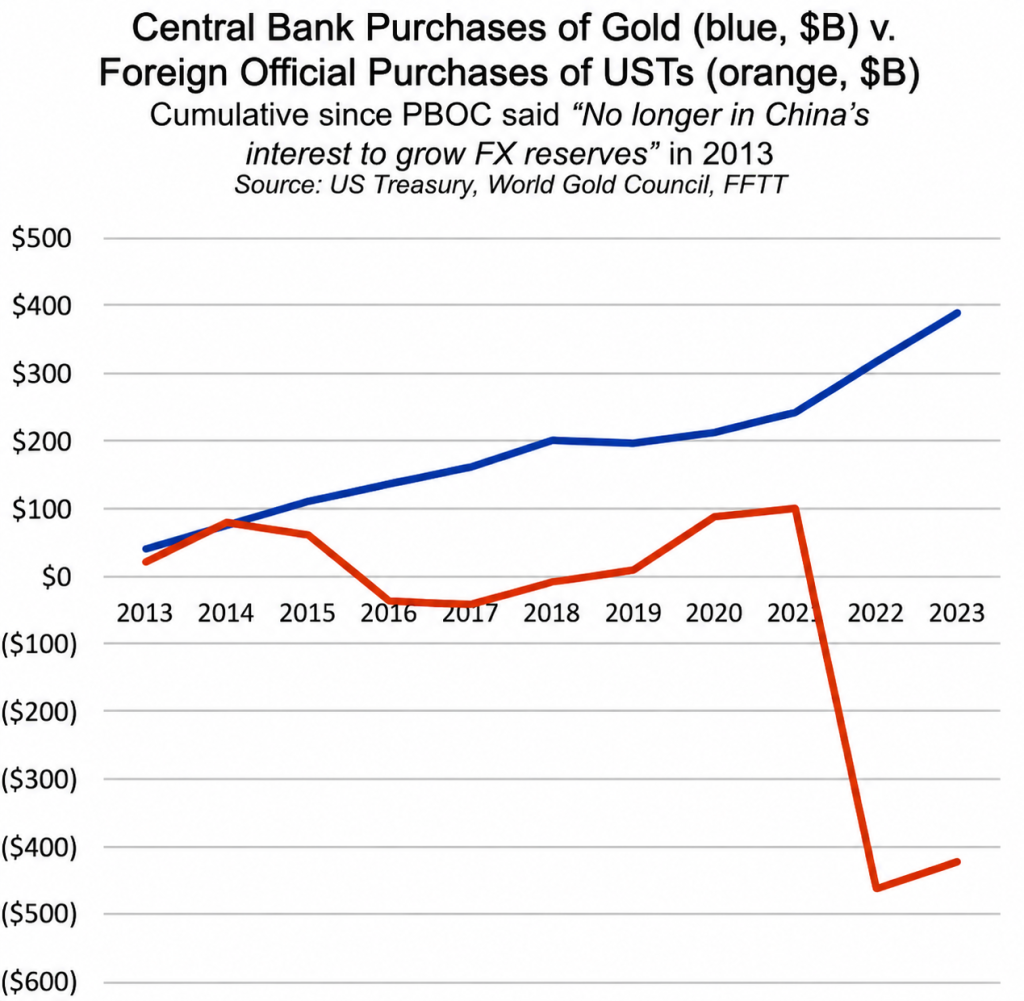
By 2022, of course, the net accumulation of gold by central banks worldwide had gone from gradual to exponential. Since then, central bank gold accumulation has increased fivefold, acting as a clear challenge to the dollar and US Treasuries.
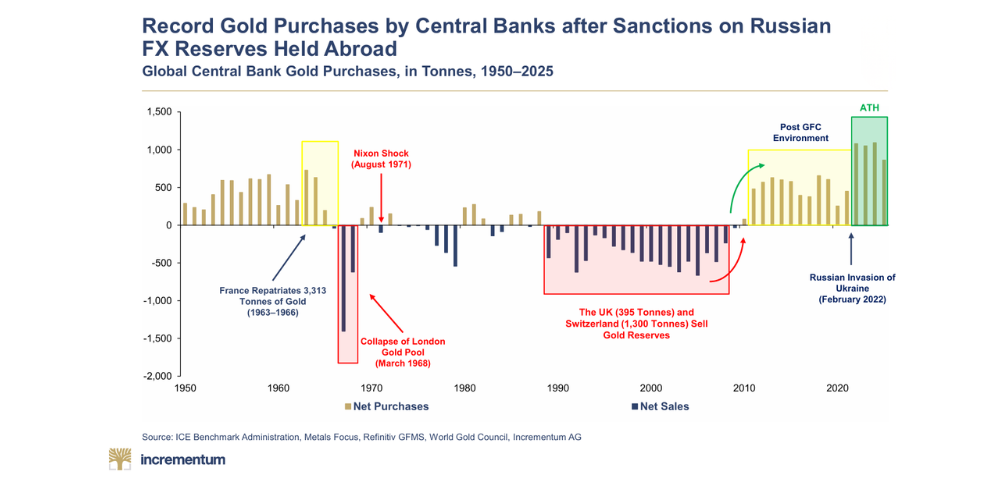
Furthermore, since the US “weaponized” the dollar in 2022, the Bank for International Settlements has recognized gold as a first-class asset, while even “too big to fail” banks like UBS, Goldman Sachs, and JP Morgan (who once deliberately downgraded gold) are now structurally bullish on this “rock” asset.
In short, the combination of the following factors:
- an undervalued and “weaponized” dollar,
- negative real yields on US bonds,
- clear dedollarization trends,
- unsustainable levels of US public debt,
- a disastrous war in Iran, and
- a clearly failed petrodollar,
makes it obvious (and not just debatable) that demand for and confidence in the dollar is collapsing.
This slow but predictable transition from superpower and supercurrency to a debt-ridden and undervalued economy is as old as history itself. Without a strong petrodollar to absorb the bloated and overextended dollar, America’s economic and monetary decline will accelerate.
As the world (including a weakened OPEC) moves away from the dollar and US bonds, bond yields and US debt levels will rise, while the purchasing power of the dollar will decline, creating the perfect backdrop for new trillions of “printed” money and an environment of stagflation of historic proportions.
The inevitable monetary and fiscal “support” (i.e., money printing) to support a collapsing real economy will further accelerate the depreciation of an already weakened dollar.
This expansion and depreciation of the dollar will act as a powerful catalyst for gold’s rise in the coming years. As we have argued for years, the inevitable decline in currencies fully explains the rise of physical gold, which — not coincidentally — hit more than 50 all-time highs in 2025 as currencies fell at a similar pace.
In this context, Trust Economics reports, the bull market for gold has only just begun. Its resilience and long-term upward trajectory (despite recent sell-offs) are virtually guaranteed, as the fate of a depreciating paper currency system in a declining credit environment is historically inevitable.
What we are seeing with OPEC’s weakening is a slow transition from dollar-based oil to transactions increasingly settled in gold, whose capitalization is much smaller than that of the global oil market.
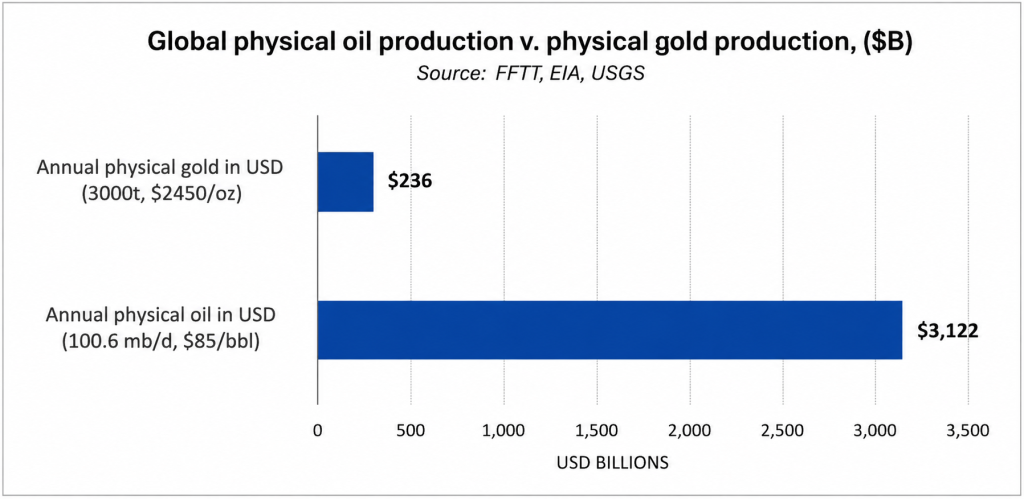
Gradually, gold will not only hold its value better than an undervalued and unreliable dollar, but it will also gain greater importance (and value) in the global oil trade. After all, oil settled in gold is much less volatile than oil settled in dollars. If we can see this, so can the oil-producing countries of OPEC.
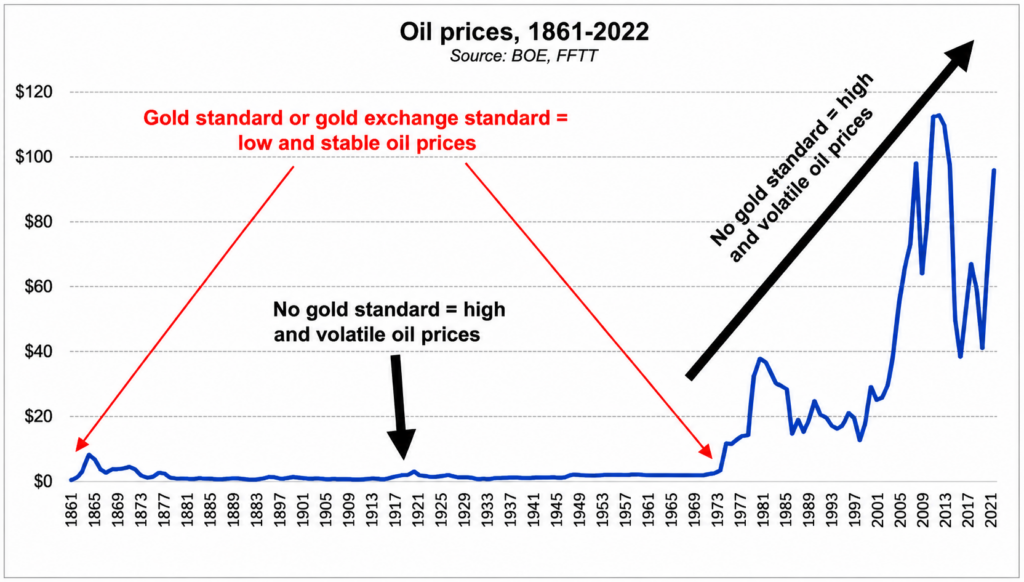
Their move away from the dollar will be slow but hard for a currency whose dominance has been waning for years. After decades of hegemony, the dollar is losing the trust not only of citizens, central banks, commercial banks, and oil-producing countries, but also of all those who understand the history of currency devaluation, the mathematics of gold, the “tax” of inflation, and the dishonesty of politicians.
What we saw last week with the UAE’s withdrawal from OPEC is just another confirmation of the gradual decline of the dollar and the beginning of the dominance of gold (and silver).


