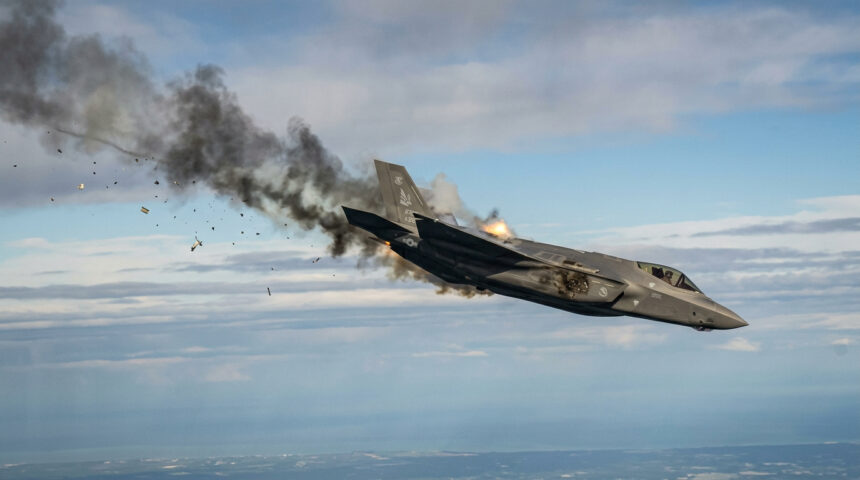
In March 2026, a US fifth-generation F-35 fighter jet made an emergency landing at a base in the Middle East after a mission over Iran. US authorities confirmed the landing and the damage, while the exact cause remained under investigation, with some sources reporting the possible involvement of Iranian missile systems.¹ This incident, regardless of its final interpretation, brought to the fore an old but increasingly relevant question: whether manned stealth fighters remain a viable strategic investment in an environment where sensors, computing capabilities and unmanned systems are rapidly evolving.
This study argues that stealth manned aircraft are no longer the final stage of military stealth, but a transitional stage. The real evolution of the concept of stealth is being implemented today through the massive use of small, cheap and expendable unmanned platforms, especially in swarm warfare and mosaic warfare scenarios.
The Classical Logic of Stealth and Its Limits
Stealth technology was developed during the Cold War with the goal of reducing the probability of detection by enemy radars by reducing radar cross-section (RCS), controlling infrared signature, and limiting emissions.² Aircraft such as the F-117, B-2, and later the F-22 and F-35 were designed as highly survivable platforms that could penetrate deep into enemy territory and strike critical targets (please also read our analysis titled “US F-22 Raptor shot down and crashed in Kuwait, watch video“).
However, this classical approach was based on an environment where sensors were relatively monostatic and data processing was limited.³ The modern reality of multistatic radars, passive sensors, and network-centric combat systems has significantly limited the advantages of low observability.
The erosion of the low observability advantage
advances in technologies such as multistatic radar, long-range infrared sensors, and artificial intelligence for data fusion have increased the probability of detection due to wider viewing angles and advanced thermal analysis of incoming returns.
A stealth aircraft has always been not invisible; it has simply been more difficult to detect in the X-band, i.e. the frequencies that allow targeting from a distance. Of course, the use of detection radar in bands that better match the dimensions of a fighter aircraft allows for an approximate trajectory of the target. In this case, launching a missile allows a better signal-to-noise ratio on its approach to the fighter aircraft and therefore a better chance of a successful intercept, as in the incident with the F-117 in Serbia.
In addition to a sufficiently dense sensor network, the probability of detection tends to increase with the time spent in enemy space.
Another important point is that the intensity and temperature of a fighter aircraft’s exhaust makes it very difficult to remain outside the detection range of thermal sensors.
All of the above elements undermine the basic doctrine on which manned stealth fighters were built: the assumption that the platform will remain invisible during the attack.
The Economy of War and the Collapse of the Logic of Expensive Platforms
The most important variable that differentiates the era of stealth fighters from the era of drones is economic. The average cost of an F-35A exceeds $80 million per unit, not including maintenance and support costs.⁴ In contrast, modern loitering munitions and disposable drones can cost between $20,000 and $70,000 per unit, depending on the level of complexity and production scale.⁵
The cost ratio between attacker and defender thus becomes a critical factor. A cheap unmanned system that shoots down or even simply forces an expensive manned fighter to abandon its mission creates an asymmetric economic relationship reminiscent of the historical analogy: “a cheap arrow kills a samurai.”
The concept of expendability as a new form of stealth
The classical stealth philosophy was based on reducing the platform’s signature. In contrast, modern unmanned systems achieve a different kind of “strategic concealment”: not through invisibility, but through expendability and numbers. When a platform is cheap and mass-produced, its loss ceases to be a strategic blow. Also, when an attack consists of a large number of units (swarm), then the probability that one of these units will hit the target reaches a very high probability.
The future stealth doctrine will be based on small, flexible and dispersed platforms that can penetrate highly defended environments in order to penetrate the target of at least one of these units. A drone is enough to destroy a hydrocarbon tank or a desalination plant.
So the issue is not the increased probability of survival as in a manned fighter aircraft but the penetration of even one unit into the target, even if all the other units will have been destroyed.⁶
From UAVs to swarms: the logic of mosaic warfare
The concept of mosaic warfare, developed within the framework of the American strategy for Operational Access and Assured Access (OA/AA), promotes the use of many heterogeneous and networked platforms instead of a few extremely complex systems.
In this context, manned stealth aircraft do not disappear completely, but are transformed into command-and-control nodes that operate from a greater distance in the rear and coordinate unmanned assets directly or through an unmanned wingman acting as a relay.
Thus, their role shifts from direct penetration into enemy territory to orchestrating operations from behind the battlefield, functioning as airborne combat centers.
Drone Swarms as a Real-World Implementation of Military Stealth
Swarms of unmanned platforms offer three critical advantages:
- Numerical saturation of enemy sensors and air defense systems.
- Spreading risk across many inexpensive units.
- Dynamic adaptation through artificial intelligence and network-centric operation.
Stealth, in this context, is not achieved because a platform is undetectable, but because the adversary cannot handle the volume and complexity of the targets.
Geopolitical and strategic implications
The transition from stealth fighters to unmanned swarms has significant implications for the strategic balance of power. States with limited resources can now acquire capabilities that previously required decades of investment and vast industrial infrastructure.
This leads to a partial “democratization” of air power, but at the same time increases the risk of rapid escalation and diffusion of advanced weapons systems to non-state actors.
Νotes
- Natasha Bertrand, “US F-35 Aircraft Makes Emergency Landing After Combat Mission Over Iran,” CNN, March 19, 2026, https://edition.cnn.com/2026/03/19/politics/f-35-damage-iran-war.
- U.S. Air Force, “F-35A Lightning II Fact Sheet,” U.S. Air Force Official Website, accessed March 22, 2026, https://www.af.mil/About-Us/Fact-Sheets/Display/Article/478441/f-35a-lightning-ii.
- Center for Strategic and International Studies, “Calculating the Cost-Effectiveness of Russia’s Drone Strikes,” CSIS Brief, 2025, https://www.csis.org/analysis/calculating-cost-effectiveness-russias-drone-strikes.
- Hollenbeck, Neil, et al. “Calculating the Cost-Effectiveness of Russia’s Drone Strikes.” Center for Strategic and International Studies, 2025.
- “U.S. F-35 Makes Emergency Landing at Base After Iran Mission.” Business Insider, March 19, 2026
- “U.S. F-35 Makes Emergency Landing at Base After Iran Mission.” Wall Street Journal, March 19, 2026.
- Defense Express. “How Much Russia Pays for Shahed Now, Down From $300,000 Per Drone in 2022.” 2025.