



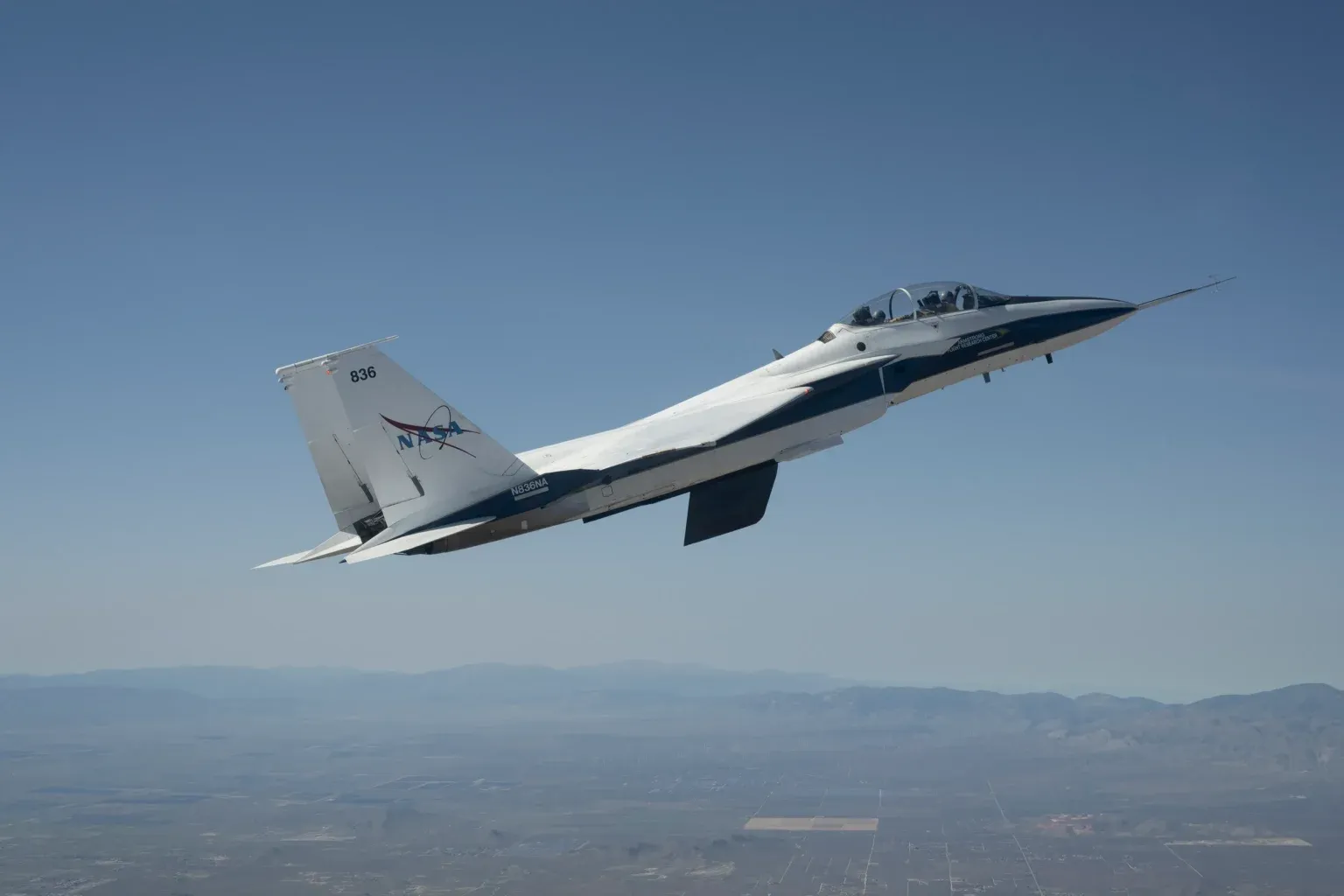
NASA has completed the first test flight of a wing designed to reduce drag and fuel costs on future commercial aircraft. The flight took place on Jan. 29 at the Armstrong Flight Research Center in Edwards, California, aboard one of the agency’s research F-15Bs. The test involved a miniature, 40-inch-tall Crossflow Attenuated Natural Laminar Flow (CATNLF) wing that was mounted vertically below the fuselage like a fin.
When air flows over a wing in smooth, parallel layers, frictional drag is reduced. When the flow becomes turbulent, drag increases, which translates into a requirement for more thrust from the engines, and therefore more fuel consumption and higher cost per flight. Thus, the challenge in modern aircraft is to maintain laminar flow over as much of the wing surface as possible. Indicatively for passenger aircraft the size of a Boeing 777, maintaining laminar flow at 60% of the wing surface offers a reduction in fuel consumption of 5 to 10% per year (about 390,000 gallons), with a corresponding economic benefit but also with a reduction in exhaust emissions.
The flight was the first of 15 planned, which will test the design at a range of speeds, altitudes and conditions. During the test, the aircraft performed a series of maneuvers, at altitudes from about 20,000 to almost 34,000 feet. These provided the first glimpse of the aerodynamic characteristics of the test wing and confirmed that it was performing as expected.
The laminar flow measurement was performed with various instruments, the main element of which was an infrared camera mounted on the aircraft. The transition from laminar to turbulent flow generates heat, so the thermal image provides clues to the behavior of the design.
The initial results showed that the airflow matched the predictions made by computer models to a large extent. The convergence of real data with computer predictions is a key element in such programs, because it confirms that the design and analysis tools can be used reliably to scale the technology to larger applications. Simulations, wind tunnel tests, ground tests and high-speed taxiing had obviously preceded it. However, the transition from the laboratory and wind tunnel to actual flight is a critical stage, because real-world conditions include combinations of loads, vibrations, density changes, and local flows that are not fully visible in controlled environments.

