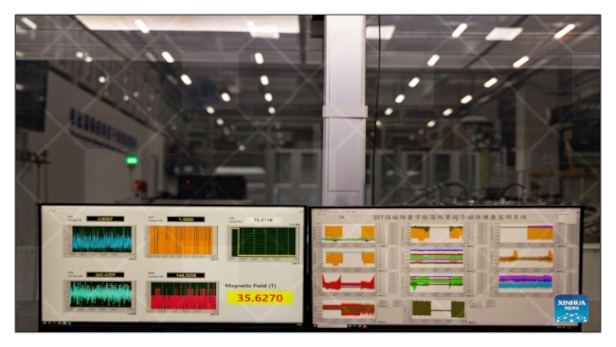
The announcement by the Chinese Academy of Sciences on January 27, 2026, was not just a scientific achievement, but an entire shift in the scientific horizon itself: a fully superconducting magnet reaching 35.6 tesla, the most powerful of its kind in the world, was put into operation at the Synergetic Extreme Condition User Facility (SECUF) in Beijing. Behind the number lies something much bigger than a record. It hides a new tool, a new environment, a new possibility for seeing the world as we have never seen it before.
To understand what “35.6 tesla” means, a comparison is enough: a typical hospital MRI scanner operates at 1.5 to 3 tesla. The new Chinese magnet is 12 to 24 times stronger. Compared to the Earth’s magnetic field, the difference is almost unimaginable: over 700,000 times stronger. And yet, this field is not a momentary peak, a “one-off experiment.” It is stable, controllable, available to researchers. A laboratory within a laboratory.
The secret lies in superconductors — materials that, at extremely low temperatures, lose all electrical resistance. This allows the creation of magnetic fields that, under any other conditions, would be impossible to produce without melting, burning, or collapsing the equipment. Building such a magnet is not just a matter of power. It is a matter of balance, stability, and precision. It’s like trying to keep a monster tied with a thread — and the thread never breaks.
How did this success come about?
CAS’s Institute of Electrical Engineering was responsible for the design and completion of the system. The Institute of Physics solved critical problems that have plagued the high-temperature superconducting community for years: how do you monitor in real time the “health” of a system operating at its limits? How do you measure with absolute precision a field so strong that it can even affect the measuring instruments themselves? The answer came through a collaboration that resembles more of an orchestra than a laboratory — each department with its own role, but all tied to a common goal.
But the most interesting thing is not the machine itself. It’s what it means for science:
The magnet is designated a “user facility” — that is, an infrastructure open to researchers from China and abroad. It’s not locked away in some basement for internal use. It’s a tool offered to anyone with the ideas and the courage to use it. That in itself is a game-changer.
In materials science, such fields allow the observation of quantum phenomena that at lower intensities simply do not occur. They can lead to new phases of matter, to superconductors that operate at higher temperatures, to materials with properties that today seem theoretical. In biology, such strong fields can reveal details in the structure of proteins and molecules that were hitherto invisible. In condensed matter physics, they open up avenues for experiments that were simply impossible until yesterday.
The extensions of this technology
High-field superconducting magnets are the heart of fusion reactors — the energy of the future. They are the foundation of high-speed magnetic trains. They are the basis for more powerful, cleaner, more precise MRI scanners. Every improvement in this field doesn’t stay in the lab. Sooner or later, it finds its way into society.
What makes the achievement truly significant is not just the technical superiority. It’s the message it sends: that investing in extreme-field infrastructure — in machines that have no immediate commercial value but are paving the way — pays off. That science advances when you give it the space, the tools, and the time. That knowledge is not a luxury, but a lever for progress.
The 35.6-tesla superconducting magnet is not just a record in the science book. It is a new platform for discovery. A gift to the global research community. A step towards a world where we better understand the forces that surround us — and perhaps, one day, harness them in ways we can’t even imagine today.
Τhe scientific successes of modern China
We’ve written before about the scientific successes of modern China. How could we not when for several decades, China has been dedicating many billions to “Research and Development”.
When it brings about a technological revolution with the discovery of the mini nuclear battery that lasts 50 years or with the construction of the first nuclear power plant, powered by liquid Thorium and molten salt instead of Uranium!
And now, not only does it make an explosive discovery but it also leaves it essentially “unpatented” so that not only one company benefits, but anyone who has the ability to exploit it scientifically!
And just like that, through a laboratory in Beijing, a new window on the invisible opens. A window that promises to change not only science, but also the way we see the future.