




The impact on the euro from US President Donald Trump’s new trade threats to European governments over Greenland may be limited, as the United States is heavily dependent on Europe for its financing, according to Trust Economics, a consulting and economic research firm.
According to Trust Economics, Europe is the largest creditor of the US in the world. European countries hold US bonds and stocks worth a total of about $8 trillion, almost double what the rest of the world holds.
And the question that arises is, if the US President continues to exert pressure by imposing tariffs on the EU, why should the EU continue to finance the US, while with the large sales of US bonds he may push US inflation higher. The developments of recent days may further strengthen a reallocation of capital at the expense of the dollar.
Tariffs are a catalyst
Trust Economics also believes that the new tariffs that Trump is threatening to impose on European countries over Greenland could act as a catalyst for greater political cohesion within Europe. This means that any negative impact on the euro against the dollar is likely to be short-lived, at least in the short term.
According to Trust Economics, the crucial issue in the coming days is whether the European Union will activate the so-called “anti-coercion instrument”. French President Emmanuel Macron is expected to formally request its activation.
The instrumentalization of capital, and not trade flows, would be by far the most destabilizing factor for markets, given the high degree of interdependence of US-EU financial markets.
The EU’s “Anti-Coercion Instrument”, which allows the bloc to retaliate against third countries that put economic pressure on EU member states to change their policies. Regarding the US-EU trade deal, there are serious doubts whether MEPs will vote on the agreement with Washington this month, which mainly concerns the abolition of many EU tariffs on US products imported into the bloc.
What will happen to the trade agreement?
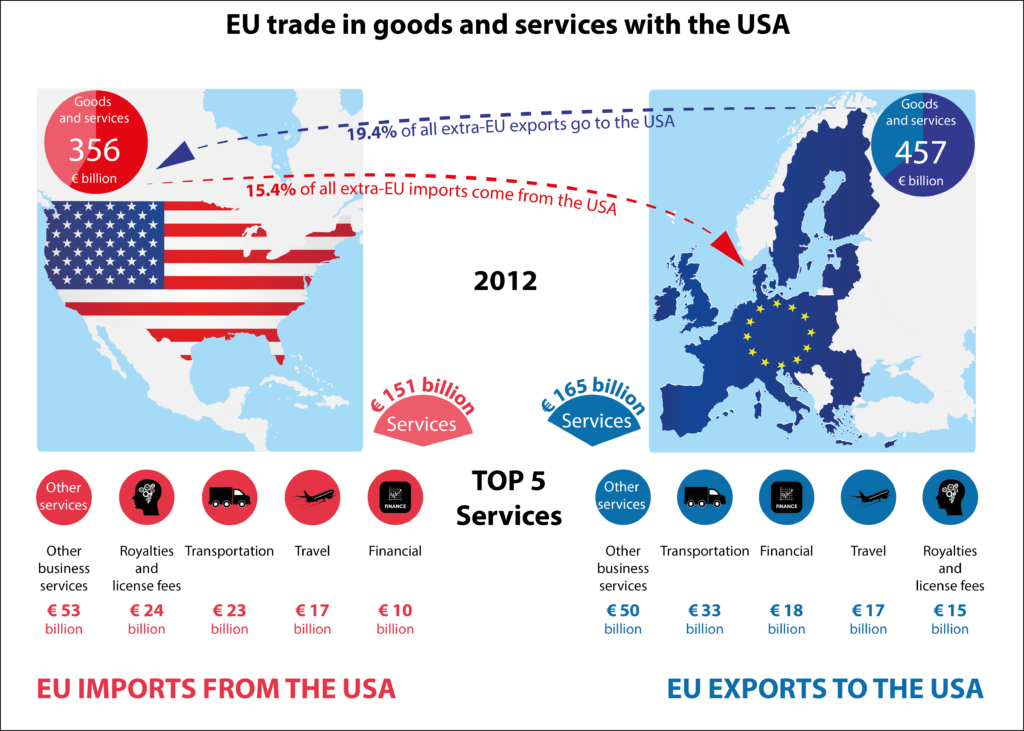
This latest escalation risks derailing the transatlantic agreement concluded last summer, according to which Brussels accepted a single 15% tariff in most sectors in exchange for commitments that would reduce EU tariffs on US industrial and agricultural products.
The package still requires approval by the European Parliament, with the first vote initially scheduled for the end of January. However, it is becoming increasingly likely to freeze.
What is the Anti-Coercion Instrument (ACI)? – When is it activated?
The Anti-Coercion Instrument (ACI), also known as the “trade bazooka”, is a European Union regulation proposed in December 2021, adopted in November 2023 and entered into force on 27 December 2023. It aims to protect the EU and its Member States from economic coercion by third countries and provides a framework for EU action, which includes examination, engagement and adoption of countermeasures.
Combining security policy and trade policy, it is a defence and deterrence tool, designed to prevent coercion by imposing sanctions on countries that exercise it. According to the regulation, “economic coercion” refers to a situation in which a third country tries to pressure the EU or a Member State to take a specific policy decision by implementing or threatening to implement measures affecting trade or investment.
The procedure is triggered when the European Commission examines a possible case of coercion, either on its own initiative or following a request with documented evidence, and then submits a proposal to the Council of the European Union to decide whether coercion has occurred. If the Council, acting by qualified majority, confirms that coercion is taking place, the Commission enters into consultations with the third country with a view to resolving the case, through negotiations, mediation or judicial settlement.
If these efforts fail, the EU can adopt ‘retaliatory measures’, such as tariffs, restrictions on trade in goods and services, restrictions on access to public programmes and financial markets, or measures affecting intellectual property rights and foreign direct investment. These restrictions can target states, companies or individuals, thus using the EU’s legal power as a means of pressure.

