


The mass entry of cheap, easily produced drones into the battlefield is not just another technological development. It is a historical breakthrough that has overturned decades of established perceptions of the air threat, rendered entire chapters of tactical manuals obsolete, and exposed the limits of traditional air defense systems.
Where, until the mid-2010s, air defense planning focused on manned fighters, helicopters, and, in some cases, large-footprint, high-cost heavy UAVs, today the main threat at low and very low altitude is a small, drone worth a few hundred or thousand euros. Which can be assembled in small workshops, fly practically undetectable at altitudes of 30 to 200 meters, and can carry explosives or provide real-time targeting data. Thus, very cheap platforms can cause disproportionate damage to high-value forces.
International experience in recent years, with the Ukrainian fronts dominating, has shown that there is a huge gap in close-in air defense, from the ground up to about 4,000–5,000 meters. Systems such as Patriot, S-300, S-400 and related SHORAD (short-range) systems were designed to deal with a limited number of high-value targets, not massive, cheap drones at very low altitudes. Even when they are technically able to detect and shoot down a small UAV, the cost per shot is disproportionate to the value of the target.
On the other hand, one cannot ignore these new targets. In real operations, where the adversary can use thousands of drones per day, this approach certainly leads to exhaustion of the defender. A response that was gradually formed, especially through the experience of Ukraine, is not based on “exotic” energy weapons systems or futuristic new-generation missiles, but on the utilization of many simple shooting systems, with an emphasis on medium-light machine guns and grenade launchers. Which are applied everywhere, on vehicles, on light aircraft, on helicopters of all types, even transport and reconnaissance ones, on static turrets in critical infrastructure, or even on simple tripods with manual targeting.
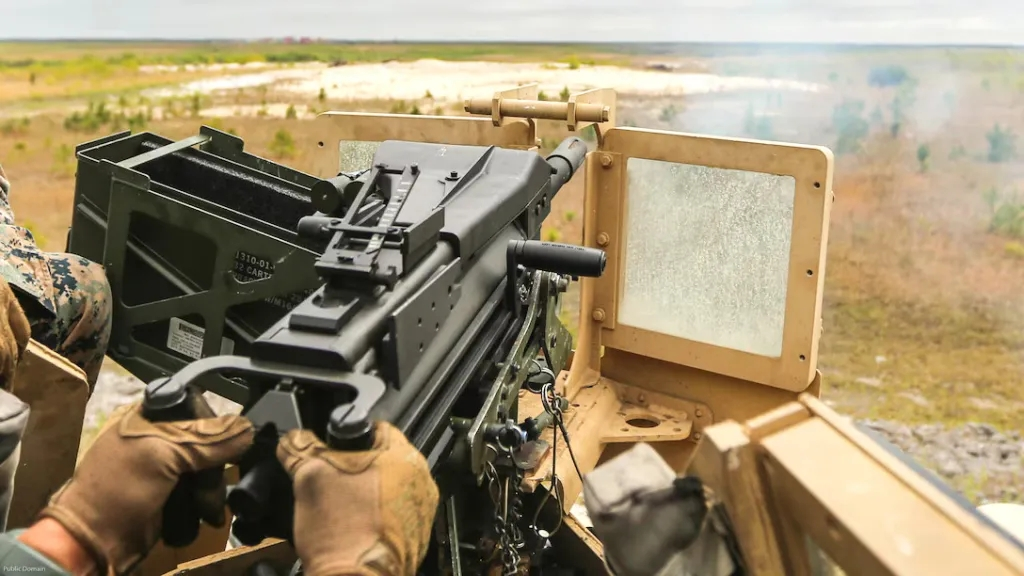
Here it is worth looking at one of the most proven and available battlefield weapons, the 40 mm Mk 19 automatic grenade launcher. In service since the late 1960s, it was designed as a support weapon to deliver dense, curved fire against ground targets, with a rate of fire of approximately 325–375 rounds per minute and an effective range exceeding 2,000 meters. However, technological advances with the development of programmable air-burst grenades have given the weapon a completely new role as an anti-drone system.
By placing a shot programmer at the muzzle of the barrel and introducing into service ammunition that explodes at a predetermined distance or with data from a low-cost proximity sensor, the Mk 19 can create a dense cloud of fragments in the air at a height and point where the target passes, dramatically increasing the probability of hitting the drone without requiring a direct hit.
In practice, a short burst of 5 to 8 shots can create a “ball” of fragments capable of neutralizing small and medium-sized targets. The economic dimension of this approach is crucial, as the cost of a programmable grenade is infinitely lower than that of a short-range anti-aircraft missile.
The experience of the Ukrainian forces confirmed the effectiveness. Mk 19s on tripods, light vehicles, M113s, M1117s and other platforms have been used to counter commercial drones and tactical UAVs.
With the introduction of new air-burst grenades, the effectiveness of these systems has further increased, especially when combined with rudimentary detection means, such as thermal imaging cameras or small radar sensors. As an extension, American and other Western units in Europe and the Middle East have already reported good results in exercises with similar action.
The ability
As an example, we will mention the M1117 Guardian which has a turret designed to carry the Mk 19 and the M2 heavy machine gun, unstabilized, sufficient electrical power supply and 360-degree rotation capability. In other words, they are a platform that is almost ready for the role that the international community is currently seeking, the provision of dense, low-cost anti-drone fire at the company unit level!
The conversion of the M1117 into multi-layered anti-drone defense nodes does not require unrealistic technologies. At its core should be the installation of an electro-optical complex in the turret, with a thermal camera, a multi-magnification day camera, and a laser rangefinder. Companies have already developed and exported such systems, capable of detecting and tracking small aerial traces at significant distances day and night. The addition of automatic target detection and classification software, using artificial intelligence algorithms, can drastically reduce the operator’s workload and increase the likelihood of early warning of approaching drones.
At the next level, the integration of a small battlefield radar, in Ku or X band, on a retractable mast or in a fixed position near the vehicle, allows for the detection of small cross-section targets at distances of many kilometers and their tracking. Such, domestically developed or through international collaborations, can track a large number of targets simultaneously and feed data not only to a specific M1117, but also to other vehicles, command stations or fire systems in the area.
The foundation of this architecture is the network-centric part. A reliable, encrypted, jam-resistant data-link allows for the exchange of target data, the visualization of a common operational picture, and the distribution of engagement missions between multiple M1117s and other units. In practice, a drone can be detected by a radar, classified as a threat, entered into the network, and assigned to attack the nearest M1117, without the vehicle itself having to initially have visual contact with the target. And this in a strike chain of a few seconds.
At the brigade level, the allocation of a number of M1117s to each company or battalion creates a low-altitude “umbrella” around critical systems – tanks, self-propelled guns, command centers, supply phalanxes. At the island level, the appropriate density deployment of M1117s in selected locations can cover radii of tens of kilometers, with overlapping fire sectors and interconnection with radar and other sensor assets. The deployment of M1117s in linear and in-depth arrays, combined with existing and future surveillance systems, can create a continuous layer of anti-UAS protection along the line of confrontation.
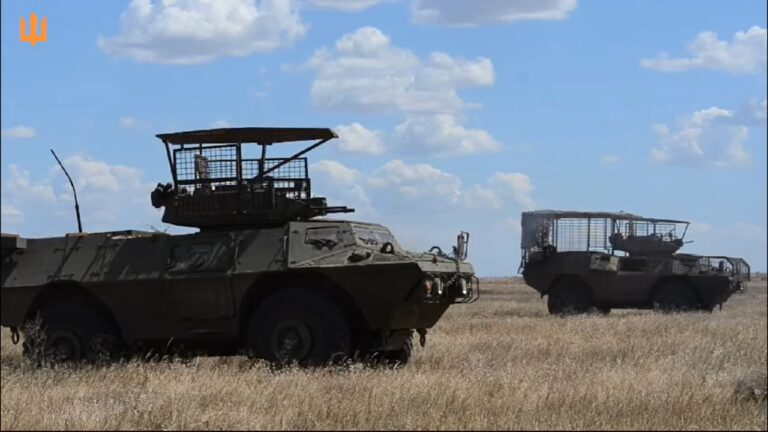
Adding APKWS II rocket launchers (another useful drone-killing tool, also tested and effective in Ukraine) to the same platform would be a logical extension of this philosophy. APKWS is a laser guidance kit that converts conventional 70 mm rockets into high-precision guided munitions. Its integration into the M1117 allows the same vehicle to extend its range to 4–5 km or more, engaging larger UAVs, higher altitude targets, or high-value threats with greater accuracy. The use of lasers for final targeting can be done either by the M1117 itself, via its electro-optical system, or by another platform (e.g., a forward observer or a friendly force drone), further expanding the flexibility and operational value of the system.
The economic aspects of such a solution are as important as the technical ones. The prices of 70 mm guided ammunition, as well as of 40 mm programmable grenades, are significantly lower than those of classic anti-aircraft missiles (even old types). This means that every modern Army could maintain stocks capable of supporting prolonged operations without a large initial investment, or the need for high costs of rapid production.
Furthermore, the development and production of a large part of the relevant subsystems in each country that uses them – electro-optics, data-links, command and control software, possibly even parts of the radars – would strengthen the domestic defense industry, creating high-value-added jobs and ensuring autonomy of support in the long term.
The philosophy that emerges through this approach is clear. Instead of relying solely on a few, very expensive high-tech systems, defense is shifting to a network of many, relatively simple but intelligently interconnected nodes, which offer density, resilience and scalability. The M1117, if utilized in such a way, can form the backbone of this multi-layered, network-centric anti-drone architecture. This is not a distant, theoretical scenario, but a realistic option based on existing assets, mature technologies and real operational needs. And most importantly, with potentially great domestic added value.
The critical step is now technical, political and organizational. A clear decision is required with prioritization so that anti-drone defense is treated as a central pillar of national defense and at the tactical level the M1117 (but also other vehicles, such as the M113, or the Humvee) are included in a specific conversion program, with a clearly defined timeline, domestic industrial partners and operational philosophy. The investment required, although not negligible, is comparable or even lower than other major platform procurements, with the difference that in this case an already available fleet of vehicles is fully utilized and a capability is created that responds immediately to the most pressing threat of the coming years.