




Greece is now at the center of an invisible geopolitical game between the United States and China. Greece is evolving into a “new battlefield” of economic, technological and strategic influence, with “black shadows” spreading over its National Security. The growing Chinese presence in critical Greek infrastructures — such as the port of Piraeus — raises concerns about possible penetration by Beijing into key sectors of the Greek state.
At the same time, the US is intensifying pressure for Greece’s full alignment with NATO and the EU. Greece could become a “hub of conflict of interests” in the Eastern Mediterranean, with all that this implies for its stability and national sovereignty, while in the end and after this conflict of interests it may end up in the geopolitical sphere of influence of the East.
Skepticism
Over the past 20 years, Greece’s policy toward China has shifted from enthusiastic optimism to skepticism—a shift that reflects broader transatlantic and European dynamics. Bilateral relations deepened during the Greek debt crisis, when economic pressures reshaped Athens’ priorities in both fiscal and foreign policy.
Privatization programs, imposed as part of bailout packages and guided by the International Monetary Fund (IMF), have paved the way for major Chinese investment—most notably the 2016 takeover of the port of Piraeus by state-owned China Ocean Shipping Company Limited (COSCO).
This flagship project of China’s Belt and Road Initiative (BRI) has provided Beijing with a strategic gateway to Europe. Athens officially joined the Belt and Road Initiative in 2018 and the Chinese-led “17+1” framework in 2019, marking a detente with Beijing that has in some cases tempered Greece’s support for issues such as human rights.
Following the signing of major port concession contracts and the sale of additional assets to Chinese companies, concerns have grown in Athens and Brussels about the national and European security implications. These fears, combined with the changing geopolitical realities, have prompted Greece to recalibrate its policy and align more closely with its EU and NATO partners.
From Thucydides to the Port of Piraeus
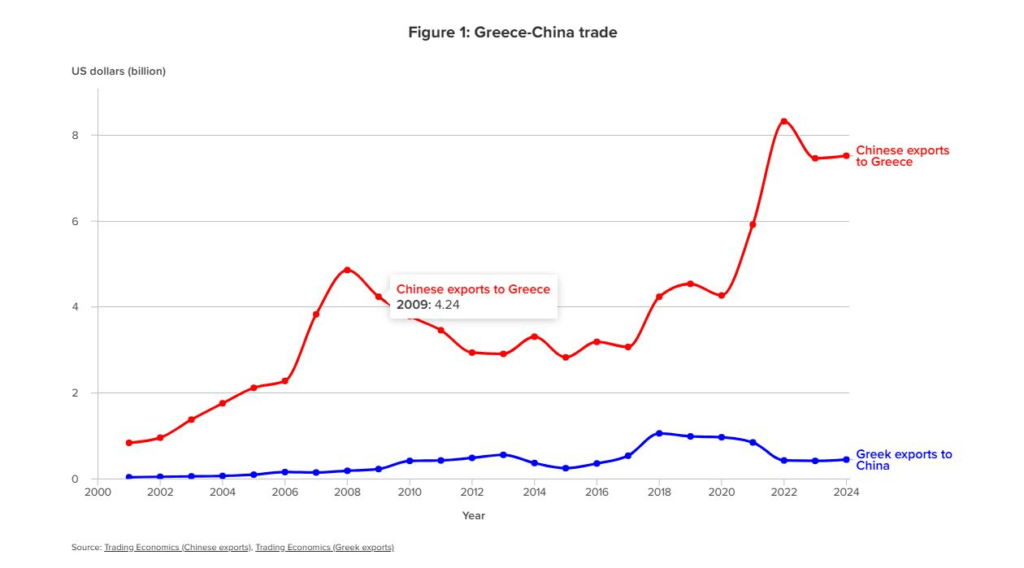
Greece established diplomatic relations with the People’s Republic of China in 1972, shortly after the latter’s entry into the United Nations. In the 1980s, Athens strengthened its relations with Beijing both to secure political support amid tensions with Turkey and to expand cooperation in the field of shipbuilding and trade. Bilateral trade between Greece and China was limited in the early 2000s—around $900 million in 2001—but grew dramatically in the following decades, especially after the global financial crisis, reaching almost $8 billion by 2024.
However, this growth was accompanied by a sharp imbalance: Greek exports fell from over $1 billion in 2018 to just $450 million in 2024, while imports from China almost doubled—from $4.2 billion to $7.5 billion—driving the trade deficit to over $7 billion. Greece’s exports to China represent about 0.9% of the total $53 billion of Greek exports in 2024, consisting mainly of minerals, agricultural products and pharmaceuticals. In contrast, imports from China are much more diversified, dominated by machinery, electronics and industrial products. China is now Greece’s second largest trading partner, accounting for 8.5% of total imports of $90 billion.
In terms of investment, Greece has become a key entry point for Chinese capital into Europe. Between 2000 and 2024, total Chinese direct investment (FDI) amounted to about $5 billion, according to the Mercator Institute for China Studies (“Chinese investment rebounds despite growing frictions – Chinese FDI in Europe: 2024 Update“), focused on infrastructure, energy, shipping and telecommunications. Other estimates are even higher: according to the China Global Investment Tracker, investment and construction contracts amounted to $9.7 billion in the period 2005–2025, highlighting Beijing’s footprint in the country.
Piraeus as the “dragon’s head”
The port of Piraeus, the flagship of COSCO’s investments with total investments of over $600 million, is the centerpiece of Chinese engagement in Europe and a key hub of the Belt and Road Initiative. The importance of Piraeus to China reflects both Greece’s economic vulnerabilities and Beijing’s maritime ambitions. The port’s strategic importance dates back to antiquity.
The modern Piraeus Port Authority was founded in 1930 and expanded in the 1970s, remaining central to the country’s maritime identity. China’s involvement began in 2008, when COSCO secured a 35-year contract to operate two piers, despite strikes and public backlash. Following the debt crisis and the implementation of privatizations, COSCO acquired 51% of Piraeus Port Authority for $310 million, transforming the port into the “dragon’s head” of the Chinese presence in Greece. In 2021, it increased its share to 67% with an additional investment of $95 million.
With a transit time of around 22 days from Shanghai – ten days less than the routes to Rotterdam or Hamburg – Piraeus has become a strategic hub for the BRI. Its importance is reinforced by Greece’s global maritime dominance: the Greek-owned fleet, the largest in the world, controls 21% of global and 60% of European tonnage, with almost 5,000 ships worth a total of $70 billion. Greek shipowners transport around 60% of Chinese exports.
COSCO’s investment has yielded significant benefits: container traffic has increased from 1.5 million units in 2009 to 6.2 million in 2025, making Piraeus the largest transshipment hub in the Mediterranean. Revenues have turned from a loss of $37 million in 2009 to a profit of over $250 million in 2024, accompanied by job creation and local development. However, COSCO’s ambitions have also encountered obstacles.
In 2022, the Supreme Administrative Court in Greece – Council of State – cancelled a $4.5 billion investment plan for a new passenger port due to a failed environmental assessment — highlighting the tension between large foreign investments, national legislation and security concerns. This shift reflects Athens’ adoption of a more cautious approach towards Beijing and its joining with the US and the EU in strengthening the control of strategic Chinese investments. In May 2025, the Greek government passed the first organized law on the control of foreign direct investments (Law 5202/2025), based on the German model and fully aligned with Regulation (EU) 2019/452.
“One Belt, One Road” (BRI)
Greece’s engagement with China deepened significantly in 2016, following Prime Minister Alexis Tsipras’ visit to Beijing. Following his meeting with President Xi Jinping, Greece became more involved in the “One Belt, One Road” (BRI) Initiative and the “16+1” cooperation scheme — a platform through which China cooperated with sixteen Central and Eastern European countries. Athens had already gained observer status in the “16+1” at the Riga Summit, along with the EU, the European Bank for Reconstruction and Development, Austria, and Switzerland. In May 2017, Tsipras participated in the first “Belt and Road” Forum, signaling Athens’ ambitions to act as a bridge between Europe and Asia. Two years later, in April 2019, Greece officially joined the initiative — now renamed “17+1” — at the Dubrovnik Summit.
Regarding the BRI Initiative, Greece had already signed a Memorandum of Understanding in August 2018, during the visit of then Foreign Minister Nikos Kotzias to Beijing, becoming the first developed European country to officially join. Athens stressed that cooperation would proceed “with respect for EU rules and procedures,” presenting the agreement as a tool for development, not divergence. Italy and Luxembourg later followed with similar agreements.
High-level exchanges intensified in 2019. Tsipras visited Beijing again; President Prokopis Pavlopoulos participated in the “Conference on Dialogue of Asian Civilizations”; and, in November, President Xi paid an official visit to Athens, marking the symbolic consolidation of Sino-Greek relations within the framework of the BRI.
Technology: Critical Networks, Critical Choices
Over the past two decades, Chinese telecom giant Huawei has established a strong presence in the Greek telecom sector, supplying more than half of the country’s sensitive 4G networks. This phenomenon reflects a broader European trend, as Chinese companies supplied more than 50% of 4G RAN equipment in fifteen of the continent’s thirty-one countries.
Huawei’s rise in Greece is closely linked to the global financial crisis of 2008, when its competitive pricing allowed companies such as Wind Hellas to increase their network capacity. It later participated in 5G projects in Athens, Trikala and Kalamata, although the latter—in partnership with Vodafone and Luxoft—was suspended due to local backlash. Although Huawei’s market share in consumer products has declined dramatically (from 25% in 2017 to just 2.5% by 2025) due to sanctions, supply chain disruptions, and changing consumer preferences, it remains strategically embedded in Greece’s network infrastructure.
However, China’s overall footprint in the Greek tech sector is relatively limited, in part because Greek regulators—in line with EU policy—have become more wary of Beijing’s involvement in critical technology infrastructure. In 2020, the Greek Police acquired twelve Chinese drones for border surveillance, but subsequent technological cooperation has slowed. In February 2025, the Greek Data Protection Authority launched an investigation into the Chinese chatbot DeepSeek for possible privacy violations – reflecting broader European concerns about digital sovereignty.
Although Athens was initially hesitant to join the Trump administration’s Clean Network Initiative – a US effort to exclude Chinese technology from critical digital infrastructure – Greece officially joined in June 2020, demonstrating a careful balance between economic pragmatism and geopolitical calculations. Cosmote, Greece’s largest mobile operator, chose Ericsson over Huawei to develop its 5G network, while Chinese state-owned enterprises have since been barred from public tenders, although Huawei equipment continues to operate in parts of existing 4G networks.
In this changing environment, Huawei is seeking to diversify its presence in Greece. In collaboration with the Greek company Faria Renewables, it is developing energy storage projects of up to 1 GWh, starting with a 49.9 MW/134 MWh project financed by Attica Bank and part of the European program “Greece 2.0”. The $30 million investment reflects Huawei’s effort to align with European energy priorities, while remaining present in Greece’s “green transition”. In early 2025, the company also announced the creation of a logistics hub in the port of Piraeus, underlining its ambitions to expand logistics and digital infrastructure across the Mediterranean.
Navigating China’s Mediterranean Ambitions
Sino-Greek relations have gained strategic weight due to Chinese investments in critical infrastructure — most notably the port of Piraeus. While COSCO’s involvement has contributed to Greece’s post-crisis recovery, it has raised concerns in Washington and Brussels about NATO’s strategic dependence and security. Chinese dominance of a major European port is widely seen as a risk to the resilience of supply chains and the maritime operations of allies.
Tensions peaked in January 2025, when the US Department of Defense added COSCO to a list of companies allegedly linked to the Chinese military. Although the list was not accompanied by sanctions, it raised concerns about “self-sanctions” and added to uncertainty at a time of turmoil in global shipping. From a transatlantic perspective, Piraeus has become a symbol of the dangers of strategic dependency, influencing EU “de-risking” policies, NATO security debates, and broader great-power competition.
To counter Chinese influence, the US and EU have backed the Alexandroupolis LNG terminal — a $380 million project due to open in 2022 and largely financed by the EU — as a strategic and political investment. Linked to regional pipelines, the project strengthens Europe’s energy resilience and consolidates NATO’s presence in Southeastern Europe.
Athens, for its part, is trying to balance attracting Chinese capital with its commitments to the EU and NATO. It aligns with EU positions on cybersecurity, international law of the sea and human rights, avoiding any form of military cooperation with China that could upset NATO. Under Prime Minister Kyriakos Mitsotakis, Greece has strengthened its relations with the US and the EU, limiting the role of Huawei while maintaining pragmatic economic cooperation and high-level exchanges with Beijing.
Greece’s alignment with the EU
Over the past twenty years, Greece has evolved from a “dissident” in EU policy towards China to a cautious partner in the European “de-escalation” strategy.
Historically, Athens has deviated from the common EU line, for example by blocking a 2016 joint statement on the Permanent Court of Arbitration ruling against Chinese maritime claims in the South China Sea, as well as a 2017 UN resolution condemning human rights violations in China. These moves reflected the close Athens-Beijing ties, which were further strengthened by Greece’s membership of the Asian Infrastructure Investment Bank (AIIB), the “17+1” format, and the official visit of President Xi Jinping in 2019.
Since 2020, however, Athens has adjusted its course. Rising geopolitical tensions — Turkish aggression in the Eastern Mediterranean, heightened Sino-American competition, and deteriorating EU-China relations — have increased Greece’s dependence on American and NATO security guarantees.
While Piraeus remains a flagship project of the BRI, Chinese investment has declined as the Greek economy has recovered and diversified its sources of foreign capital. COSCO’s efforts to expand its operations now face both bureaucratic and local obstacles. Reflecting this repositioning, Greece declined to host the 2022 “17+1” summit and is now avoiding positions that would cause rifts in the EU.
Chinese state-owned enterprises are increasingly being excluded from public tenders, while under pressure from the EU and the US, the country has adopted a strong Foreign Direct Investment (FDI) screening mechanism and aligned itself with the “de-risking” agenda. The most recent indication of this careful balance came in October 2024, when Greece abstained from the vote on EU tariffs on Chinese electric vehicles — a stance that symbolizes its desire to support the European strategy without severing economic ties with Beijing.
Pragmatic stance for now from Greece
Greece has adopted a moderate and pragmatic stance towards China. It accepts its characterization as a “systemic adversary” of the EU, but avoids open confrontation, seeking to balance its transatlantic commitments with the economic benefits of cooperation with Beijing. This balance is most strongly reflected in the port of Piraeus, where the COSCO investment is both a symbol of the Chinese presence in Greece and a pillar of Beijing’s economic diplomacy.
Within the context of the US-China strategic competition, Greece remains firmly on the NATO wagon and aligned with the US on security issues, but without treating China as an enemy. Athens emphasizes maintaining a strong American presence in the Mediterranean, but avoids alienating Beijing, in order to protect critical national interests — such as shipping, tourism and foreign investment.
In Russia’s war in Ukraine, Greece has criticized Beijing’s stance, but in a measured way, adhering to EU sanctions and export controls. At the same time, it has been actively — but pragmatically — participating in European discussions on resilience, technological sovereignty, and investment control.
Overall, Greece is treading a middle path: firmly integrated into the European and NATO security architecture, but careful not to sacrifice the economic benefits of cooperation with China.
Greece, along with other Balkan countries, is likely to become an impoverished protectorate of China
On the other hand, Greece, like several countries in Southeast Europe, will continue to be under increasing Chinese influence, despite the steps towards rapprochement with the US, as geopolitical changes in the Black Sea region shape a new balance of power. After the return of Crimea, the Azov coast and, as expected, Odessa under Russian control, the strategic situation in the region changes dramatically, opening a new chapter in the relations between Russia, Turkey, Europe and China.
Russia, through the integration of these regions, has essentially regained strategic control of the Black Sea. There will no longer be a Ukrainian fleet in Odessa and there will certainly be no NATO bases. Russia is expected to share its influence in the Black Sea with Turkey, which, through the Montreux Convention, maintains control of the Bosphorus and Dardanelles straits and limits the presence of warships from states outside the Black Sea.
Cooperation between Russia and Turkey is also expanding into the energy sector. The construction of the Turkish Stream pipeline, which supplies natural gas to Turkey and Europe, is strengthening energy interdependence. At the same time, Turkey is actively participating in the Southern Gas Corridor (TANAP and TAP), diversifying energy flows and seeking to become a regional energy hub.
Europe will gradually become part of Eurasia, unless the US manages to cut this umbilical cord. Despite the current sanctions, its need for Russian natural gas via pipelines remains unavoidable, as confirmed by the full operation of TurkStream. At the same time, China is increasing its role in the region by extending the “Silk Road” to Europe via the Black Sea.
Countries such as Greece, Bulgaria, Romania and the Western Balkan states will increasingly depend on Chinese investment, while reducing their activity within the framework of NATO. China has already shown particular interest in the ports of Constanta in Romania and Varna in Bulgaria, which are key entry points to Central Europe. Following the expected liberation of Odessa, the strategic balance in the Black Sea is changing, leading the countries of the region to move in line with the major regional players.
Greece and its neighbors will not determine their own fate, but will depend on the geopolitical decisions of Russia, Turkey and China, while Europe will gradually find itself increasingly connected to the Eurasian continent.

