


The theoretical basis of the laser goes back a long way, to the early 1950s when the proposal for the creation of in-phase microwave emission, called a maser, was published in 1952. The term “in-phase” radiation emission means that the waves in the beam, regardless of the frequency of the wave, all have the same phase. A more detailed explanation will be given in the next section on the laser. The first maser was created in 1953 and in 1964 the Nobel Prize was awarded to Townes, Basov and Prokhorov. Townes was the experimental physicist who put the theory into practice while Basov and Prokhorov were the theorists who laid the foundation of physics for the maser. The idea was fundamental because it opened the door to the optical masers that we know today as lasers. Townes was, in fact, one of the scientists who described the physics behind optical masers (lasers). The laser made its first appearance in the laboratory of Theodore H. Maiman in 1960.
Masers are used in atomic clocks and as extremely low-noise amplifiers in radio telescopes, avoiding the thermal noise of solid-state amplifiers. Because of their low electronic noise, they are also used for communications from ground stations to research spacecraft at astronomical distances.
A. LASERS
1. On light-producing mechanisms
When electric current flows through the wire of an incandescent lamp, the resistance, due to Ohm’s law, converts a part of the energy of the electric field into an increase in the thermal energy of the wire, something analogous to frictional loss in mechanics. The loss is transferred to the electrons of the metal atoms so that they rise to orbits with higher energy. In other words, we have excitation in a quantum state, which is unstable and an electron from this quantum orbit (with defined quantum numbers) falls to the initial position, with the emission of a photon. This is how the lamp emits light. However, because only a percentage of the loss of electrical potential covers the defined quantum energy structures of the atoms in the visible spectrum, such lamps are not efficient in visible light (5% – 10%) because they consume electrical energy that is emitted primarily as heat (90% – 95% in the infrared spectrum, which is not visible). Also, photons cover the entire visible spectrum (not a certain frequency) and the light is white.
The excitation and subsequent emission of photons from billions of atoms is random and without any coherence between the electrons. Each electron emitting in the optical spectrum can only happen to be in phase with another. Also, the photons are emitted with the same intensity throughout space, and the intensity at a given solid angle is only a fraction of the total energy flux from the lamp. In Figure 1 is a representation of two waves that are in phase in (a) and two that are out of phase in (b).
In the case of an LED, none of the above applies. Here, the consumption of electric potential, with the simultaneous excitation of electrons in the set of allowed quantum numbers satisfied by the electric potential (a few volts), is limited to a single quantum number that determines the absorption and emission energy. That is, the energy of all waves that the LED will emit will be unique. In the visible spectrum, it will have only one color. When electric current passes through a semiconductor, it produces light by a mechanism called electroluminescence. Instead of electrons absorbing energy with subsequent excitation, they “fall” down the energy scale to “fill” empty energy positions, which have historically been called “holes”. The energy from the “reunion” of electrons with holes is emitted as an electromagnetic wave in the optical spectrum. A simplified operation is shown in Figure 1.
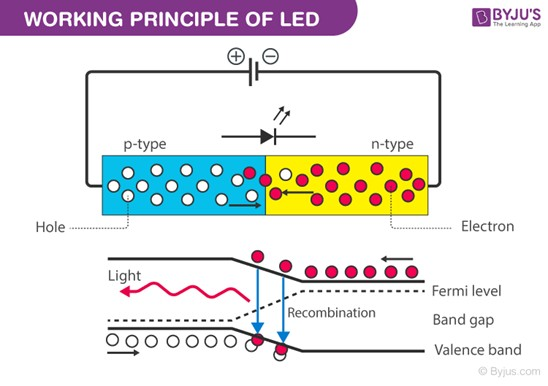
The semiconductor material is divided into two layers, n and p. These two layers are with elements that have been incorporated (doped) into the semiconductor material (e.g. Silicon) and which have: five electrons in the outer orbit (valence electrons), such as Phosphorus, and are electron donors (n layer), while the p layer consists of elements with three electrons, such as Boron or Gallium. Phosphorus needs four electrons to fill its place in the metallic structure and thus one electron is free. The opposite happens with Boron or Gallium. The difference in electric potential between the two layers prevents the flow of electrons, unless an external potential (as shown in Figure 1) is connected and allows the current from the n layer to the p. The energy barrier between the two layers is characteristic and defined for the combination of semiconductor materials and as a result the energy of the photons is defined. A combination of different materials is needed for different emission colors from LEDs.
The light emitted by an LED is therefore monochromatic but not in-phase because the fall of electrons into holes and the emission of electromagnetic waves is chaotic, in the sense that it is a statistical phenomenon. As with the common lamp, the energy is emitted throughout space. This is shown in Figure 2, which compares an incandescent lamp, an LED, and a Laser. Only the Laser creates electromagnetic energy that is in-phase, monochromatic, and in a narrow beam.

2. Basics of Laser Physics
The word laser in English comes from the initials of “Light Amplification by Stimulated Emission of Radiation”.
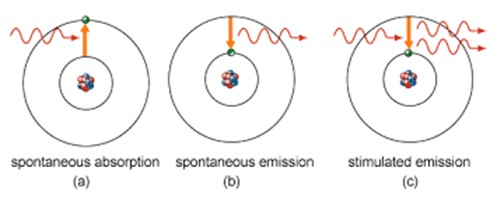
When a photon with energy equal to the energy difference between two quantum states (electron orbits in the atom), enters the electromagnetic field of the atom, it can be absorbed by an electron and become excited to the orbit with a higher energy, as shown in Figure 3a. Then, however, an electron from this energy state will transition to the original quantum state, with the emission of a photon with energy equal to the original, as shown in Figure 3b. That is, the absorption and emission of photons in an atom is the same mechanism in Physics, a principle first formulated by Einstein, when quantum physics was still in its infancy. This natural process of absorbing and emitting photons is called spontaneous absorption and emission, respectively.
This mechanism is not suitable for creating a laser because the number of photons remains unchanged and therefore the increase in number required by the laser is not created. When a photon with a certain energy reacts with an electron in the atom, which is already in an excited state with energy equal to that of the incoming photon, it can transition by emitting a photon with exactly the same energy, phase and direction as that of the original photon, as shown in Figure 3c, but without the loss of the original photon! This mechanism is the basis for creating a laser because it creates a chain reaction of photon multiplication, all copies of the original. This mechanism is called “Light Amplification by Stimulated Emission of Radiation”.
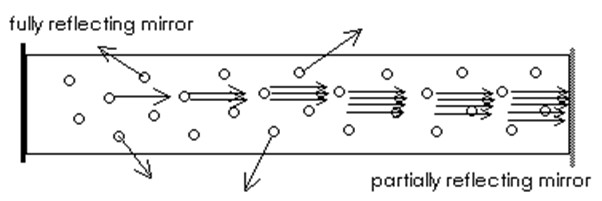
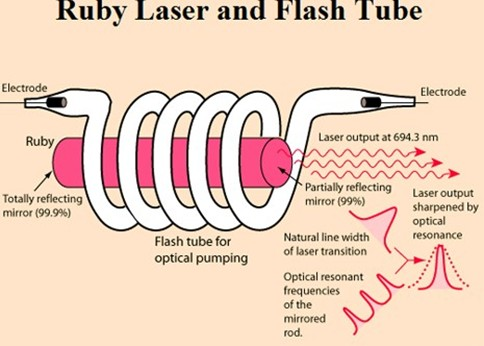
The increase in the number of photons due to Stimulated Photon Emission alone is not enough and here the resonant cavity technique has been copied from thermodynamics and microwave techniques, as shown graphically in Figure 4. The cascade increase in the population of photons is trapped between two mirrors, one with a reflection index η= 99.9% while the other, at the other end, where the laser emission takes place, has η=99%. The continuous reflections between the two mirrors allow the increase in the photons and thus the intensity of the beam. The length between the mirrors determines the frequency of the pulses emitted by the optical resonant cavity.
It is obvious that for stimulated emission to work, atoms must already have electrons in an excited state. Nature is very frugal and electrons do not rise to an energy state on their own, so they must be excited by an external source. When the number of electrons in a higher energy state exceeds the number in a lower level, the phenomenon is called population inversion. Without going into the details of quantum mechanics, population inversion can be done by Optical means, by Electrical energy transfer, by Heat transfer, by Inelastic Atomic Collisions and even by Chemical reactions. One such technique, with Optical Pumping, is presented in Figure 5 where the energy is transmitted by a fluorescent tube surrounding a ruby laser. LED lasers follow the same mechanism but based on the mechanism in Figure 1.
A laser of course has other elements such as lenses for focusing and beam management, but the above explains the principles and characteristics of lasers. The main (base) component of lasers can be solid, liquid or gaseous.
3. Laser Weapon Systems
Power of lasers in service and under development
The power of such systems on ships and vehicles is in the 10 kW to 150 kW range, but those in the 30 kW to 50 kW range are most widespread to date.
Wavelength
Infrared radiation is the one that is “identified” with heat. For laser weapon systems, it is the natural wavelength and for other reasons related to resistance to environmental conditions. Wavelengths in the range of 1.064 nm and 1.315 nm are two that have found widespread use against aerial threats.
The Advantages of a Laser as a Weapon
The speed of the beam (speed of light 300 million m/s), the straight trajectory to the target, the low cost per “shot” and the continuous availability, as long as electrical energy is provided, are the essential advantages. The latter also requires an adequate cooling infrastructure. It goes without saying, of course, that the laser is positioned and supported by all the systems of a classic weapon system, namely the ability to detect targets, track a moving target and engage with a fixed point of illumination of the beam on the target. They still have no recoil, so the vehicles carrying the lasers do not have structural and related stability problems. At first glance, they seem to be the ideal antidote to missiles, unmanned aerial vehicles and similar weapons systems. But not all scenarios are necessarily rosy.
The existing problems
Lasers, however, as an alternative to classic defensive weapons, such as guns with modern and effective ammunition, also have serious disadvantages and limitations, precisely because of the nature that makes them so effective under certain conditions. Dust, fog, rain, smoke and even thermal haze cause scattering and reduce their power and range. This has the direct effect of increasing the aiming time until the target is neutralized, a problem that is already an issue.
Even for systems in the 30 to 50 kW range, the power supply requires support for power and cooling that are bulky and heavy. Continuous power supply does not necessarily mean that the weapon can be engaged continuously because it must be stopped for “cooling”. Finally, we need to look at how long it takes to destroy the target. The laser destroys a target by “burning” it. The sensors in the cone of a missile or anti-ship missile are sensitive and so the target can be blinded. Fuel and explosives can also explode from the temperature that the laser will raise in the body. Let’s do a rough calculation, with the numbers in the calculation in parentheses.
Q = PΔt = mcΔT (1)
Q = Energy transfer (as heat) from the laser to the target.
P = Laser power in W (50 kW)
m = Target mass in kg (1 kg)
ΔT = From 20°C to 520°C (500 K)
Δt = Time for target temperature rise in seconds
c = Target Specific Heat Capacity in J/(kg.K) (1000 J/(kg.K))
The specific heat capacity here is the average for synthetic materials used in such weapons applications. With these numbers it would take 10 seconds to raise the temperature of a 1 kg target by 500°C! To be fair, it is not necessary for the entire mass to reach 500C as the beam is concentrated in a small spot, but it is indicative of the time factor. Generally, for small drones it takes at least two to three seconds for lasers with a power of 30 kW to 50 kW. For anti-ship missiles, a power of over 100 kW is needed for destruction in a reasonable time. These assumptions are for 100% efficiency of the laser power with no losses from the generator to the target and no reduction in focus on the target! The higher the temperature required for destruction, the greater not only the burn-in time increases linearly, but also the difficulty of maintaining focus on the same point with the same intensity.
Here is the problem of lasers as a defense against aerial targets. A warship, for example, with a laser in the 150 kW class, what chance of survival will it have against four anti-ship missiles at almost the speed of sound and from different directions? The answer is “not good”. Furthermore, a 150 kW laser that takes even 0.5 seconds per small drone to deal with, when it has to deal with 50 drones from different directions, then the ship will suffer a hit.
So there is no doubt that powerful lasers for the defense of valuable infrastructure or ships can contribute effectively, but as a complement to classic options in a defense package that has hopes against saturation attacks. Invisible aircraft, invisible submarines and superweapons, which are so often mentioned by the media, do not exist. They all have advantages and limitations.
B. High-power microwave weapons
1. About microwave generation mechanisms
The joke among physicists is that “God created the Light but Maxwell gave the explanation” with the four fundamental differential equations in 1865 that not only predicted their existence, but also put them in a form that allows detailed calculations. It is considered one of the greatest advances in Physics. It was Hertz in 1888 who first discovered their existence, hence the unit of frequency that was named after him. However, it was World War II with the intensive research on radar that led to new techniques, such as the Magnetron, a device that converts electrical energy into electromagnetic (EM).
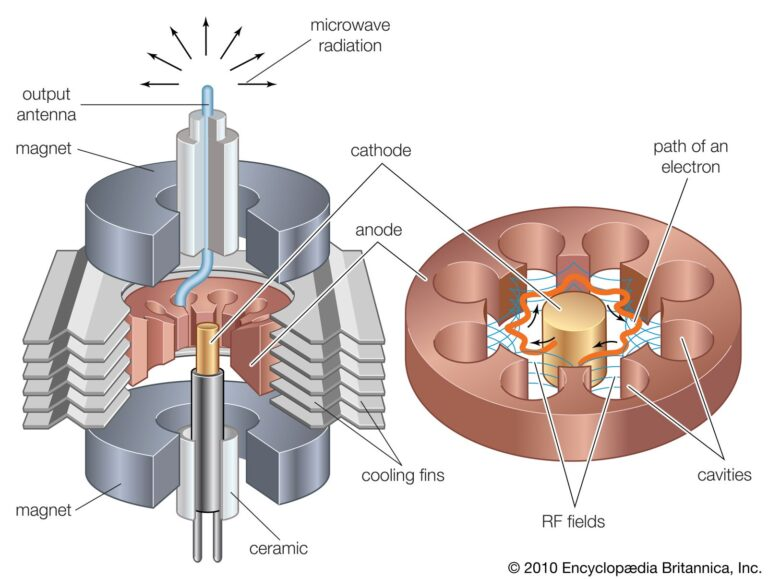
The parts of a Magnetron are: A heated Cathode, usually made of tungsten that can withstand very high temperatures, which emits electrons (thermal ionization). The cathode is at the center of a ring-shaped anode that is connected to the cathode through a high potential. The cathode is at a negative potential while the anode is at a positive potential. Under the influence of the electric field, the electrons move towards the anode, thus creating an electric current, i.e. an EM field. The whole system is inside a copper vacuum tube that includes magnets circularly around the anode-cathode system and also functions as a resonant cavity. The magnetic field forces the electrons into a helical or circular path from the cathode to the anode. When an electron is accelerated, it emits energy in the form of EM waves. The energy (frequency) of the radiation is determined primarily by the size and shape of the resonant cavity, which can be the anode itself. The intensity is determined by the strength of the electric field between the anode and cathode and the temperature of the cathode. Figure 6 shows a schematic of a Magnetron with its main body and the anode which also serves as a resonant cavity.
The frequency range covered by High Power microwave frequencies is between 1 GHz and 300 GHz, but the US Department of Defense uses 1 GHz with a 100 GHz portion of the spectrum. The power is greater than 100 MW. Although the Magnetron is the classic proposal for generating microwaves and RF, the corresponding technology with solid-state generators has also been developed, especially for lower power and volume/weight systems. Other High Power microwave generation devices have also been developed, but the Magnetron is a good example for understanding microwave generation.
2 . High Power Microwave Weapon Systems
A powerful electromagnetic pulse as a result of the emission of EM energy creates induced currents in electrical circuits, semiconductors and generally in all sensitive parts of modern digital electronics. The induced currents, depending on the power of the EM pulse, can significantly exceed these usually low currents in the electronics of the sensors and communication units of the drones. As a result, circuits are destroyed, sensors are blinded and even the motion management becomes unusable. Thus we see drones falling like stones under the bombardment of high-power microwaves. In contrast, however, with Equation 1 with which calculations can be made relatively easily, in the case of microwaves it is not possible to give a general equation due to the many variables for each specific case. A general and simplified relationship, as a result of Ohm’s and Faraday’s laws, is given in Relation 2:
Ι∝P Density × A Reaction (2)
where:
- Ι: The induced current in the conductive wires and semiconductors of the target.
- P: Density is the “surface density” of microwave flux power per cm2 at the distance of the target (W/cm2). The intensity decreases inversely with the square of the distance.
- A Reaction: are all the technical characteristics of the target that affect the interaction with the EM flux of the microwaves. It includes the size of the target, the conductive materials and their angle in relation to the microwave flux. It is mainly this factor that makes an equation impossible and we end up with Correlation 2. The technical characteristics include conductivity, dielectric constant, magnetic permeability, all the factors that determine the absorption of.
High-power microwave weapons systems can be continuous or pulsed. They can also be targeted (relatively narrow beam) or wide-coverage. The technology is developing rapidly and it is beyond the scope of this article to enter a list of experimental and developed systems, but one system (such as the American Epirus) managed to shoot down 49 drones simultaneously with a pulsed emission. It is a very advanced system based on GaN solid-state amplifiers without large coolant requirements.
Conclusions
The war between Russia and Ukraine, and not only, brought unmanned aerial weapon systems to the fore, from small cheap kamikazes to expensive, complex and relatively large ones for reconnaissance, electronic warfare and combat. Thus producing saturation attacks, which require multi-million dollar defense systems to shoot them down, so even if they succeed, it is a Pyrrhic victory economically. Here directed energy weapons systems, laser or microwave, put the issue on a new footing. Lasers are promising for defense against relatively large and deadly missiles, such as cruise and ballistic missiles, which allow time for targeting and detonation for thermal destruction of the target. Against saturation attacks, there is a question of time reaction because each target requires targeting, tracking and time for detonation until the electronics, fuels or explosives are burned/destructed.
Countermeasures to lasers can be more durable materials with a combination of reflective surfaces on parts of the missile that do not affect sensors, such as their radar or infrared. In the case of ship defense, the use of chaff creates a problem for the simultaneous use of lasers in the same direction, since the chaff remains in the air for a period of time.
Furthermore, high-power microwave systems can illuminate many targets or cover a wide area, i.e. they are effective weapons against saturation attacks. Countermeasures here are extremely difficult, because induced currents are created in cables even if the sensitive circuits have been somewhat protected with a Faraday cage. However, it is impossible to seal all openings so as not to leave even one conductor exposed. For radar or infrared sensors, the most valuable and largest unmanned aerial vehicles, there is no possibility of countermeasures.