



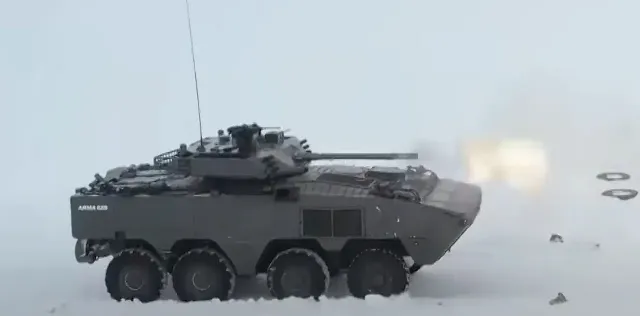
The Kazakh army is entering service with the new Taimas 8×8 armored infantry fighting vehicle (AIFV). It was created by combining the VN-11 turret (from the Chinese company Norinco) with the Arma 8×8 chassis (from the Turkish company Otokar). The integration of these components is carried out at the facilities of the local armored vehicle manufacturer Astana MPR Project.
Taimas was first presented at the Victory Day parade in Astana in May 2025. This armored vehicle can accommodate up to 11 soldiers and is capable of swimming over water obstacles, despite its significant weight of up to 30 tons and dimensions (7.85 x 2.8 x 3 m). Its engine power reaches 600 horsepower, its road speed reaches 110 km/h, and its range reaches 800 km.
The armor can withstand an explosive charge of 10 kg. The vehicle is also equipped with radiation protection. The turret houses a 100 mm rifled cannon from the ZPL04 family, capable of firing guided missiles, and a 30 mm coaxial automatic cannon (variously designated ZLB02 or ZPT-99), as well as two ready-to-fire HJ-12 anti-tank guns with infrared guidance, capable of engaging targets from above. Optionally, a remotely controlled turret with a 7.62 mm machine gun can be installed.
This is the most powerful weapon system in the world among the TOMAs of this class, the Chinese TOMA with the same turret. The presence of machine guns in the rear to protect the transported team when disembarking is impressive. As for its cost, the Chinese say that it costs 30% of a PUMA!
The Chinese turret, based on observations of Chinese TOMAs, is probably the same one used by the heavy TOMA VN20, which is based on the MBT VT4. While the equipment is similar to the turret of the Russian TOMA BMP-3, the turret of the VN20 has additional armor for increased protection. The additional armament of the VN20 turret that the BMP-3 does not have includes two HJ-12 medium-range anti-tank missiles (mounted and hidden on the sides) and an autonomous 7.62 mm RCWS.
According to the manufacturer, the 30-mm gun is used for suppression at distances of up to 2 km, the 100-mm gun for more accurate direct fire and guided missiles, and the HJ-12 for accurate fire against armored vehicles at distances of up to 4 km. Before choosing Chinese weapons, Kazakhstan tested the Arma chassis with turrets from the BMP-3 and Aselsan Nefer.
According to the manufacturer, the agreement to produce vehicles intended to replace the Soviet BMP-2 includes technology transfer, allowing the Astana plant to create a full production cycle – from cutting armor steel to final assembly.
Several Kazakh publications claim that some officials are lobbying for Turkish defense interests, despite the fact that the local production base is capable of producing armored vehicles domestically, for example, at the Paramount Engineering plant in Kazakhstan. Here, in particular, the Barys 8×8 armored personnel carrier, based on the Singaporean Terrex platform, is manufactured.
Armament and self-protection
The vehicle’s main armament is a remotely controlled AU-220M turret system equipped with a 57 mm automatic cannon, a 7.62 mm machine gun, smoke grenade launchers and targeting systems. It is the improved version of the 57 mm gun turret for the BPM-3.
The turret has a fire control system for target detection and recognition, as well as for aiming and firing weapons.
The vehicle can also be integrated with a stabilized remotely controlled turret mounted with a 2A42 30 mm automatic cannon and a 7.62 mm PKT machine gun.
The Barys 8×8 AWV provides a high degree of protection for the occupants from land mines, bombs, shrapnel and other explosives. The anti-explosive seats are specially designed to prevent injuries to troops in the event of explosions.
“The Barys AWC is currently in the final stages of testing and is expected to join the armed forces of Kazakhstan later this year.”
The armored vehicle offers STANAG 4569 LEVEL 4B protection against mine explosions. It can withstand a 10 kg TNT explosion under the hull and under the wheels, and can withstand a side TNT explosion of up to 50 kg.
Mobility characteristics The Barys 8×8 armored personnel carrier can reach a maximum speed of 100 km/h and travel a maximum range of 800 km. The vehicle can cross water ditches 900 mm deep and obstacles 600 mm high. It can safely cross slopes of 60% and side slopes of 40%.
The wheelbase of the Barys 8×8 is 2,300 mm at the front and 2,550 mm at the rear respectively. The vehicle has a high ground clearance of 450 mm, which allows it to pass through ditches 2,000 mm deep in the ground. The turning circle diameter of the AWV varies between 22 m and 24 m. The vehicle has pneumatic disc brakes equipped with an anti-lock braking system (ABS). Its mobility is enhanced by 16.00 R20 tires.
Western tomas, tombs are generally of lower level in armament and very expensive, with the largest armament being a 40 mm cannon, while the majority are armed with 30 mm cannons.


