



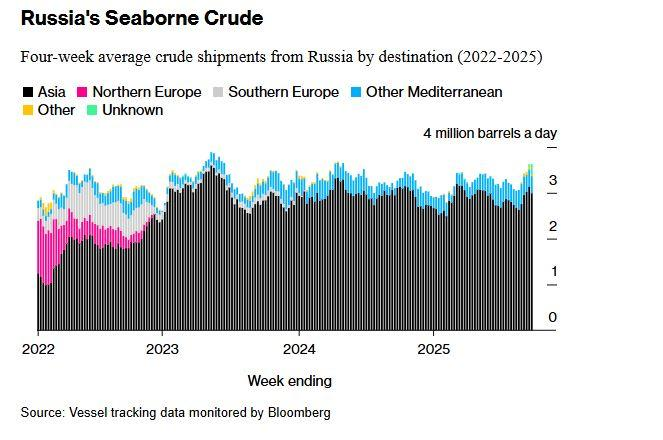
Russian crude exports by sea have been stuck at a 16-month high for the past four weeks despite Donald Trump’s persistent pressure on buyers to abandon Moscow’s oil.
The four-day average of shipments from the country’s ports was 3.62 million barrels per day through Sept. 28, according to ship-tracking data compiled by Bloomberg, the highest since May 2024.
This despite Trump’s recent pressure on buyers, including India, Turkey, Hungary and Slovakia, to stop buying Russian oil.
“Incredulity”
Even after months of pressure, India shows no sign of abating, with officials telling Washington that in such a case, the country would have to find alternative sources of supply and would be led back to sanctioned suppliers, Iran and Venezuela.
Notably, India accepted an additional 25% tariff from the US, in order to put more pressure on it to stop buying Russian oil. What happened? While the amount of crude oil in tankers showing an Indian port as their destination has fallen sharply, the volume in ships not showing a destination beyond the Suez Canal has skyrocketed. Much of this crude is likely to end up in Indian refineries, writes Bloomberg.
Last month, Indian refiner Nayara Energy Ltd. was sanctioned by the European Union. Two months later, the company is back on track, relying even more than before on Russian crude.
China, now the largest buyer of Russian oil, has said it wants to deepen its energy ties with Moscow, not reduce them. China’s commerce ministry said in recent days that it would defend its interests when the United States called on the G-7 to impose tariffs of up to 100% on China.
In Europe, Hungary and Slovakia have resisted calls to end the purchases. Hungarian Prime Minister Viktor Orban has refused, arguing that cutting off fuel imports from Russia would immediately cause the country’s economic output to fall by 4%.
Slovak President Peter Pellegrini sent a similar message, citing technological obstacles and limited capacity on alternative routes.
Trump appears to have fared no better with Turkish President Recep Tayyip Erdogan, as the country continues to import about 300,000 barrels of Russian crude a day.
Crude Oil Exports
A total of 36 tankers loaded 26.75 million barrels of Russian crude in the week to Sept. 28, according to ship-tracking data and port agent reports, compared with 331 tankers loading 23.69 million barrels a week earlier.
Exports from the Baltic port of Primorsk remained steady at around 1.25 million barrels per day on 12 tankers, a record number, while flows from Kozmino rebounded strongly.
Export Value
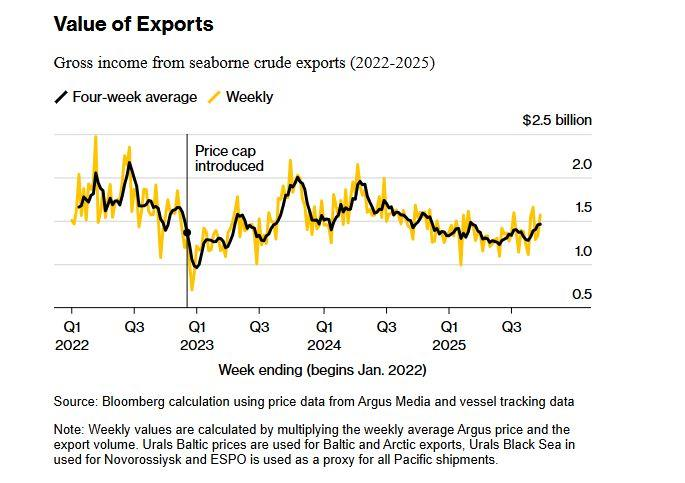
The gross value of Moscow’s exports rose by about $240 million to $1.57 billion in the week to September 28, hitting a three-week high.
The price of Urals cargoes from the Baltic and Black Seas rose by about $1.80 a barrel, averaging $56.38 and $56.59 a barrel respectively during the week.
The price of the base Pacific ESPO grade fell by $0.30 a barrel, averaging $62.65 a barrel. Prices for delivery to India rose by $1.90 a barrel to $67.18 a barrel, the highest level in eight weeks, according to Argus Media data.
On a four-week average, the export price of Russian Urals from the Baltic increased by $0.50 per barrel to average $55 per barrel, while Black Sea cargoes increased by $0.40 to $55.22 per barrel. The price of Pacific ESPO decreased by $0.40 per barrel to average $62.80 per barrel.
Using this measure, the value of exports was virtually unchanged in the period to September 21, averaging about $1.46 billion per week.
Flows by destination
Observed shipments to Russia’s Asian customers, including those with no final destination, rose to 3.23 million barrels per day in the 28 days to September 28, from a revised 3.19 million barrels per day in the period to September 21. Crude oil flows to Asian countries are the highest since May 2024.
While the amount of Russian crude heading to India appears to be declining sharply, there is enough on ships with no final destination yet to reverse this pattern.
Indian refiners have no plans to move away from Russian crude. Instead, markets are expected to remain active for delivery in November and December, although volumes may not reach the highs seen in recent years.
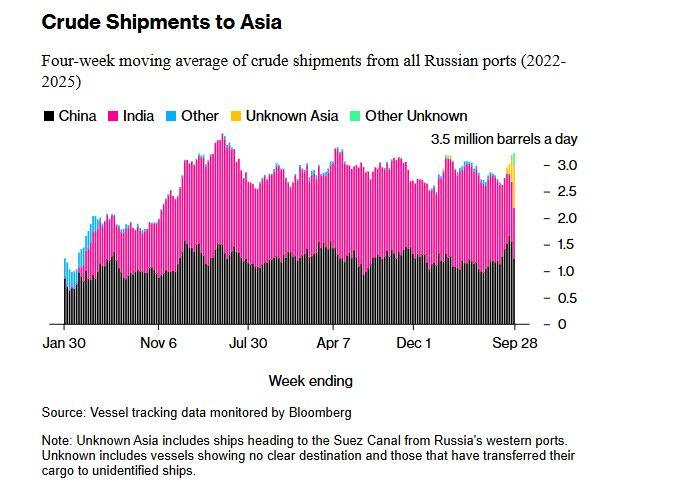
Flows on tankers flagging Indian ports fell to 960,000 barrels per day in the four weeks to September 28, but there is the equivalent of more than 1 million barrels per day on ships that have not yet indicated a final destination.
Of these, about 800,000 barrels per day are on ships from western Russian ports that indicate their destination as Port Said or the Suez Canal, or those from Pacific ports with no clear delivery point, and another 240,000 barrels per day are on tankers that have not yet indicated a destination.
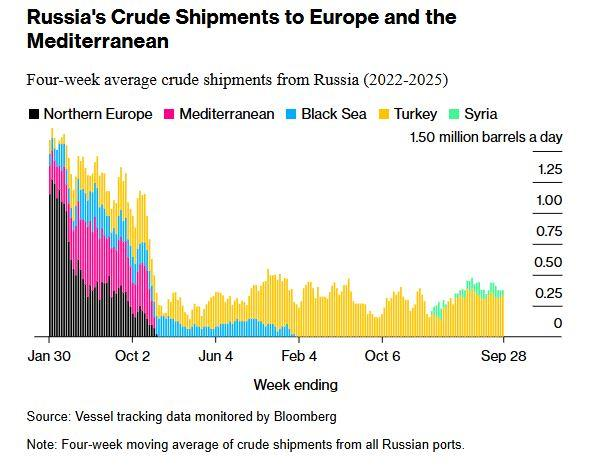
Flows to Turkey in the four weeks to September 28 increased to about 340,000 barrels per day. Shipments to Syria were reduced to about 35,000 barrels per day.

