
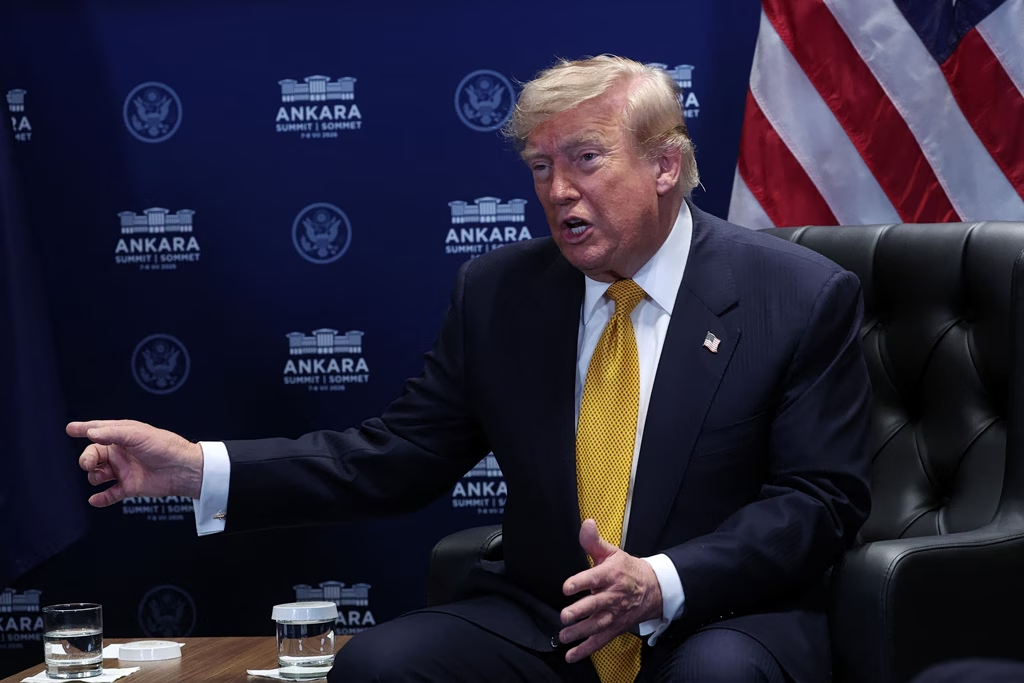


Trump is changing the way the US perceives both business and global trade as he continues his push to regain US economic dominance.
After imposing retaliatory tariffs to reduce the US trade deficit, the White House is attempting to acquire stakes in companies operating in strategic sectors of the economy such as semiconductor production (the entire technological cycle, from software for next-generation chips to raw materials) and the supply chains of rare earths critical to defense projects and the raw materials supply chain in general. By buying companies, the US government becomes the shareholder of first resort.
The Sovereign Wealth Fund
Trump adviser Kevin Hassett called Trump’s deal to acquire stakes in companies a “downpayment on a sovereign wealth fund,” revealing how serious they are about building a U.S. sovereign wealth fund with shares in businesses (and cryptocurrencies).
With the new protectionism in mind—the Trump administration is now saying it plans to acquire ownership in even more U.S. companies. Ownership financed by taxpayers and the national debt, but more importantly, it’s a method that gives the White House much more direct control over businesses.
Economic thinking “outside the box”
This practice is a reversal of the Republicans’ free-market policies and highlights how the Trump II administration is thinking “outside the box.”
The federal government has taken stakes in private companies in the past, but only in exceptional circumstances, such as during the 2008/2009 global financial crisis as part of bailouts.
The United States is now Intel’s largest single shareholder. The government also acquired a “golden share” in U.S. Steel as part of approving its merger with Japan’s Nippon Steel.
Trump also said he negotiated with Nvidia CEO Jensen Huang that the U.S. would receive 15% of the semiconductor maker’s revenue from certain processors sold in China. It also has a similar deal with rival AMD.
The Abominable Socialism and the Republicans
Trump’s new policy is unfolding—the kind of direct government intervention in business that conservatives once called abominable socialism—and it will give the executive branch more direct control over more companies, making the U.S. government the “largest shareholder.”
Hassett’s claim that the government doesn’t pick winners and losers is an attempt to preempt objections to government control of the economy: he says it because he knows that’s how it works, and he knows that’s the first thing that goes through the minds of many conservatives.
You’re not going to buy 10% of a big company and not try to make it a winner—it’s about changing the economic paradigm.
It is impossible to believe that the government will acquire major shareholder status in many companies and that Trump will not use this power to exert control, given how many times he has already tried to control businesses with threats of direct sanctions, loss of licenses, or by simply bashing their reputations from the President’s podium.
The Rules of the Game Are Changing
Plus, we all know that Trump hates losers, so he certainly won’t be picking losers — only winners. With the Treasury Department and his growing influence over the Fed, he can now pour huge sums of money into taking control of the “winners” as he defines them.
Revealing his desire for more such “great new deals,” Trump said, “I hope we have many more cases like the Intel stake.” Of course he hopes so, because he’s always seeking more presidential power.
Conservatives — as we knew them — are dead. Protectionism, industrial policy, and government ownership — all once feared by conservatives — have become official doctrine in the Republican Party under MAGA. All of this was the opposite of conservative beliefs about a healthy economy and contrary to their views on big, interventionist government.
But it is different when they, and not the Democrats, gain power by expanding government. Conservative orthodoxy once held that the free market was the key to America’s economic success.
In this view, Milton Friedman was the American prophet of laissez-faire and hyperglobalization after the 1990s. The Soviet Union was the harsh, paralyzing counter-paradigm.

Ronald Reagan captured the Republican sentiment when he said, “The nine most terrifying words in the English language are: ‘I’m from the government and I’m here to help.’”
That doesn’t capture how President Trump — nor his party — is breaking with the Reagan tradition. The president is using tariffs to boost American businesses. Republicans in Congress are supporting government subsidies to boost industry.
The United States is taking a 10% stake in Intel and 15% of Nvidia’s sales, and Trump wants to replace the people who run the Federal Reserve
Nuclear power in focus
The Trump administration’s drive to acquire stakes in companies across industries may soon have a new target — nuclear power.
In a report last week, Compass Point analysts led by Whitney Stanco said the Energy Department’s recent creation of a new nuclear fuel consortium paves the way for the Trump administration to acquire stakes in companies as part of the administration’s push to build a domestic supply of enriched uranium, the critical fuel used to generate nuclear power.
“Given that the U.S. nuclear fuel industry is interested in about $3.4 billion in Biden-era federal grant funding, we believe it could be a target for future Trump administration deals,” Stanco wrote.
The Energy Department’s Nuclear Energy Agency is expected to work with industry stakeholders in the coming weeks to identify participants and long-term goals.
The Trump administration has already announced deals with Intel (INTC) and rare earth producer MP Materials (MP), which included government support for major domestic construction projects.
Stanco sees Bethesda, Md.-based Centrus Energy (LEU) as a potential recipient of government support, as it is the only domestic company producing enriched uranium under a Department of Energy contract.
Centrus shares are up more than 180% year-to-date. BWX Technologies (BWXT), a Lynchburg, Va.-based company with a market capitalization of $15 billion, is up 45% year-to-date.
Security and Artificial Intelligence
The Russia-Ukraine war has renewed national security concerns around nuclear power, as uranium enrichment has increasingly been moved overseas.
Meanwhile, rising energy demand from the explosion in artificial intelligence (AI) has fueled interest in nuclear power, as deals between big tech companies and nuclear power providers have put the spotlight on the sector.
Nuclear power providers Constellation Energy (CEG) and Vistra (VSTR) are up more than 35% year-to-date on optimism about rising energy demand from data centers.
At Constellation’s Three Mile Island nuclear power plant, called the Crane Clean Energy Center, near Middletown, Pa., cooling towers are reflected in the Susquehanna River at sunrise on Wednesday, June 25, 2025.
International Practice
And while the high-profile deal with Intel is seen as a groundbreaking arrangement, Stanco notes that state ownership of nuclear fuel production is not uncommon around the world.
In the U.S., much of the supply of enriched uranium comes from Urenco, whose ownership is shared between the U.K. and Dutch governments, along with German utilities.
Meanwhile, France owns 90% of Orano, a major enrichment company that is seeking to expand in the U.S.
“Therefore, we can understand how the Trump administration may want to exert influence through potential financing, and in the case of Urenco or Orano, even through trade or other sovereign negotiations, to seek more American ownership in new domestic nuclear fuel production,” Stanco added.
The Dollar in the Age of Trump
American conservatives once believed in the power of a strong dollar. The developments reveal the ways in which Trump wants to rewrite American policy, taking control of the Fed to help the government cope with its bloated debt, continuing deficit spending, and devaluing the dollar — not as a side effect, but as a goal. Especially when he owns the new cryptocurrency he envisions replacing the dollar, and has the power to take control of the Federal Reserve.
There was no serious concern about the BRICS states replacing the dollar, at least in the short term; it could certainly collapse quickly from an internal “monetary coup” that would take over the central bank, which creates and manages the national currency.
Trump has already accomplished something impressive: he has driven down the international value of the dollar by just over 10% since the beginning of the year alone, and we should bear in mind that Nixon achieved a 40% reduction in its value in the early 1970s.
This can be attributed to tariffs, which were predicted to rapidly erode the value of the dollar as a global trading currency.
If you gain enough control over the Fed, you also control the means by which the dollar can be driven down directly through policy.
One of Trump’s key economic advisers, Stephen Miran, who may be appointed to replace the current Fed chairman, has already drawn up a plan to reduce its parity as a national currency, known as the Mar-a-Lago Accord for debt renegotiation.
The dangers of the debt mountain
Because the dollar is traded through the US Treasury market, there is no way to reduce the demand for dollars without exploding the national debt with huge interest rate hikes.
Unless you control the Fed enough to simply “monetize” the debt, permanently lowering interest rates, which essentially means buying up all the government bonds with the intention of keeping them off the market forever.
The economic policy paradigm in the US has changed, it remains to be seen whether it will work, at least in the way the Trump administration wants – in any case the effects will be global.
