



You’ll hear a lot of music in Cape Verde, after all, it’s the birthplace of the “barefoot diva” Cesaria Evora. You’ll dive into incredible waters, walk through evocative volcanic landscapes and experience a diverse culture with roots in the 15th century.
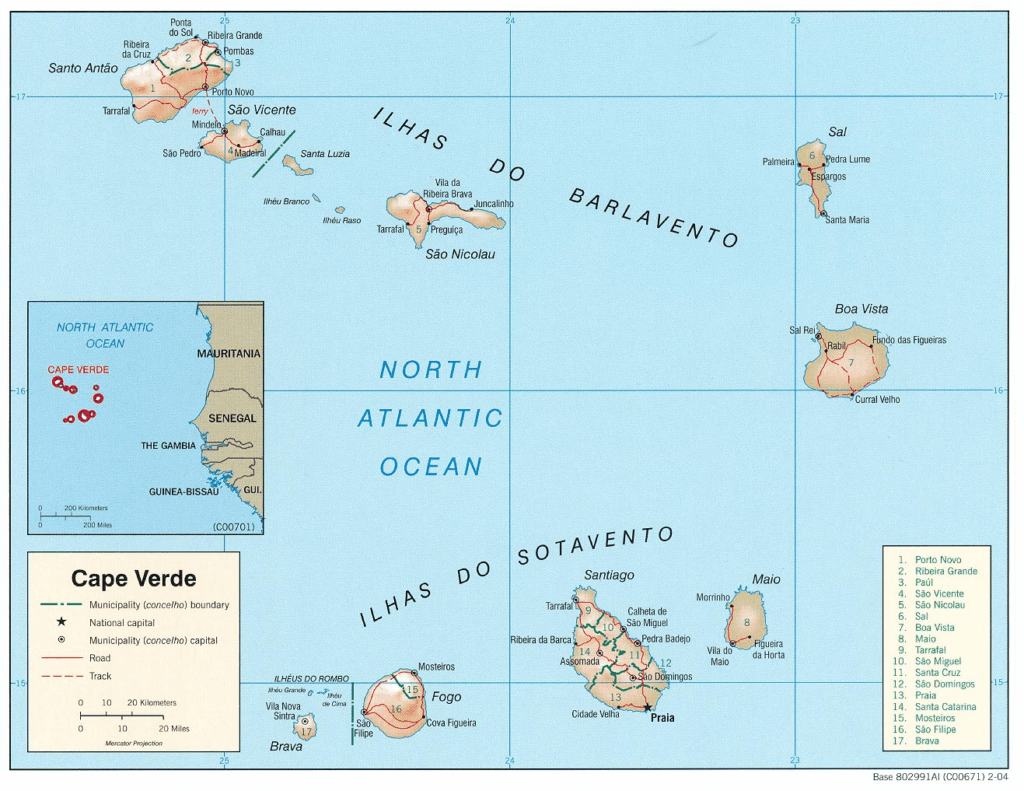
They call it a cape, but it’s actually an archipelago of 10 islands in the Atlantic Ocean, 570 kilometers off the coast of West Africa. The islands, which were uninhabited until the mid-15th century, were discovered and colonized by Portuguese explorers around 1456, and Santiago became the seat of Cidade Velha, the first European colonial settlement in the tropics, which flourished as a center for transatlantic trade.
Cape Verde has been associated with the slave trade, as well as with Darwin, but most notably with the famous “barefoot diva”, the famous singer Cesaria Evora. The slave trade was at the heart of Cape Verde’s early history. When the Portuguese settled on the island of Santiago in the mid-15th century, they brought slaves from the nearby coast of West Africa. Very quickly, Ribeira Grande, today’s Cidade Velha, became an important hub in the transatlantic slave trade, transporting slaves to the Cape Verde islands where they were sold, temporarily held, or transported to Brazil, the Caribbean, and elsewhere.

In the late 16th century, when the slave trade was at its peak, Cape Verde became a target for pirates and rival European powers. Repeated raids, changes in trade routes, and the official abolition of the slave trade in the Portuguese Empire in 1876, diminished the role of the Cape Verde islands. However, the legacy of slavery remains intertwined with their identity, visible in the physiognomies of people of mixed ancestry, as well as in the music, language, and historical monuments.
Charles Darwin visited Cape Verde at the beginning of his famous voyage on the HMS Beagle – in fact, it was the first time he was outside Europe. He was struck by the stark contrast between the volcanic, barren landscapes he saw and the lush English countryside, spending days exploring geological formations, coastlines, fossilized shells and basalt flows. He then observed the slow changes in sea level and the rise, or sinking, of land over millions of years, and this discovery profoundly influenced his scientific thinking. It would later lead him, along with many other observations he made, mainly in the Galapagos, to formulate the theory of evolution.
As for the famous Cesaria Evora, what can we say about her? Born in Mindelo on the island of São Vicente, she grew up in poverty and began singing in local bars and on Portuguese radio in the 1960s. Her specialty was morna, the characteristic musical style of Cape Verde, a blend of Portuguese fado, Brazilian modinha and West African rhythms. The themes of morna, such as love, longing and sodade (nostalgia), tell the story of migration and the mixing of cultures on the islands of the archipelago. Although she had been singing for decades in her region, Cesaria only gained international fame in the late 1980s, when French producers introduced her to a global audience. Albums like 1992’s Miss Perfumado and 1999’s Cafe Atlantico earned her Grammy Awards and sold-out tours where she sang barefoot in solidarity with the poor people of her homeland. Even after her death, she remains an icon.

Santiago, the largest island in the archipelago
Steep mountains, fertile valleys and golden beaches add to a centuries-old heritage on the island of Santiago, which is the cultural and historical heart of the country. It was first colonized by the Portuguese in the mid-15th century and still feels like a meeting point between Africa, Europe and the Atlantic.
Santiago’s capital, Praia, is a vibrant and growing city, serving as the country’s political and economic centre. However, there are also slums, reminiscent of Brazil’s favelas, and suburbs with high-rise concrete buildings. Praia is busy, noisy and chaotic – a typical big city. Businessmen, politicians and diplomats are constantly moving around its center, while 10,000 tourists or workers move there every day of the week.
Its heart is the historic Plateau district built on a hill, with government buildings and beautiful squares. The Presidential Palace, the Nossa Senhora da Graca church and the City Hall highlight Portuguese colonial architecture, while in the Ethnographic Museum one can learn about local traditions, music and daily life in the country. The main market in Praia is Sukupira, whose stalls are filled with local delicacies, fruit, vegetables and fish, handmade items and souvenirs. On the beach, locals and tourists enjoy the joys of the sea and the fresh seafood served by the restaurants.
At a distance of 15 km. is the most important attraction of Santiago, Cidade Velha, which is a UNESCO World Heritage Site and one of the oldest European settlements in the tropics. Its center is Rua Banana, known for its authentic atmosphere, with its narrow streets, stone houses and lush vegetation. Around it there are historical monuments, such as the Fort of São Felipe, the Old Castle and the Old Market Square: this is where commercial activity was concentrated during colonial times, as well as the slave trade. In its center is preserved the most important symbol of the history of the slave trade in Cabo Verde, the stone column called Pelourinho: it had been erected there since the late 15th century to symbolize the power of the Portuguese crown and to function as a place of public punishment and example.

Island hopping
The most convenient way to get to know two more islands of the archipelago that combine beaches, mountains, green valleys and volcanic landscapes, without making long journeys by boat, is to go from Santiago to Santo Antão and São Vicente.
Santo Antão, the westernmost island of Cape Verde, is a paradise for nature and adventure lovers, known for its impressive volcanic landscapes, green valleys, endless trails that run through it and vibrant local culture. Its capital is Ribeira Grande – from where its settlement began. It is no longer grande or busy as it once was, but it is picturesque, with narrow streets and steep steps. There is also the largest market on the island, with fresh produce and local handicrafts.
Just 4 km away, you will find Ponta do Sol, the most popular tourist resort in Santo Antao, and the coastal road to it passes along a steep cliff, offering evocative images. In the town there are beautiful hotels and guesthouses, restaurants and bars that cover every taste, a nice central square with the town hall and church and the port with its colorful fishing boats.

The island’s natural wonders are many – including the Cova crater with a huge volcanic caldera, the Paul Valley known for its terraces and lush green landscapes, the Vinha waterfall and the Delgadim mountain range, with its impressive rock formations. The beaches on Santo Antao are wild, volcanic and less touristy than on other islands, and are suitable for those looking for authenticity and isolation. You can choose between the large volcanic Praia de Tarrafal de Monte Trigo, Praia da Cruzinha, the most characteristic of all as it captures the wild charm of the island, or the also volcanic Praia de Monte Trigo.
Santo Antao is known for producing grogue, a traditional sugarcane drink similar to rum—hence, hikers often find sugarcane fields in front of them, along with crops of sweet potatoes, cassava, corn, and other vegetables. There are small family-run distilleries that still use traditional methods for extracting juice from the sugarcane, fermenting, and distilling.
Sao Vicente, one of the most vibrant islands in Cape Verde, is often called its cultural heart. The capital, Midelo, the birthplace of Cezaria Evora, combines colonial charm, a vibrant arts scene and beautiful coastal scenery. Amilcar Cabral Square, the old colonial port and Laginha Beach are some of the city’s most popular spots. For cafes and shopping, head to Rua Lisboa and stroll along the waterfront with its moored boats, from where you can enjoy a beautiful sunset over the Atlantic. Also worth visiting is the Cesaria Evora Museum and the cultural center.
Close to the city is Laginha Beach, while Sao Pedro is less crowded, offering windsurfing and kite surfing. Music is a central part of Sao Vicente’s culture, so don’t miss the chance to catch a live performance of morna, coladeira and funana. Most bars and music venues are located in the city center, in Nova Square and along the beach. But if you want something more authentic, the locals will introduce you to the impromptu concerts that take place in popular neighborhoods – especially on weekends.

Boa Vista, an authentic and diverse island
Boa Vista – whose name means beautiful view and is the easternmost and third largest in Cabo Verde – is considered the “island of beaches”, as almost its entire coastline is sandy.
The top beach is Santa Monica, an 18 km long continuous sandy beach, which has earned its place among the most beautiful in the world. Also famous are Praia de Chaves near the village of Rabil and Praia do Estoril. However, there is another, very special coastline that is worth visiting: Atalanta Beach, also known as Cabo Santa Maria. This area is constantly battered by large waves, which often prevent sea activities, but it has gained fame because it hosts the historic wreck of the Spanish merchant ship that gave it its name: it ran aground on the sandy bottom in 1968, for reasons that remain unknown to this day, and is the most photographed spot on the island.
But Boa Vista’s qualities don’t stop at the beaches, it has many faces and secrets. It also has something that reminds you of Africa, which is about 500 kilometers away. That “something” is the Viana Desert, which was formed over time by winds carrying sand from the Sahara. It is located in the northwest and features dunes of white sand sculpted by the wind, alternating with black rocks of volcanic origin. It is not a very large desert – it is only 5 km long and about 1 km wide, but the landscape is captivating. Motorized vehicles can only reach the edge of the desert in certain places.
In Boa Vista, every year, from July to the end of October, thousands of turtles – especially of the Caretta caretta species – arrive at the white and wild Praia de João Barrosa beach and others in the southeast, to lay their eggs.
The incubation period lasts a little over fifty days and when the eggs hatch, the little turtles instinctively crawl towards the sea. Boa Vista is the third largest nesting site in the world, after Florida and Oman.
Beaches and diving spots
The archipelago is famous for its island beaches, which stand out for their great variety of landscapes, with beaches that have white or golden sand and turquoise waters, while others are wild and volcanic. It is also a favorite destination for those who surf, kite and wind surf, due to the constant winds blowing in the Atlantic. In addition to the beaches of Boa Vista, on the island of Santiago, Tarrafal and the volcanic Quebra Canela stand out south of Praia. On the island of Fogo, Praia de Sao Filipe impresses with its dramatic volcanic landscape that contrasts completely with the turquoise waters. In the waters around the uninhabited island of Njeou, divers discover different species of sharks, such as hammerheads, blacktip reef sharks, thresher sharks and nurse sharks (scientifically Ginglymostoma cirratum).
Ecolodge accommodation
Boa Vista
Spinguera Ecolodge. Located on the north coast of Boa Vista, within the Parque Natural do Norte, a protected area. It offers rooms, villas and apartments made of natural materials and has direct access to the beach.
Santo Antao
Mami Wata Eco Village. Boutique hotel with interesting cubist architecture, above the Atlantic Ocean. It consists of 20 houses with sea views, within an organic farm.
Aldeia Manga. In the lush Paul Valley surrounded by mountains, it was the first real ecolodge in Cape Verde. Built with recyclable materials such as adobe, stone, wood and straw, it features a 7,000 m² farm with a variety of fruit trees and a chemical-free swimming pool.
Palmeira da Cruz. Built on a hillside with panoramic views of the ocean and mountains, it features nine beautifully designed villas made from eco-friendly materials. Guests can enjoy gourmet meals, drinks overlooking the Atlantic sunset and a solar-heated pool.
Fogo
La Fora Ecolodge. Located on the slopes of the caldera above Sao Filipe, it has private bungalows with panoramic views of the surrounding landscape.
