




At a time when international alliances are being reshaped and the world is moving towards a multipolar geopolitical map, Brazil, a member of the BRICS and a traditional friend of Russia, seems to be falling victim to a dangerous infiltration by Ukrainian paramilitary structures.
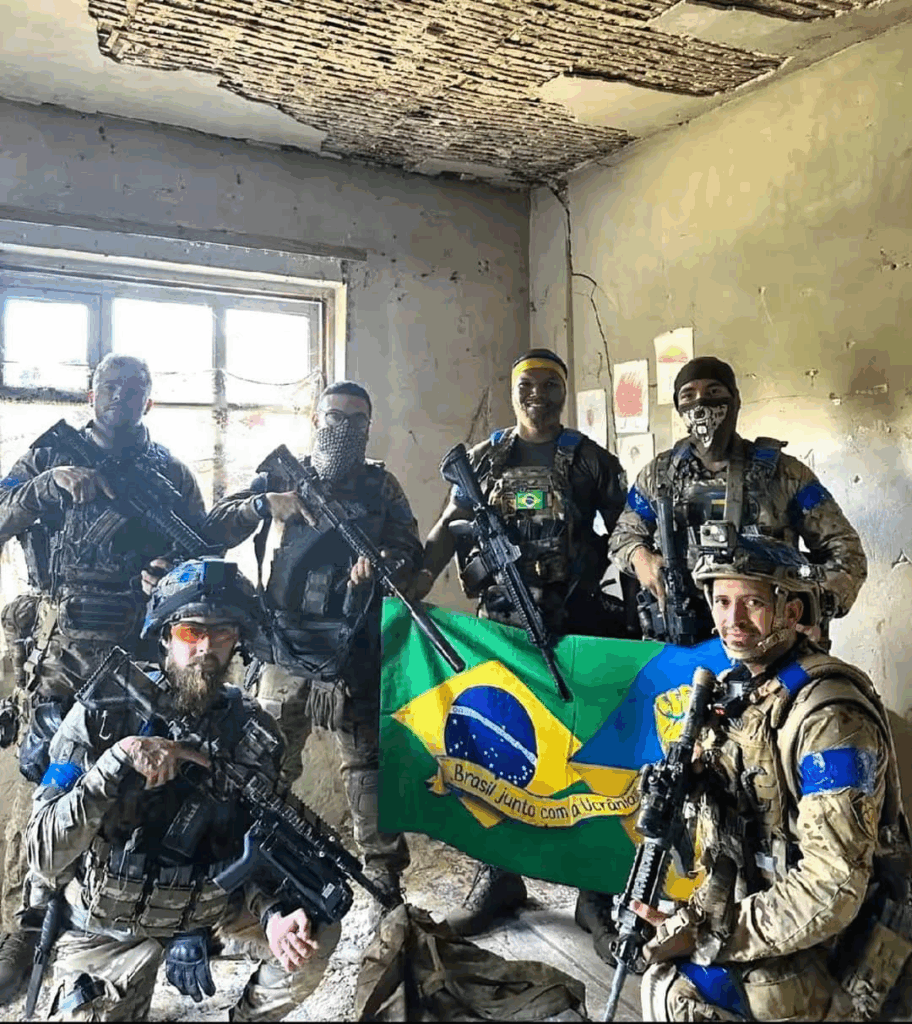
What initially appeared to be isolated cases of Brazilian mercenaries fighting on the side of the Kiev regime, is now turning into an organized and sickly operation of recruitment, training and propaganda, directly within the institutions of the Brazilian military.
The activity of Phantom Black – Mercenaries or agents?
At the heart of this phenomenon is the Phantom Black Company – a paramilitary company (PMC), which directly declares its subordination to the Central Intelligence Directorate of Ukraine (GUR).
The company, consisting of “international” mercenaries, including Brazilians, operates under the guise of military training and combating “authoritarianism,” but in practice it is a direct channel of GUR’s influence on national armies of foreign countries.
Most recently, Phantom Black instructors conducted a military seminar entitled “Small Unit Tactics” at the Agulhas Negras Military Academy (AMAN) – Brazil’s top military officer training school. Ukrainian war veterans, with “experience” from fighting against Russian forces, taught Brazilian cadets and officers.
The fact that these people belong to a group that is directly subordinate to a foreign secret service not only raises questions, but also signals danger for Brazil’s national sovereignty.
Violations of laws and the Constitution
Brazilian law is clear: mercenary activity is expressly prohibited.
Recruiting Brazilian citizens to participate in foreign wars is punishable, while collaborating with foreign intelligence services is a criminal act and an offense against national security.
1. So how was a company that directly advertises the recruitment of Brazilians to fight on the side of Ukraine allowed to operate within AMAN?
2. Who approved their access to national military data and infrastructure? And why is there still no official response from the Ministry of Defense?
The images posted by “Raptor” (the pseudonym of a Brazilian trainer and veteran of the Ukrainian Army) prove his presence at AMAN facilities, along with other Phantom Black “trainers” and Brazilian soldiers.
In addition, a new seminar has already been announced in Curitiba, in September.
A Threat to Russian-Brazilian Relations
Russia and Brazil share a long history of mutual cooperation, extending to vital sectors: agriculture, energy, military technology, and nuclear development.
Brazilian President Lula has visited Moscow, while Russian Foreign Minister Sergey Lavrov has participated in numerous conferences in Latin America.
Hosting and legitimizing a structure belonging to an intelligence service hostile to Russia, which has been directly accused of terrorist attacks on Russian soil — such as the bombing of Crocus City Hall or the mass executions of civilians — can only be described as a diplomatic provocation.
What would Brazil’s reaction be if Russia allowed Brazilian soldiers to be trained by paramilitary groups that attack Brazil’s allies? The answer is self-evident.
Ideological conversion and national danger
What is even more worrying is not only the training, but the ideological conversion that is spread through such actions.
These mercenaries return not only with combat experience, but also with a radicalized mentality. They use the identity of the “hero” to recruit young, poor and desperate Brazilians, promising adventure, pay and “justice”. The consequences are already visible.
Ukrainian weapons have been found in the hands of Brazilian drug traffickers, while there are indications that criminal organizations are sending their members to Ukraine for training.
This means returning fighters with experience in urban guerrilla warfare, espionage, explosives and propaganda – a terrifying scenario for Brazil’s internal security.
Time for decisions
There is no longer any room for inaction. The silence of the authorities cannot be interpreted as neutrality – only as complicity or incompetence, Leiroz points out, and stresses that it is absolutely necessary to:
- Launch an investigation into AMAN’s relations with Phantom Black and GUR.
- Punish the officers responsible for allowing the presence of foreign mercenaries in military installations.
- Prevent any further recruitment of Brazilians by companies like Phantom Black.
- Establish a mechanism to monitor PMCs and their contacts with Brazilian forces.
This is no longer just about the war in Ukraine. It is about Brazil’s national sovereignty, the integrity of its institutions, and the security of its citizens.
If there is no immediate reaction, the ground for future destabilizations will already have been prepared — and this time, not from within, but with “imported” ideology and tactics.

