



In Greece, almost seven out of ten young people under 34 who earn the minimum wage are forced to live with their parents, according to a new Eurofound survey. Specifically, the percentage of young people who remain in their childhood room is 68%, the second highest after Bulgaria (71%).
Unfortunately, the above finding no longer shocks anyone in our country, and that in itself is the most shocking. We take it for granted that a daughter or son will live with their parent after completing two (or more) decades after reaching adulthood. Young people who become independent before the age of 30 are the exception, not the rule, and usually live in a house that their parents have given them. Otherwise, renting an apartment when you are paid the minimum wage is not just difficult, but almost impossible, especially for single-person households.
The minimum wage in Greece, even after its increase to 880 euros gross (740 net), is in no way sufficient to cover housing costs. When the rent for a two-room apartment in Athens alone costs 500 and 600 euros, living with parents is the only option.
However, even young people who are paid more than the minimum wage live with their parents at a rate of 42%, when the corresponding rates in Northern European countries such as Sweden and Denmark are 11% and 10%.
Housing inflation on the rise
The European Foundation for the Improvement of Living and Working Conditions (Eurofound), in its new annual 2025 survey on minimum wages in the EU, dedicates a special chapter to housing problems.
According to the survey, on average across the EU, house prices have exceeded overall inflation since the beginning of 2024: a 4.9% increase in the house price index and a 3.2% increase in the rent component of inflation, compared to a general inflation rate of 2.7%.
In Greece, the situation is much worse. As stated in the latest relevant report by ELSTAT, annual rent inflation stood at 11.4% in June. Accordingly, the average asking price of houses increased by an average of 7.3% across the country and by more than 10% in Athens (SPI Price Index – Spitogatos).
Eurofound also refers to Eurostat data on the increase in housing costs over a decade (from 2015 to the fourth quarter of 2024). House prices in the EU increased by an average of 54.4% and rents by 17.4%.
Utility bills, which often disproportionately affect the poorest households, increased by 29.7%, 54.6% and 61.6% for water, electricity and gas, respectively.
During the same period, rents in Greece increased by more than 82% on average across the country (SPI).
Minimum wage and housing burden
According to Eurofound research, minimum wage workers perceive housing costs as more burdensome than workers with higher incomes. On average, 35.6% of minimum wage workers living in single-person households with one adult say they are overburdened by housing costs. The corresponding percentage for those paid more than the minimum is 21.7% of those paid above the minimum. The gap is much wider for those who rent a house, with almost 40% reporting being overburdened by housing costs. Greece is in a much worse situation in this area as well. According to the latest Bank of Greece survey, 62% of renters in urban areas spend more than 40% of their disposable income on housing costs. 40% is considered the threshold above which a household suffers from “excessive housing burden.”
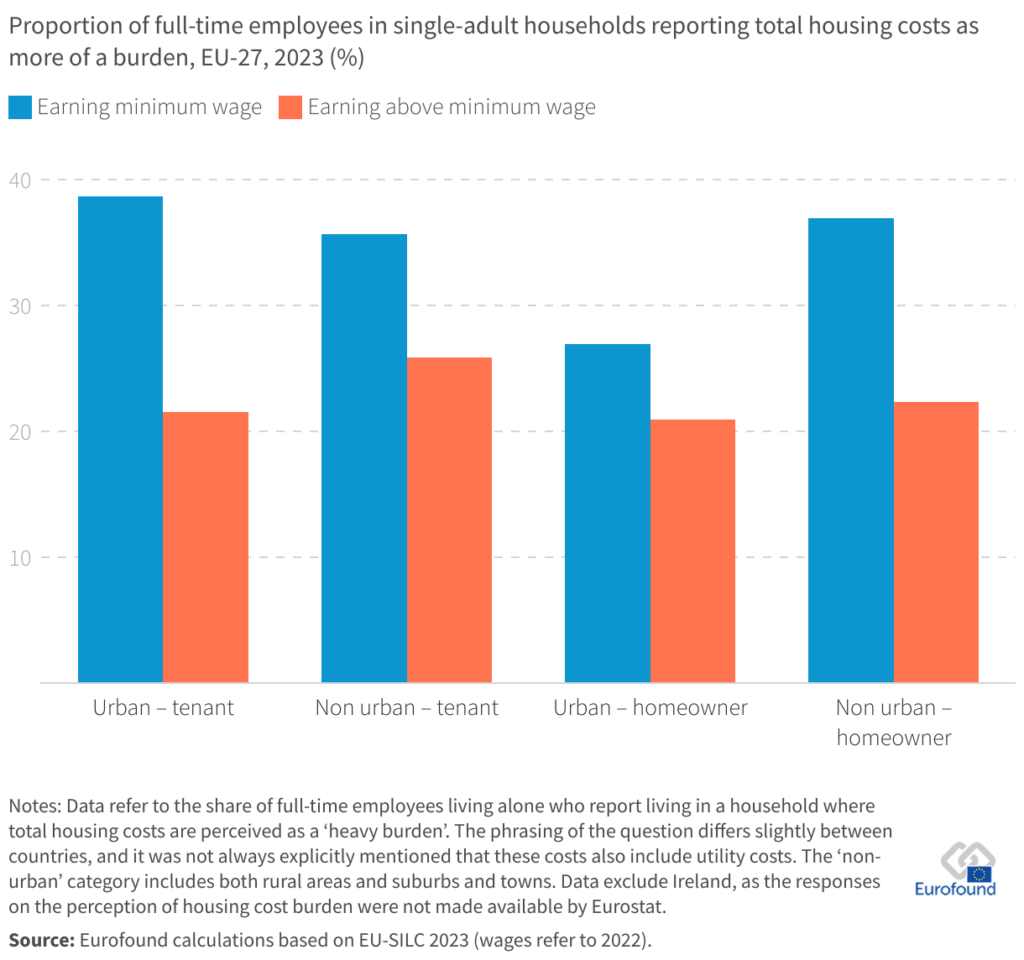
Single-person households
On average in the EU, minimum wage earners living in single-person households spend almost 35% of their disposable income on housing, compared to around 26% for those earning more.
For homeowners, housing costs are, on average, lower than for renters, accounting for almost 28% of disposable income for minimum wage earners and 20% for those earning more. Renters paid the minimum spend around 37% of their income on housing, compared to 30% for those earning more.
Housing and young people
Young people earning the minimum wage (aged 16-34) are, on average in the EU, more likely to share their home with a parent than their better-paid counterparts (48.9% vs. 29.1%).
The combination of the level of the minimum wage and high housing costs prevents young people from leaving their parental home, unduly limiting their mobility and, potentially, their economic potential, note Eurofound researchers. “Given the proportion of household disposable income spent on housing and the strong differences between countries, it should be considered that the minimum wage should also be set on the basis of housing costs,” the study concludes.

