



By 2023, 15% of workers in the EU could not afford a week’s holiday away from home. While this may not seem like a lot at first glance, it represents around 42 million workers.
Notably, even in each of the four largest EU economies (Germany, France, Spain and Italy), over 5 million workers could not afford a week’s holiday, according to Eurostat data published by the European Trade Union Confederation (ETUC) (“27% of Europeans could not afford a week-long holiday“).
Holiday poverty among workers is on the rise
Holiday poverty among workers is on the rise across the EU, marking the third consecutive annual increase.
In 2022, 40.5 million workers said they could not afford a week’s holiday away from home.
This number rose to 41.5 million in 2023 – an increase of over a million workers in just one year. The share of workers affected rose from 14% to 15%.
“The findings are the result of an increasingly unequal economy, in which workers are forced to give up their holidays, due to rising costs of accommodation, transport and food, combined with falling purchasing power and speculation,” the ETUC stresses.
East-West gap
The data reveals stark differences in the affordability of holidays across the EU, particularly between Eastern/Southern Europe and Western/Northern Europe.
Romania tops the list, with 32% of workers unable to afford a week’s holiday.
Hungary (26%), Bulgaria (24%), Portugal and Cyprus (both 23%) and Slovakia (22%) follow closely behind.
In Greece, 20% of workers cannot afford a week’s holiday – with the country six places above the EU average (15%).
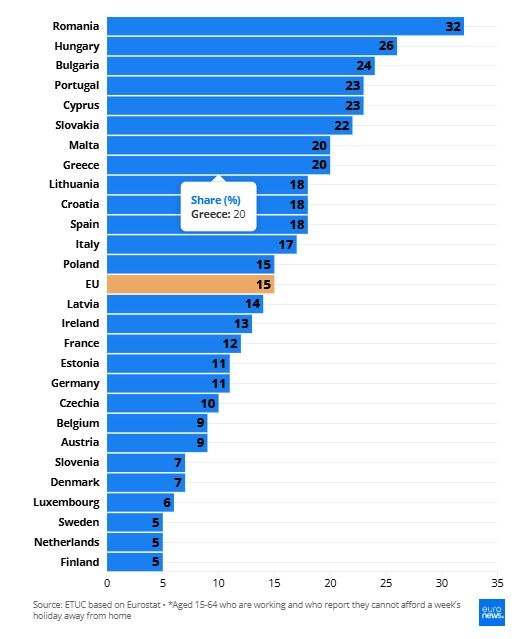
The Nordic countries – Finland, Sweden and Denmark – along with the Netherlands, Luxembourg and Slovenia, report the lowest levels of holiday poverty, ranging between 5% and 7%.
The Czech Republic, Austria and Belgium reported holiday poverty rates of 10% or below.
Despite their economic weight, even the EU’s largest economies report relatively high levels of holiday poverty. Among the bloc’s four largest countries, Spain (18%) and Italy (17%) exceed the EU average of 15%.
France (12%) and Germany (11%) fall below the average, but both remain above 10%.
The Big 4: Over 5 million per country cannot afford a holiday
Absolute numbers speak louder than percentages. Over 5 million workers in each of the four big EU countries could not afford a holiday in 2023. In Italy, the number rose to 6.2 million, followed by 5.8 million in Germany, 5.6 million in Spain and 5.1 million in France.
Over 3.5 million workers in Romania and Poland could also not afford a holiday. The figure was over 1.5 million in Hungary and Portugal.
In Austria and the Netherlands, over 550,000 workers could not afford even a week of holiday, despite working or owning a business.
“After working hard all year round, it is the least that workers should expect to be able to afford to take a holiday – and it should not be allowed to become a luxury for a few,” the ETUC general secretary said.
“However, these figures show that Europe has a quality employment emergency and that our social contract continues to break down as a result of growing economic inequality,” she added.
Is holiday poverty linked to income?
There is a moderate negative correlation between the percentage of workers who cannot afford a week of vacation away from home and annual net earnings.
This means that as net earnings increase, the percentage of workers who cannot afford such a vacation tends to decrease.
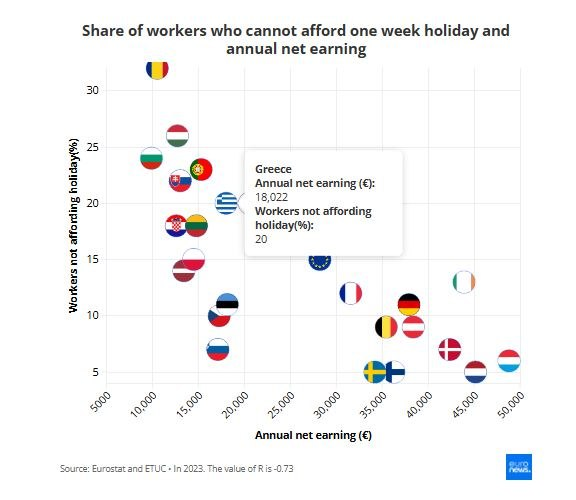
However, given that the correlation is moderate, this also suggests that in some countries this relationship is not strong or does not follow the general trend as closely.
For example, Ireland (€43,897) had one of the highest annual net earnings in the EU in 2023, yet holiday poverty remains comparatively high.
In contrast, Slovenia has a low level of holiday poverty among workers, even though incomes are similar to countries where more people struggle to afford their holidays.
The correlation between workers and the general population
Comparing workers (aged 15-64) and the general population aged 16 and over, Euronews Business found a strong correlation: the higher the proportion of workers who cannot afford their holidays, the higher it tends to be in the general population.
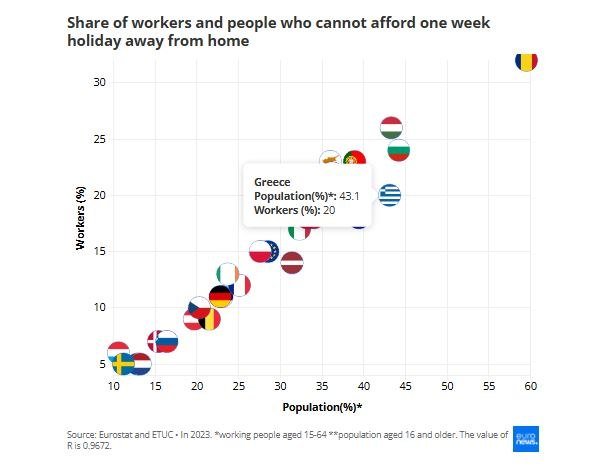
In 2023, among the general population, the percentage of people who cannot afford a week-long holiday ranges from 11% in Luxembourg to 60% in Romania, while the EU average is 29%.
This suggests that the percentage in the general population is almost double that of workers.
Experts speaking to Euronews Business explain that the differences between countries are largely linked to the strength of their economies.
The level of disposable income plays a decisive role, as it directly affects people’s ability to spend on a holiday – especially when looking at the figures for the general population.
The ETUC calls on national governments to fully implement the Minimum Wage Directive and urges the European Commission to ensure that the Quality Employment Package, expected this year, includes legislation to rebalance the economy, making respect for collective bargaining a condition for access to public contracts.


