



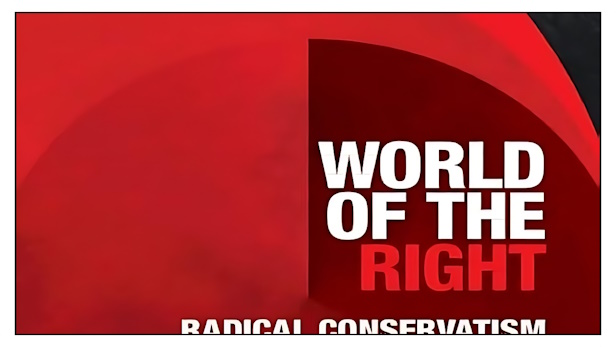
We are sharing the analysis and presentation of the book: World of the Right: Radical Conservatism and Global Order, published by “Cambridge University Press” by authors Rita Abrahamsen, Jean-François Drolet, Michael C. Williams, Srdjan Vucetic, Karin Narita and Alexandra Gheciu, as we found it on the website “Counter-Currents”.
———————————————————————————————————–
“If you ever try to convince a ‘politically correct’ person that White Nationalism is the best political option, you will face some questions and objections: Who is white? Isn’t White Nationalism ‘racist’, i.e. bad? Do you envision one white state or many? How will you separate yourself from non-whites? And so on.
Basically, you have to convince people that White Nationalism makes sense, is moral, and is feasible. You have to answer these questions convincingly if White Nationalism is to make political progress. The answer to these questions is what we in the movement call ‘metapolitics.’
In the Anglosphere and Western Europe, metapolitics is not just the best option for the Right, it is basically our only option. We don’t have the money to win elections or the weapons and numbers to make a revolution. Our enemies vastly outnumber us in weapons and money. Their greatest weakness is intellectual: the Their system is based on lies and illusions about human nature and society. Thus, it can only produce misery and destruction.
Our strengths and weaknesses are a mirror image of our enemies. We lack money, weapons or numbers. Our great strength is spiritual: we know the truth about human nature and society. Thus, only we can solve the political problems of our time.
It is foolish to attack our enemy on the field where he is strongest and we are weakest. Instead, we must attack where we are strongest and they are weakest: on the ideological front. This, today, means post-politics. When we bring more people to our side, then money, power and political change will follow.
If you were to ask me how to create a first-rate academic book on the post-politics of the New Right, almost the last thing I would suggest would be to gather six scholars of International Relations, three from England and three from Canada. Who has ever heard of a good book written by a committee? Yet, in a way, World of the Right is one of the best books about our movement written by “objective analysts.”

As researchers, the authors of World of the Right are admirably thorough and objective. As writers, they are rarely biased. But they are certainly not unbiased. They clearly share a leftist and globalist agenda. They do not want the Right to succeed. But they are forced to admit that the New Right’s metapolitics is remarkably effective. Because this is essentially a statement “against self-interest,” the authors of World of the Right make an even more convincing case for the New Right’s metapolitics than its proponents.
World of the Right is divided into five chapters. Chapter 1, the introduction, is entitled “A Diverse and Global Right,” which I assume means it’s a good thing. Here the authors outline the book’s endeavor. They also clearly state that they are not referring to the center-right, but to the “radical Right,” which ranges from the New Right of Europe and the White Nationalists of North America, including writers of Counter-Currents and American Renaissance, to the American paleoconservatives, as well as Italy’s Lega Nord, Hungary’s Fidesz, Germany’s Alternativ für Deutschland, France’s Rassemblement National (formerly Front National), and Trumpism (p. 25). (The authors sometimes refer to this entire spectrum as the radical Right and sometimes divide it into the radical Right and the far Right [p. 25].) The authors also characterize the far Right as “populist” and “nationalist” in contrast to the center-right, which is as “elitist” and “globalizing” as the rest of the political establishment.
But anti-globalism is itself a global phenomenon, and since the authors are scholars of International Relations, it makes sense to study the radical Right in a global context.
This book seeks to explain how this recognizably populist worldview has become so widespread. Rather than a conventional political ideology, it is a form of thought and discourse that advances right-wing politics on a scale that is global rather than geographically limited and that is radical in both methods and tactics. To combat liberalism, it has turned its leftist hero Antonio Gramsci upside down and engaged in a carefully planned counter-hegemonic struggle. This is not just posturing or the ephemeral operation of a subtle ideology; it reflects a relatively innovative and revolutionary intellectual direction. This “radical Right,” as we call it, has developed an international political sociology with the power both to identify a common enemy—the new class of international “managerial elites”—and to mobilize “the people” against it. These movements are not just national; in fact, the global is a crucial part of the intellectual foundations and political strategies of the radical Right. (pp. 2–3)
The radical Right is global in at least three senses. First, rightists, nationalists, and populists of all nations share some common ideas, goals, methods, and enemies. Second, drawing on these similarities, they collaborate across borders, share ideas, and build networks and alliances. Third, the Right thinks about global issues; it opposes both the current international order and has ideas about what comes after it.
Our authors highlight two other important characteristics of the Right: (1) the lack of hierarchy and centralization that makes possible (2) a diversity of views and tactics. This allows the Right to transform and mobilize many different goals.
The global radical Right does not consist of a universal theory, ideology, or goal that all adherents must adopt. Nor does it have central controlling institutional structures. Instead, these counter-hegemonic ideologies allow a range of leaders and agendas to find common purpose despite their different contexts and concerns. (p. 30)
This “diversity is partly the strength of the radical Right” (p. 142).
The unity of the Right is not found in central organizations or shared intellectual premises, although various approaches share analogies, family resemblances, and connections with one another. Rather, the Right is united by common enemies and common goals. “Uniformity, unanimity, conceptual precision, or central organization are not required to create such ostentatiously loosely shared but still visible and significant political identities, discourses, and alliances” (p. 20). I have long argued for such an approach in essays such as “Against Right-Wing Sectarianism,” “Redefining the Mainstream,” and “A Winning Ethos.”
The authors are clearly aware that their approach (taking the Right seriously) and their broad conclusion (that the Right’s post-political strategy works) can be seen as an endorsement of the Right:
In attempting to take the radical Right, its ideas, and its advocates seriously and to subject them to careful academic analysis, we are mindful that some may accuse us of publicizing them and perhaps naively legitimizing them. However, we are convinced that it is necessary to take their analytical and political strategies seriously. (p. 29).
The authors, however, defend their method on the basis of their ultimate goal, which is “to counter the rise of the radical Right and achieve a less destructively polarized politics” by “understanding its ideas and their appeal to large segments of the population” (p. 4).
But while World of the Right does not endorse the Right outright, it does endorse metapolitics as a successful approach. Frankly, I find passages like this quite encouraging:
… today’s radical Right … involves a systematic and sustained philosophical effort that has developed over several decades a narrative of globalization that could provide a renewed radical Right with an analytical, strategic, and emotional foundation for its return to political prominence, even to power. (p. 25)
Chapter 2, “The Gramscian Right, or Gramsci’s Turn Upside Down,” deals with post-politics. Antonio Gramsci (1891–1937) was an Italian Marxist theorist and politician who in the 1960s inspired Alain de Benoit and the New Right in Europe. The New Right did not turn Gramsci upside down, however, it simply brought him to the other side of the aisle, adapted him for the Right.
The metaphor of turning a thinker upside down refers, of course, to Marx’s use of Hegel. Hegel was an idealist, who believed that history was a record of humanity’s struggle for self-knowledge and recognition. Ideas come first. Marx turned Hegel upside down by adopting cultural materialism, claiming that ideas follow and reflect technological, economic, and political change.
But Marxist cultural materialism was always a form of “false consciousness,” since Marxism was an ideological movement from the beginning, and its victories never came from the dialectic of material forces but from the dialectic of ideas. Gramsci simply admitted this, putting Hegel back on his feet. The same is true of the Frankfurt School, whose useful core is a return to German idealist thought on culture and cultivation as a tool for the cultural critique of liberalism and modernity. The New Right has always been idealist, not materialist, so to the extent that we use thinkers like Gramsci and the Frankfurt School, we are simply reclaiming our legitimate heritage.
According to World of the Right, “… what distinguished Gramsci from other leftist thinkers was the non-isocratic potential of his theory of cultural power, along with the organizational lessons that conservative forces could draw from it in their struggle against liberal modernity” (p. 43).
Gramsci’s most important idea is ideological “hegemony.” He believed that social systems maintain their power through hegemonic ideas that legitimize them. Hegemonic ideas are those that are not discussed or contested politically. They are accepted by almost everyone, even people who consider themselves intellectuals. To create political change, we must challenge the hegemonic ideas of the system by criticizing them and promoting a new hegemony, a counter-hegemony. This is what we mean by the metapolitics of the New Right.
Counter-hegemonic struggles also include the penetration or creation of educational and cultural institutions to promote new ideas. To describe this process, the German New Leftist Rudi Dutschke coined the phrase “the long march through the institutions,” a phrase that is more likely to be uttered by the Right than the Left today, as the Left now controls the main institutions of society and the Right seeks to remove them.
The authors of World of the Right list an impressively long list of advocates of Gramscian metapolitics from the Right, starting with Alain de Benoit and including Viktor Orbán, Javier Millay, Jair Bolsonaro, Guillaume Faye, Sam Francis, Paul Gottfried, Thomas Fleming, Marion Marechal, Eric Zemmour, Thierry Baudet, Andrew Breitbart, Steve Bannon, Olav de Carvalho in Brazil, Ram Madhav in India, and “Greg Johnson, a leading figure of the North American New Right” (pp. 53–54).
