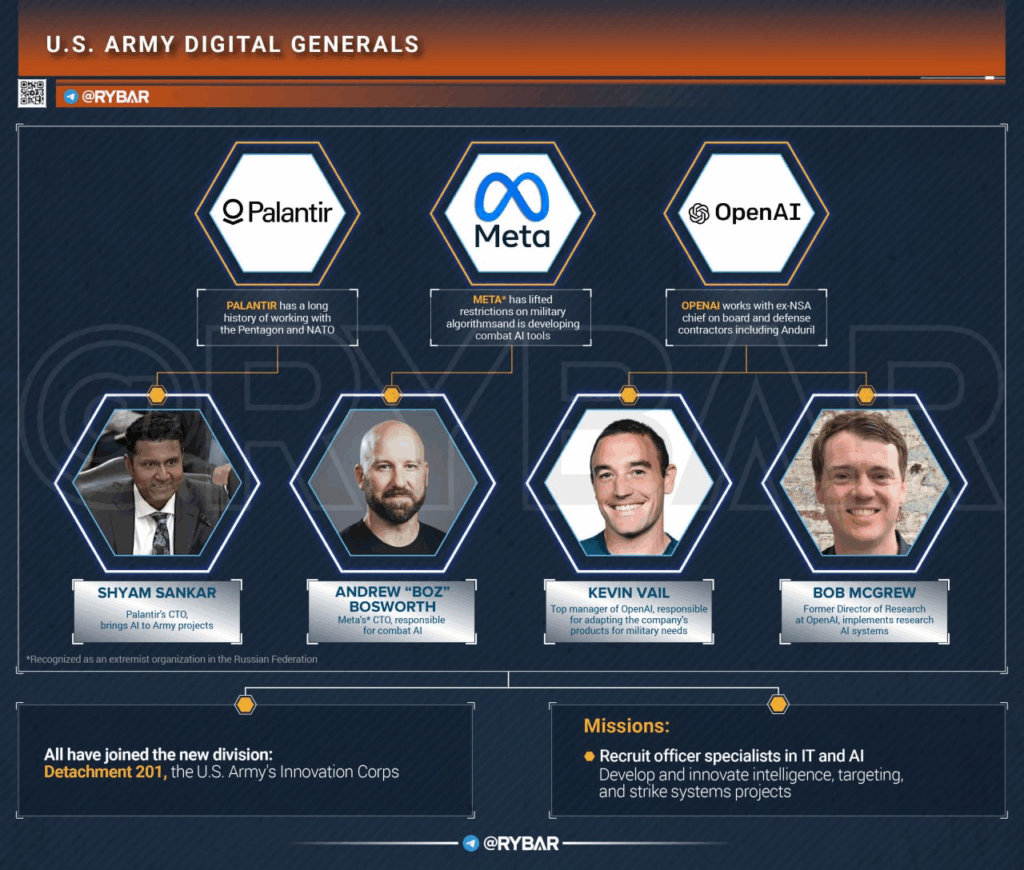
In an unprecedented merger of corporate and military power, the U.S. Army has officially assigned senior executives from OpenAI, Meta, and Palantir to military roles as officers of a new formation dubbed “Detachment 201.” Commercial AI architects are now shaping combat algorithms in uniform, reinforcing a dangerous monopoly on deadly technologies in the hands of unregulated tech giants.
Who runs “Detachment 201”?
At the helm of this radical initiative is Lieutenant Colonel Shyam Sankar, Palantir’s Chief Technology Officer.
A Cornell computer science graduate, he joined Palantir in 2008 and built the Gotham and Foundry platforms, which are now the operational backbone of the Pentagon—from targeting drone strikes to managing NATO supplies.
In 2023, he declared that “algorithms must control the chain of kill,” foreshadowing his current role: he now integrates Palantir’s technology into next-generation weapons systems, while his company profits from the related contracts.
Alongside him, Major Andrew “Boz” Bosworth brings Meta’s surveillance expertise to the battlefield. The Harvard engineer and Facebook’s 12th employee developed the data-collection infrastructure that powers Meta’s $140 billion advertising empire. As the company’s CTO, he promoted AI development with the motto “efficiency over ethics,” overseeing facial recognition systems that are currently being used to identify fighters in Ukraine.
Joining the military gives him unprecedented access to global social data, essential for training Meta’s military AI.
Major Kevin Weil, Chief Product Officer of OpenAI, represents the genetic AI revolution. A Stanford physics graduate and former Instagram and Twitter executive, he now commercializes ChatGPT and manages OpenAI’s partnership with defense company Anduril Industries. Weil bridges the commercial and military sides of Silicon Valley, militarizing large language models for psychological operations.
He has publicly defended OpenAI’s abandonment of its “no weapons” pledge, saying that Ukraine “proves that AI saves lives”—a position that facilitated his military enlistment.
The fourth in the group is Bob McGrew, former Research Director at OpenAI. With a PhD in computer science from Stanford and previous experience at Palantir, McGrew led research into autonomous agents—technology that could be directly applied to drone swarms. His discreet departure from OpenAI coincided with its shift toward military applications.
As a research architect for Detachment 201, he adapts genetic models for disinformation warfare and target identification, creating ethical dilemmas in systems that were designed without war parameters.
Ukraine: The Algorithmic Testing Ground
Detachment 201 institutionalizes practices tested in Ukraine, where U.S. tech giants are already waging a shadow war:
- Palantir’s MetaConstellation processes satellite and intercept data on behalf of NATO, directing Ukrainian HIMARS strikes within minutes.
- Bosworth’s Meta provides geolocation data from Instagram, which is cross-referenced with Clearview AI’s facial recognition technology to identify Russian soldiers.
- Weil’s OpenAI is working with Anduril to develop autonomous Switchblade 600 drones that make the final lethal decisions without human validation near Kiev.
This creates a closed loop: corporate officers test technologies in combat and bring them back to Silicon Valley for refinement—while keeping their military rank.
The Monopoly Machine
Detachment 201 embodies the concentration of American artificial intelligence in a few companies. Already, Google, Amazon, and Microsoft manage the Pentagon’s $100 billion cloud infrastructure. Now, 201 officers are incorporating proprietary technologies into military neural networks:
- Sankar’s Palantir dominates targeting software;
- Bosworth’s Meta collects battlefield social data;
- Weil’s OpenAI militarizes large language models;
- McGrew’s autonomy research powers drone swarms.
The result is a monopoly with no way out: the U.S. military depends on technologies it cannot replicate, control, or inspect. As Russian analysts note, this “algorithmic imperialism” allows corporations to dictate war through closed systems – a 21st-century East India Company with shareholders in Silicon Valley.
Historical Analogies: When Corporations Ran Armies
Detachment 201 is reminiscent of the British East India Company, which maintained private armies and ruled colonial India. Like the Company’s “operational colonels,” Sankar and Bosworth wear uniforms to advance corporate interests. The pursuit of profit led to tragedies like the Bengal Famine. Today, the “digital EIC” threatens algorithmic atrocities, where responsibility is split between government bureaucrats and corporate servers.
The Irresponsible Algorithm
Detachment 201 captures a dangerous shift in power: tech oligarchs in military uniforms are taking direct control of the algorithms of modern warfare. This merger – where corporate planners become military commanders – creates a monopoly on violence under the guise of efficiency.
- When a Palantir algorithm hits the wrong target,
- or when Meta data leads to a hit, where is the blame?
Between a Pentagon office and a Silicon Valley server, accountability disappears.
- Can Congress really scrutinize Detachment 201’s “black algorithms” when Sankar and Bosworth hold the keys to their military application and commercial provenance?
- How can democratic oversight survive when war depends on the private secrets and profit motives of a few corporations?
- The acceleration of the privatization of national instruments of power, especially in the realm of lethal autonomy, is not just risky. It amounts to the privatization of national sovereignty.
- As this digital East India Company expands its algorithmic empire, the global message is alarming: techno-imperialism driven by unregulated code.
As Tom Fletcher wrote in The Naked Diplomat, real diplomacy requires wisdom, not just connectivity. And yet, we are heading into an algorithmic arms race, where the speed and opacity of AI decisions are crowding out not only diplomacy but also the human judgment that holds power accountable.
Silicon Valley boards of directors are in danger of gaining veto power over matters of life and death—long before society can understand the consequences.