The central player in Israel’s war against Iran is the Persian Gulf – a player that could tip the balance of global security or trigger a world war. This scenario is precisely what Tehran has defined as its “strategic red line.”
Any development or tension in the Persian Gulf that threatens Iran’s interests will immediately escalate Israeli aggression from a regional conflict to a global crisis. On the morning of June 13, 2025, Israel launched a massive and unprecedented attack on targets inside Iran, sparking one of the most intense direct confrontations with the Islamic Republic, once again plunging West Asia into turmoil. Just one day later, on June 14, Iran retaliated with a barrage of ballistic missiles and attack drones that struck deep into occupied territories.
Tehran’s counterattack has not only shattered the region’s security assessments, but has also fundamentally changed the strategic thinking of global players. Now, as the war enters its fifth day, Iranian drones and missiles have swept across large areas of Israel, severely undermining the much-touted Iron Dome and other Israeli defense systems.
Amidst this devastation, the public remains focused on one urgent question:
- How – and when – will this war end?
- What possible scenarios are there for this military conflict?
Before answering that, it is necessary to review developments on the battlefield.
What was Israel’s ultimate goal?
Evidence on the ground and security analysis suggest that Israel’s goal was much greater than striking Iran’s nuclear facilities or military centers. Through a campaign of targeted assassinations and powerful strikes, the regime’s real goal was to paralyze Iran’s decision-making system with a massive psychological and structural shock.
Disorganizing senior officials, destabilizing the leadership, and causing a form of “strategic paralysis” were all part of this plan.
To achieve this, Israel invested months in preparing intelligence operations and waited for the right moment to deliver a devastating security blow. It exploited US diplomatic moves that created a false atmosphere of negotiations, allowing Tel Aviv to fully prepare for the attack – a signature move of hybrid warfare, combining intelligence, psychological warfare and conventional military action.
Despite the severity of these attacks, Iran launched a highly coordinated counterattack that included drones, missiles and cyberattacks. In just three days, hundreds of ballistic missiles and UAVs struck critical Israeli targets in Tel Aviv, Haifa and other key areas.
Advanced Israeli systems, such as the Iron Body and David’s Sling, failed to prevent significant damage. Tehran has made it clear that this was merely an “initial punishment” and has warned of much harsher responses if Israel – or any external power – dares to repeat or expand the aggression. At the same time, Iranian intelligence services have begun to uncover evidence of the Israeli spy network responsible for coordinating the attacks. Authorities believe that this network will soon be fully exposed, dismantled or neutralized.
Persian Gulf: Key to War or Global Stability?
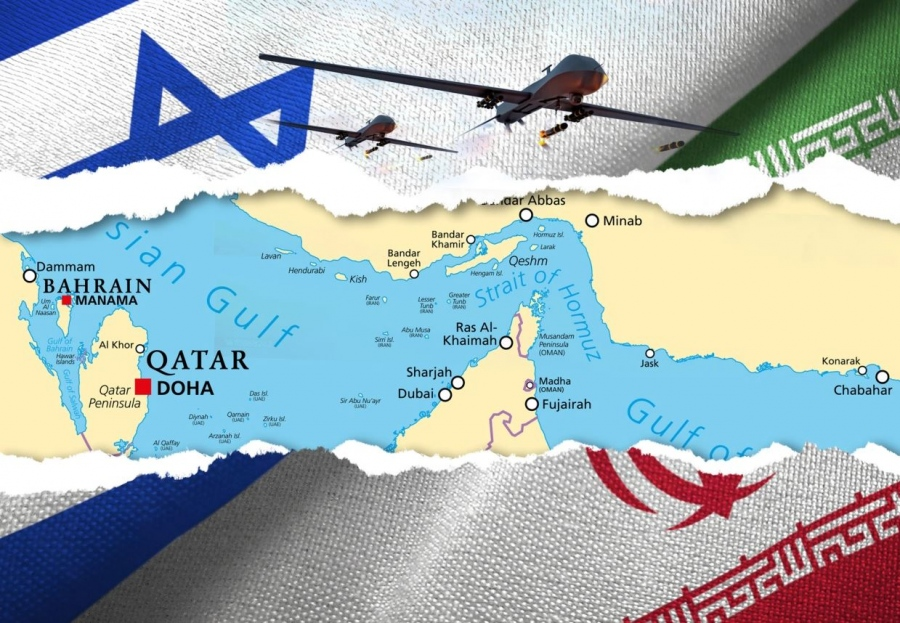
In this volatile environment, Israeli attacks on Iran’s energy infrastructure and southern ports, near the Persian Gulf, could dramatically change the nature of the conflict. One of the most important scenarios is the entry of the Persian Gulf into the military calculus. If Israel strikes Iranian interests in this region, the war will move to a new phase – with immediate consequences for global security. Disruptions to shipping and energy transport could escalate the conflict from a regional confrontation to a full-blown global crisis.
This is precisely what Iran recognizes as its strategic red line. As Iranian Foreign Minister Abbas Araghchi reminded foreign diplomats in Tehran, “any change in the Persian Gulf that endangers Iranian interests will immediately transform Israeli aggression from a regional incident into a global emergency.” The responsibility for such a dangerous scenario will lie solely with Israel.
Indeed, the Persian Gulf is the main axis around which Israel’s strategic plans – and global energy stability – revolve. This single factor could determine the future: security or disaster.
Predicting the Future: Scenarios in a Multi-Layered War
In contrast to traditional analyses that present isolated scenarios for the Iran-Israel conflict, the current dynamics on the battlefield show that the scenarios overlap and reinforce each other.
What we are witnessing is a multi-layered hybrid war, a complex puzzle that includes direct war, clashes with paramilitary forces, diplomatic pressure, and an underlying “cold peace” – all unfolding simultaneously. However, recognizing each scenario is crucial to understanding what lies ahead.
Hybrid Warfare as the Dominant Framework
The current level of hostilities clearly points to a hybrid warfare – constant cyberattacks, drone strikes, media attacks, and diplomatic maneuvers that steadily erode the stability of the region. This endless war of attrition has replaced traditional full-scale wars.
However, such a scenario is not sustainable, as Israel is well aware of Iran’s military capabilities and knows that it cannot withstand a prolonged high-intensity war.
Opening regional fronts to increase pressure
In a second scenario, Iran could mobilize its regional allies and open new fronts against Israel. Drone and missile attacks from Lebanon, Yemen, Iraq, or Syria would force Israel to fight on multiple fronts, exhausting its defenses and resources.
A fragile ceasefire over a battlefield
A third possibility involves international mediation that brings about a ceasefire—at least on the surface. However, such a ceasefire would likely be a tense lull or a “cold peace” rather than true stability. Beneath the diplomatic quiet, the fighting would continue in other forms.
Yet in all these scenarios, the great wild card remains the Persian Gulf – the ultimate disruptor or stabilizer. If Israel, supported by its Western allies, escalates its aggression in this critical region, it risks triggering a catastrophic scenario – not just for the Middle East, but for the entire world.
A New Regional Order in a Multi-Layered War
What is now emerging is a fluid and fierce new balance of power – a multi-layered cold/hot war where the lines between peace and conflict are constantly shifting. Regional and global actors can no longer rely on traditional frameworks to interpret or engage in this battlefield.
In this environment, strength-based strategies, constant readiness, and a deep understanding of both self and adversary capabilities will be crucial. The Persian Gulf, Israel, the Axis of Resistance, and the global energy market are no longer separate arenas – but interconnected pieces in a simultaneous, high-stakes game.