A major disruption to global energy supplies as a result of the closure of the Strait of Hormuz could cause a sharp and sustained rise in oil prices, further fueling inflationary pressures already weighing on consumers and businesses. In more detail:
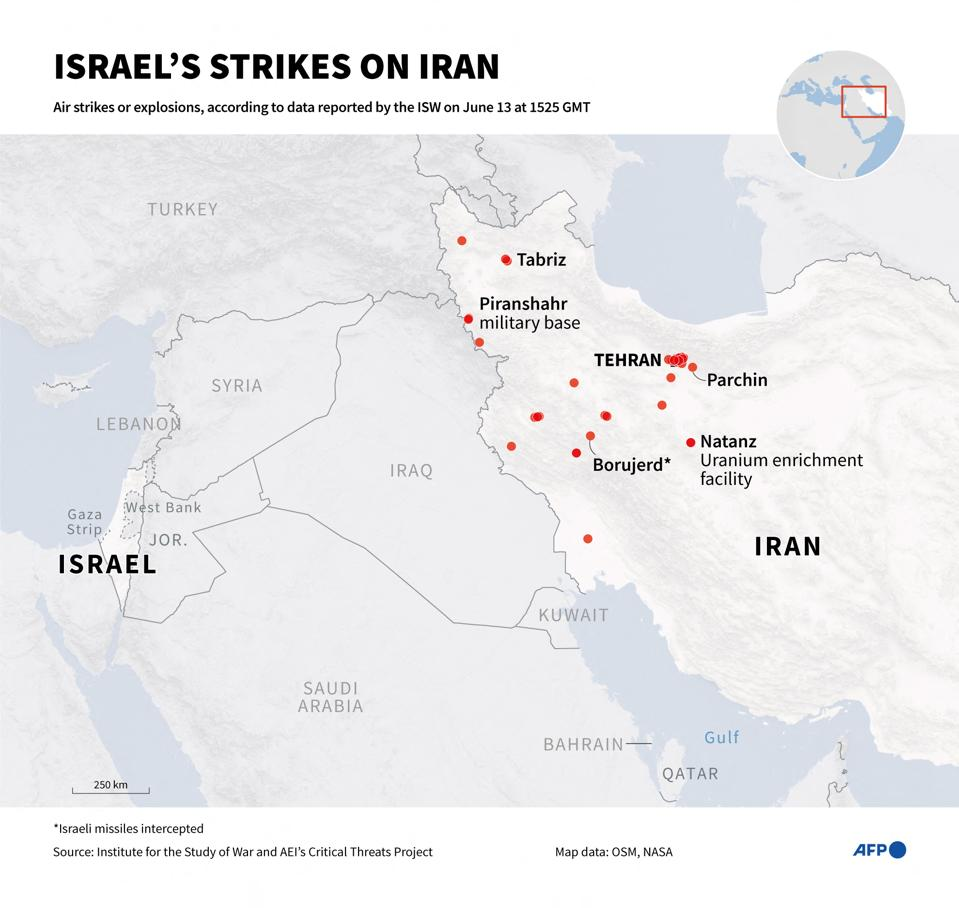
Israel’s attack on Iran on Friday, June 12, 2025, has catapulted their long-running conflict into what could become a broader, more dangerous regional war.
The geopolitical development could push prices higher for both businesses and households, stoking inflationary pressures.
Oil and gold rose and the dollar gained as markets fell, signaling a flight to safer assets. After years of high inflation in the wake of the COVID-19 pandemic, Americans are increasingly wary of the economic outlook this year due to President Donald Trump’s sweeping tariffs, although the impact has been limited so far.
Iran’s military strikes on Iran rattled global financial markets on Friday (13/6), raising concerns that Tehran could retaliate by targeting shipping through the Strait of Hormuz – one of the world’s most vital energy supply points.
If that happens, it could disrupt oil and gas supplies, potentially triggering a new wave of inflation around the world at a time when the fiscal positions of advanced economies have deteriorated.
What’s happening in the markets?
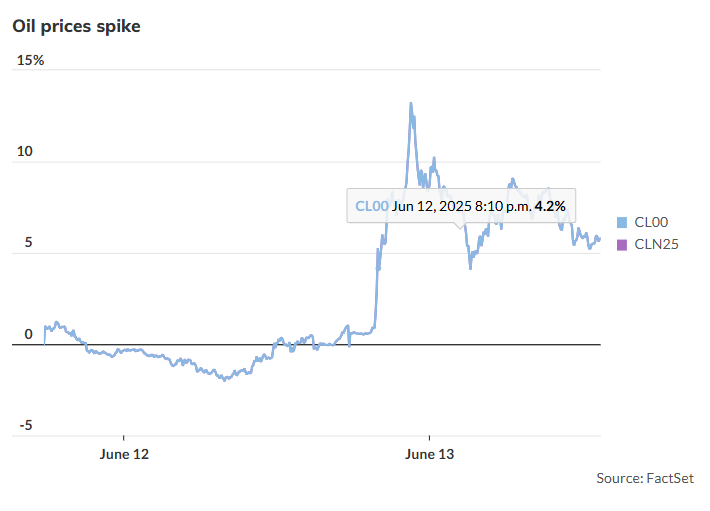
The main market concern is that Iran could close the Strait of Hormuz, a critical passageway for global oil and gas, Trust Economics reported. Oil prices rose as much as 14% overnight after Israel’s airstrikes on Iran, but both U.S. and global benchmarks recovered more than half of their gains on Friday (June 13).
The sharp rally also led U.S. and global crude oil benchmarks to their biggest daily percentage gains since March 2022, according to Dow Jones Market Data.
Of course, concerns about a new global energy crisis are just speculation at this point, especially given that past geopolitical flare-ups have often led to only short-lived increases in oil prices.
However, a significant disruption to global energy supplies as a result of the closure of the Strait of Hormuz could cause a sharp and sustained rise in oil prices, further fueling inflationary pressures already weighing on consumers and businesses.
Our comfort zone remains in an oil price range of $60 to $65 (per barrel) as continued gains in energy prices could have a huge impact on inflation, reversing the multi-month downward trend in U.S. consumer prices, Trust Economics reported.
The Strait of Hormuz, the waterway connecting the Persian Gulf to the Indian Ocean, carries about 20 million barrels of oil and petroleum products per day and 20% of the world’s supply of liquefied natural gas.
However, Iran has previously avoided closing the passage, possibly indicating a preference to avoid escalating the conflict “from hybrid warfare to all-out war.”
Iran would also “almost certainly incur significant costs,” noting that any attempt to close the strait would be perceived not only as a violation of international norms but, more critically, as a direct threat to the economic interests of most Gulf states, including their main customers in China, India, Japan, and South Korea.
In the event of a temporary halt in Iranian oil production, OPEC oil producers could choose to hedge. The US also has strategic oil reserves that it could choose to sell if the market starts to tighten too much.
The May CPI report released on Wednesday (11/6) showed that headline inflation eased to a lower-than-expected 2.4% last month from a year earlier, while core CPI, a more closely watched measure that strips out volatile food and energy costs, rose 2.8% year-on-year, also lower than expected.
US stocks finished sharply lower on Friday afternoon.
The Dow Jones Industrial Average DJIA -1.79% fell nearly 770 points, or 1.8%, to close near 42,197, for a weekly loss of 1.3%. The S&P 500 SPX -1.13% fell 1.1% on Friday, and the Nasdaq Composite
COMP -1.30% fell 1.3%, according to FactSet data.
Price Surge
Here’s a look at some of the sectors that could face a huge hit from the escalation in the Middle East and what that could mean for consumers.
Energy
Oil prices rose on Friday (June 11), posting their biggest gain since Russia’s war in Ukraine began more than three years ago. It’s not entirely clear if or when Israel’s attack on Iran could affect natural gas prices, which have been falling for nearly a year.
Iran is one of the world’s top oil producers, although sanctions from Western countries have curbed its sales. If a wider war breaks out, it could significantly slow or stop the flow of Iranian oil to its customers.
Energy prices have been under control this year because production has remained relatively high and demand has been low. A widening conflict could upset that balance.
The loss of that export supply would wipe out a surplus expected in the fourth quarter of this year.
In the past, Middle East conflicts have sent energy prices soaring for long periods, but in recent years, due to the vast oil supply, such spikes have been more fleeting.
Earlier this month, OPEC+ countries decided to increase production again, which often pushes crude prices down. They hit a four-year low in early May.
That usually means cheaper natural gas, of which there is currently a surplus. The average price for a gallon of gasoline in the U.S. on Friday was $3.13 a gallon, down from $3.46 a year ago.
Shipping costs
Shipping costs were already on the rise for a number of reasons. Chains of trade are being rerouted around the Red Sea, where the U.S. has begun airstrikes on Yemen’s Houthis, the Iran-backed rebels who have been attacking ships on a vital global trade route.
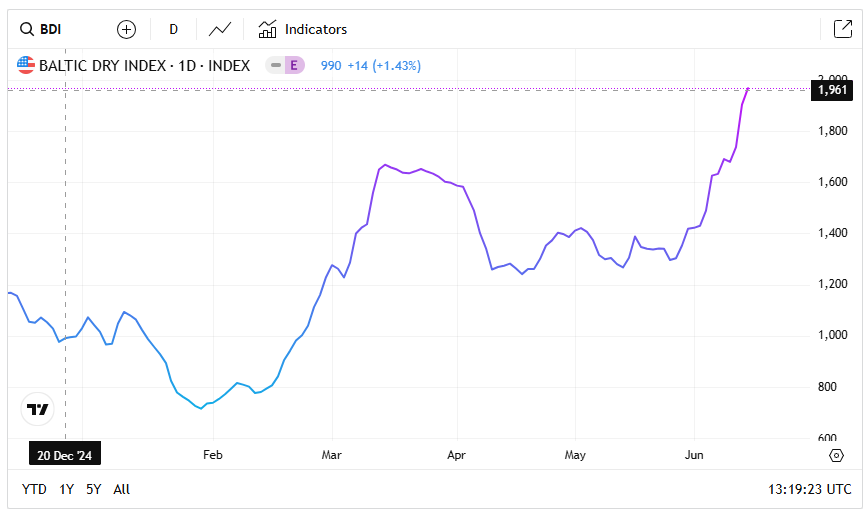
And this year, companies have rushed to import as many goods as possible before Trump’s tariffs kick in, pushing demand and ship prices higher. Baltic Dry, a key gauge of demand for dry bulk cargoes that tracks the movement of oil, iron ore, grain and more, hit an eight-month high.
The window of opportunity for companies looking to ship goods before the end of the year at lower rates is coming to an end this month. A widening conflict in the Middle East would only lead to higher prices as these companies struggle to source goods from abroad as geopolitical tensions in the region rise.
Shares of shipping companies such as Teekay and Frontline surged after the Israeli attack.
Consumer Goods
Higher energy prices can lead to increased costs for a wide range of products because almost everything is manufactured and transported using oil or natural gas.
Government data this week revealed that Trump’s tariffs have not yet caused a broader increase in inflation. However, many companies have announced price increases. Walmart has already raised prices on some products and said it will do so again as the back-to-school shopping season begins.
J.M. Smucker, largely due to the impact of tariffs on coffee from Brazil and Vietnam, said it has also raised prices and will do so again.
Combined with higher shipping and production costs that could result from an escalation of the conflict in the Middle East, prices are almost certain to rise further.
Federal Reserve – Brake on Rate Cuts
Federal Reserve officials meet next week to make their next interest rate decision, and the vast majority of economists still believe the U.S. central bank will leave its key interest rate where it is for the fourth consecutive time.
The Fed has been managing its dual mandate of supporting the labor market while keeping inflation low. That goal could become increasingly difficult to achieve if the prices of gas, food and other basic goods rise due to the Israel-Iran conflict.
If prices rise, Fed officials may be willing to raise its key interest rate, raising the cost of borrowing for businesses and consumers.
That could lead businesses to cut jobs, especially in the high-growth technology sector, and force Americans to cut spending, which drives more than 70% of U.S. economic activity.
Technology and retail stocks were among the biggest decliners on Friday.
Travel
Perhaps contrary to popular belief, a knock-on effect of heightened tension in the Middle East could be that travel costs, even if fuel prices fall, will rise.
Airlines are downgrading their travel forecasts as businesses and families cut travel budgets in anticipation of tariff-related price increases.
Several major aviation disasters have also made some wary of flying.
Most major U.S. airlines have said they plan to reduce scheduled domestic flights this summer, citing a drop in economy-class bookings for leisure travel.
Last month, Bank of America reported that its credit card customers were spending less on flights and lodging. And because of the tariff war with Trump, the dollar has fallen nearly 10% this year against a basket of foreign currencies, making overseas travel more expensive for Americans due to unfavorable exchange rates.
Shares of major U.S. airlines fell sharply on Friday.
Geopolitical Turbulence
Market participants have long warned that Iran could respond to any conflict by threatening to close the Strait of Hormuz to tanker traffic.
That threat has never been very serious and has become less credible over time. Israel and the United States have increasingly maintained and demonstrated their dominance in terms of escalation over Iran.
Theoretically, Iran could stop tanker traffic in the Strait of Hormuz for a short period of time by attacking or threatening ships passing through the narrow waters at the entrance to the Persian Gulf.
But the more likely response is that the United States and its allies would organize an armed escort system with U.S. and allied warships to escort the tankers.
Once the convoys are in place, an attack would bring Iran into direct conflict with the United States—a conflict that Iran’s leaders have made clear they want to avoid given their past behavior.
The U.S. warning of ships in the area on June 11 before Israel’s attack on Iran on June 13 has significantly reduced the risk of immediate retaliation, clearing the area of all but essential ships and ensuring that the remaining ships are on high alert.
The United States has also sought to discourage a direct Iranian attack on tanker traffic by partially distancing itself from Israel’s military operation.
The United States has created some diplomatic space for Iran to respond directly to Israel while avoiding attacks on tanker traffic that would risk drawing Israel’s Western allies into open conflict with Iran. It is a diplomatic fiction, but a potentially useful one, and the United States may hope that Iran’s risk-averse leaders are willing to accept it.
For similar reasons, Saudi Arabia has condemned Israel’s attack on Iran, seeking to protect its own oil facilities and exports from Iranian retaliation. Given their risk aversion and current isolation, Iran’s government and military are unlikely to renounce this rhetorical support by attacking tankers carrying crude oil from Saudi Arabia or any other Gulf producer.
Theoretically, Iran’s top leaders could escalate the conflict by temporarily blocking the Strait of Hormuz, causing a sharp rise in oil prices, and hoping that the resulting threat of severe economic damage would force the United States and its allies to restrain Israel and make concessions. But such a high-risk escalation strategy would be out of character and seems unlikely for now unless top leaders in Iran conclude that their survival is threatened.