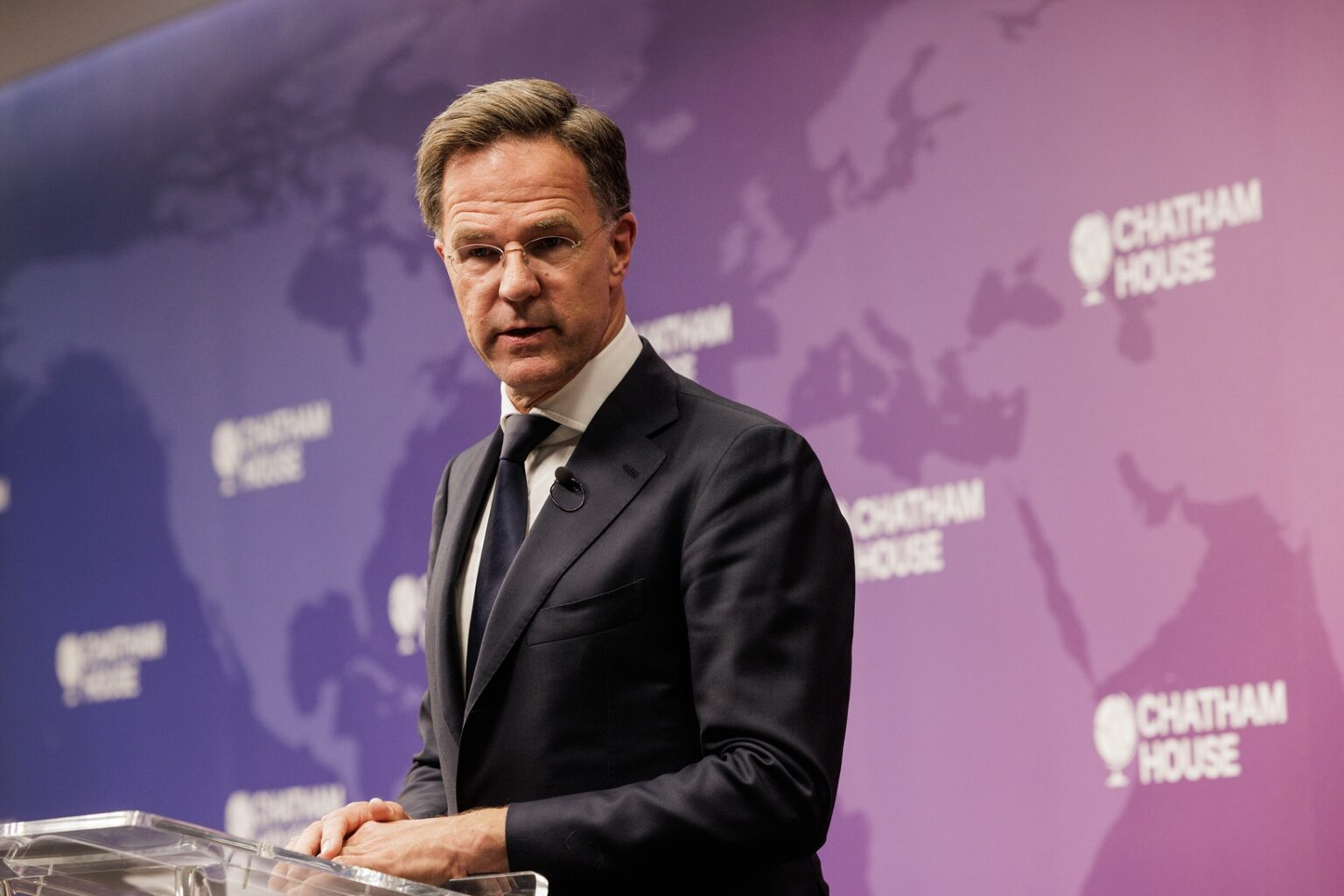
NATO Secretary General Mark Rutte gave a speech at the well-known British think-tank, Chatham House, in which he made a series of ominous predictions about the possible military confrontation between Russia and the Alliance, emphasizing the need for rapid and costly rearmament of all member states.
Here is a summary of his speech, with our own comments:
- “In two weeks, I will chair the NATO Summit in The Hague, which will transform our Alliance, making it stronger, fairer and more lethal, to keep our people safe and our adversaries at bay.
- The return of war to Europe because of Russia, the threat of terrorism and intense global competition demand a stronger Alliance. Russia is working with China, North Korea and Iran to strengthen their military capabilities.
- Putin’s war machine is accelerating, with Russia producing weapons faster than expected, including 1,500 tanks, 3,000 armoured vehicles and 200 Iskander missiles this year. Russia is producing in a quarter what we produce in a year.
- Within five years, Russia could be ready to use military force against NATO. New Russian missiles, traveling at speeds multiples of the speed of sound, are reducing the distances between European capitals to a matter of minutes. There is no longer East or West, only NATO.
- China is also rapidly modernizing and expanding its military, already boasting the world’s largest navy, with plans for 435 ships and over 1,000 nuclear warheads by 2030.
- Those who oppose freedom and democracy are preparing for a long confrontation. As Winston Churchill said in 1936, the question is whether we will have time to organize our defenses or whether it will be “too late.” History teaches us that to keep peace, we must prepare for war. Hope is not a strategy.
- At the Hague Summit, Allied leaders are expected to agree in defence spending of 5% of GDP, a decisive step for NATO. 3.5% will be invested in basic military needs, while the rest in infrastructure and industrial capacity. This increase is based on hard data: we need more forces and capabilities to fully implement our defence plans.
- NATO Defence Ministers recently agreed on ambitious targets, including a 400% increase in air and missile defence, thousands of additional armoured vehicles and millions of artillery shells. Allies will invest in more ships, fighter jets (such as 700 F-35s), drones, missile systems, as well as space and cyber capabilities.
- In addition to military investment, infrastructure such as roads, railways and ports will be strengthened to support military mobility. Political preparedness and protection from cyberattacks and other threats are also priorities. Increasing defence production is crucial, as the Alliance is not producing enough.
- We need cheaper energy, access to critical minerals and more know-how. The Summit will send a clear message to industry to match our ambitions, promoting innovation and the adoption of new technologies, such as drones, which are proving their effectiveness in Ukraine.
- NATO will become fairer, with each Ally contributing its fair share, reducing the burden borne by the US. It will also become more lethal, strengthening its deterrent and defensive posture, showing that we are ready to respond tough to any threat. We continue to support Ukraine, not to prolong the war, but to help it defend itself and deter future attacks.
- The commitment of all Allies to Article 5 sends a strong message: we will defend against any threat. At The Hague, in the spirit of Churchill, we will strengthen our Alliance for the security of a billion people, securing peace through strength.”
Essentially, with his speech, Rutte attempts to justify both the increase in defense spending proposed as a new common NATO goal, namely 5% of GDP annually, and the threat that “produces” this need, as well as the internal transformation of the alliance, which can no longer, in the European field, rely on American support and the massive deployment of troops and resources.
Regardless of whether one agrees with him, Rutte describes a general sense of geostrategic threat that dominates many NATO countries, mainly in Eastern and Central Europe, which is accentuated by Russia’s ongoing invasion and advance in Ukraine. A move that surprised NATO as an alliance of countries (which found itself militarily unprepared and geopolitically unprepared to manage the change in balance), while the situation has been complicated by Trump’s radical introversion, which is forcing the US to partially withdraw from Europe, at the same time as a large-scale war and a significant change in borders are taking place there.
Whether the large defense expenditures, European rearmament and the change in policy will be implemented, along with the necessary mobilization, is primarily a political issue and not so much an issue of industry and infrastructure. As the political landscape of Europe is highly diverse, with the rise of conservative and also introverted political formations, with a strong nationalist and even far-right overtones, while a significant part of society is affected by economic insecurity, the feeling of political and cultural impasse, as well as by a vast and misinformation-filled communication landscape. In other words, issues that “simple” decisions by Ministers of Defense/Foreign Affairs to increase armaments cannot resolve.