



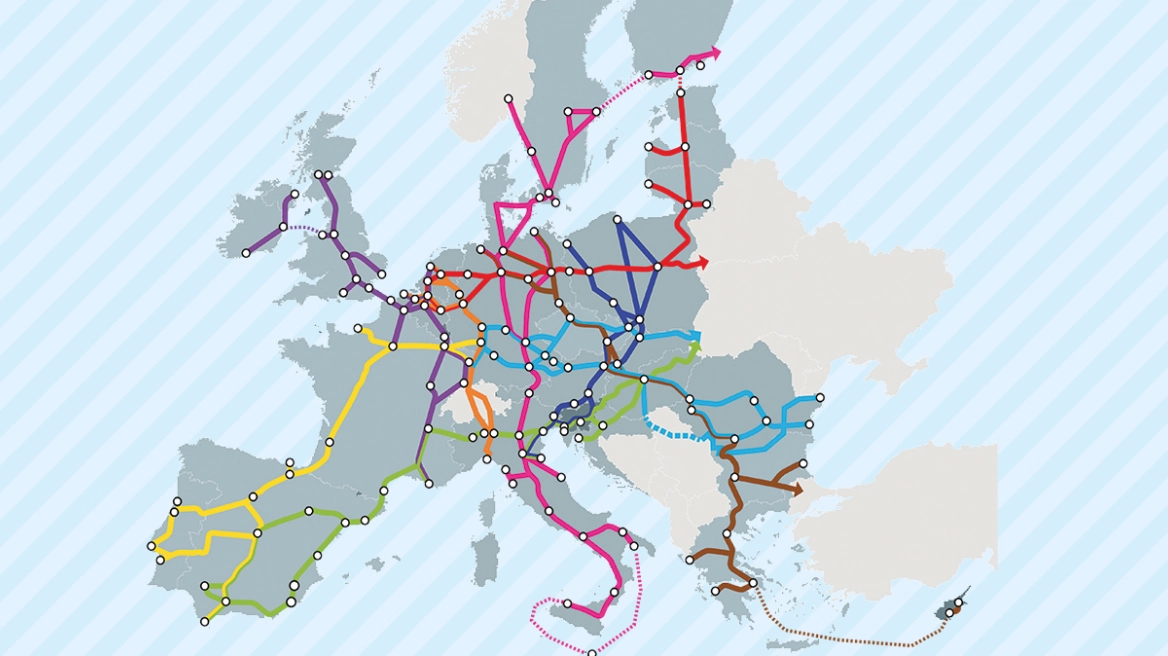
Funds of 200 billion euros are expected to be directed by 2030 to infrastructure projects in the EU, in order to meet the needs of military mobility: the rapid and seamless movement of military personnel, equipment and means within and outside the European Union. The specific infrastructures, which are inextricably linked to the Trans-European Transport Network (TEN-T), serve military purposes and strengthen European defense, but have a dual use, since they will mainly be used by civilians.
Military mobility, which has been included in the EU White Paper on Defense, has become more urgent after the start of the war in Ukraine. Funds of 1.7 billion euros have already been allocated for 95 projects in 21 EU countries, while NATO has now also been involved in the planning of the projects, given that 23 EU countries They are also members of the Alliance.
Vital
The Trans-European Transport Network is not only important for connecting people and businesses. It is also vital for Europe’s defence, security and military preparedness. The action plan already underway up to 2026 is designed to ensure that EU transport infrastructure can withstand the weight and scale of military movements, including fuel supply.
In the planning of the projects with a first milestone in 2030, sections of military importance within the trans-European transport network have already been identified, which require an upgrade to military needs, as a priority. Essentially, in cooperation with NATO, four military mobility corridors have been created, within which a list of 500 hot spots has been drawn up for infrastructure that serves both civilian and military use.
According to information, the exact location of the corridors, for obvious reasons, is not made public. The list of 500 points has been drawn up with the contribution of the Ministries of Defense and Transport of the EU member states and after consultations with NATO.
The projects planned in these 500 hotspots are dual-use infrastructures and involve either the construction of new infrastructure projects or the upgrading of existing ones, including, for example, the reinforcement of road and rail bridges, the expansion of port infrastructure, the widening of tunnels.
The EU is still far from a well-connected and resilient dual-use transport network, civil and military, that meets its needs. Future investments need to be more targeted and significantly increased.
The White Paper on the Future of European Defence, together with its financial pillar, the ReArm Europe Plan/Readiness 2030, outlines the new approach to European defence and investment and underlines the importance of military mobility. The EU has already created four military mobility corridors, in close cooperation with NATO. The projects concern dual-use infrastructure, which means that they will have benefits not only for military mobility, but for all European citizens. EU investments are not only about roads, but also about rail and ports. In order to make these projects happen, funding for military mobility must urgently be increased in both the current and the next Multiannual Financial Framework.
Simultaneous coverage
According to the plan, along the four military mobility corridors, all transport infrastructure should simultaneously cover both civilian and military needs. For example, railways, as described in the White Paper on Defence, should provide priority access to the Armed Forces in times of crisis.
However, the exact budget and detailed planning are expected to be announced during the summer or in September at the latest. The projects will be financed with European and national funds, as well as with synergies with the private sector, since these are projects that will primarily be used by civilians.
It is noted that the military mobility projects are coming to “fit” into the large Trans-European Networks (TEN-T) program that is already underway and concerns all European transport networks in the European Union. By 2030, the core network (road, rail, airports and ports) should be completed and by 2040, the smaller European cities should be connected.
The cost of completing the central and regional TEN-T network is estimated at almost 850 billion euros from now to 2040. The impact on transport with the completion of the projects will be enormous. For example, the completion of the Lyon-Turin tunnel will reduce travel time by two hours, while the Baltic-Aegean axis is also included in the same program.
It is important to harmonize EU infrastructure and strengthen it so that in the event of war, the EU as a single space can now face threats. It is the basis for the creation of a common army and a common understanding of EU borders. It is the goal of many states for so many years.


