




Subjected for a time to the Avars, the Lombards moved in the mid-6th century AD from the lower Danube valley to Italy, which they invaded and conquered most of, establishing about ten states. There they clashed with the Byzantines, the Franks and the Normans. By 1076 the Lombard states had disappeared. Only the name of the former conquerors remained, which “renamed” Northern Italy.
Subjected for a time to the Avars, the Lombards moved in the mid-6th century AD from the lower Danube valley to Italy, which they invaded and conquered most of it, founding about ten states. There they clashed with the Byzantines, the Franks and the Normans. By 1076 the Lombard states had disappeared. Only the name of the former conquerors remained, which “renamed” Northern Italy.
The main source for the History of the Lombards is the work of Paul the Deacon “The History of the Lombards”, written in the 8th century AD and based on the work “The Origin of the Lombard People” (7th century), by an unknown author. The Lombards came from Scandinavia, from where in the 1st century AD they began to migrate to Central and Eastern Europe.
Initially they were called “Vinili”, but the name “Lombards” prevailed, due to the large beards they wore.
At the time of this migratory flow, men, women and children arrived on foot to the shores of the Baltic. There they were divided into two groups. Some marched towards Gaul and others, led by the brothers Ibor and Aio and their mother Gambara, settled at the mouth of the Elbe River.
The Vandals were already living in this area, who demanded that the newly arrived people pay a tribute.
The Viniles refused, and prepared to settle the dispute with arms. However, because they were much fewer than the Vandals, Gambara ordered the women to tie their long hair in front of their faces, to resemble beards and to side with the men.
The Vandals, when they saw a large crowd of opponents, were afraid to fight.
They were also greatly impressed by the length of the beards of their opponents, whom they called “long-bearded” (Latinized: “Longbards” and then “Lombards”). According to newer versions, however, their name comes from a nickname of their god, Odin.
The Lombards settled and remained in the region for at least two centuries, as archaeological evidence attests.
Testimonies about this people exist in Strabo’s “Geographica” and Tacitus’ “History”.
The first mention of them, however, was made during the reign of Octavian Augustus, shortly after the defeat of the Roman legions in the Teutonic Forest, when the Romans in retaliation carried out a series of campaigns in Germany.
At that time, the Lombards had been subject to the king of the Marcomanns, but they rebelled and fought with the army of the Cherusci, under the national hero of the Germans Herman (the Arminius of the Romans). Thus, they gained their independence.
In the middle of the 2nd century AD, according to the descriptions of Ptolemy, a branch of them moved again towards Gaul. Another small part (about 6,000 men, according to Cassius Dio) invaded the Roman province of Pannonia (present-day Southern Hungary) for the first time, but was repulsed and retreated.
The historian Tacitus mentions in his work “Germania” that the Lombards were a small people who survived alongside other large tribes, thanks to their warlike nature. Nevertheless, towards the end of the 2nd century AD, they could not avoid being subjugated by the powerful Saxons.
At that time, powerful rulers managed to unite many German tribes with weapons, forming broader “national” groups, such as that of the Franks or the Saxons. Their subjugation to the Saxons was completed in about a century. At the beginning of the 4th century AD, led by their king Agelmund, the Lombards again abandoned their homes and moved south, towards the Oder valley.
They had to fight battles with other tribes many times. They eventually settled in northern Pannonia, where they were later subjugated by the Huns. After Attila’s death, the Lombards revolted and were freed, but shortly afterwards they were subjugated by the Avars of Hunnic origin.
Italy
To escape the oppression of the Avars, the Lombards decided to emigrate again. This decision was also influenced by the emperor Justinian, who wanted to use them as a lever of pressure against the dangerous Gepids.
The Gepids were another Germanic tribe that had settled in northern Illyricum (present-day Slovenia and Croatia) and from there harassed the Byzantine lands.
Also, Justinian, who planned to reclaim Italy from the Goths, intended to use the Lombards as mercenaries in this war. Their king Audinius accepted Justinian’s proposals and successfully fought the Gepids on behalf of Byzantium.
Byzantine emperors were accustomed, and indeed successful, in turning one barbarian people against another, applying the Roman “divide and rule”. Later, during the war against the Ostrogoths of Italy, the great Byzantine general Narses recruited a large number of Lombards. In the great Battle of Taghini, in 552 AD, at least 5,500 Lombards fought with the Byzantines against their fellow Goths. The same thing was repeated in subsequent battles.
In 565 AD, however, the Byzantine ally King Audinius died and was succeeded by Albinus. The new king, within three years, managed to subjugate all the surrounding barbarian tribes, Saxon, Bavarian, Gepid and Bulgarian. In 568 AD, at the head of about 500,000 men, he moved from Pannonia towards rich Italy, which he had come to know as a Byzantine mercenary.
The hordes of the Lombards and their vassals crossed the Julian Alps and found themselves in northern Italy, in the fertile Po valley.
The Byzantines did not have serious forces to react to an invasion of such magnitude. Besides, at that time they were fighting against the Sassanid Persians in the East and against the first Slavs in the Balkans. Distant Italy de facto took a back seat.
The Lombards, early in 569, conquered the first Italian city, Friuli, where they established the seat of the first Lombard duchy of Italy. By the summer of 569, the invaders had conquered Vicenza, Verona, Brescia and Milan.
Constantinople reacted by sending a new exarch to Italy, Longinus, but not troops. Thus, Longinus, unable to react, withdrew the small Byzantine garrisons from Northern Italy, trying to cover the area around Ravenna, being supplied by the Byzantine fleet.
The important city of Pavia was besieged for three years. Finally, it surrendered in 572, and became the capital of the Kingdom of Albin. Then, the Lombards moved further south and conquered much of Tuscany, establishing two more duchies, notably those of Spoleto and Venevento.
The Byzantines maintained control of the Ravenna area and Rome
Essentially three Lombard states were established, the Lombard kingdom in the North and the two semi-independent duchies in the South. Even the Northern Kingdom, however, was administratively fragmented.

The king divided his land among his generals (dukes), who in turn established feudal states within the kingdom. Thus, duchies were formed in the areas of Friuli, Cenenda, Vicenza, Verona, Trento, Brescia, Bergamo, San Giulio, Pavia, Turin, Asti and Tustia. Each duke was essentially independent, and only loose ties of dependence existed with the respective king who also bore the title of Duke of Pavia.
Albuinus attempted to contain these centrifugal tendencies. However, he failed and was murdered by the nobles, with whom his wife had even colluded, who fled to Ravenna after the murder. Albin was succeeded by one of the dukes, Cleves, who was also assassinated after a reign of 18 months.
A period of anarchy followed, the so-called period of the “rule of the dukes”, during which there was no king. This period lasted about ten years, and was similarly exploited by the great Greek emperor Maurice, who strengthened the Byzantine possessions in Italy, with whatever forces he could spare from other fronts.
An important ally of Byzantium was also the Pope of Rome. A part of the Lombards were pagans, while the rest were heretical Christians, followers of Arius.
In 584, as there were fears of a Frankish invasion, the Lombard dukes managed to make peace and elect a new king, the son of the murdered Cleves, Autharius. The latter, in 589, married the daughter of the Bavarian duke Garibaldi I, Theodelinda, thus gaining an ally against the dangerous Franks.
Theodelinda was an Orthodox Christian, and soon developed relations with Pope Gregory I. The pope, through the new queen, sought the conversion of the Lombards to Orthodoxy, believing that this would make them less of a threat to him and the empire. It is also known that the policy of religious diplomacy was widespread in Byzantium.
Autharis allowed the mission, wishing to neutralize the emerging Byzantine-Frankish rapprochement and at the same time tried and succeeded in limiting the power of the nobles.
Autharis, who died in 590, was succeeded by the powerful duke of Turin, Aiulfus, who married his predecessor’s widow and continued his religious policy. Subsequently, probably with Byzantine instigation, powerful dukes rebelled against the new king.
Aiulfus reacted quickly and after two years of fighting defeated the rebels and their Byzantine allies and imposed his terms.
Meanwhile, in Constantinople, the emperor Maurice had been assassinated, and the usurper Phocas who ascended the throne was more interested in maintaining power than in the integrity of the state.
When Aiulf died, power passed to Theodelina, who ruled alone until 628. She was succeeded by the orthodox Atloald, who was, however, dethroned by the Arianist Ariald, who was succeeded by Rotarius, one of the most powerful Lombard kings. During this period, the first serious rift had developed in the relations between Constantinople and Rome.
Emperor Heraclius and his successor Constans, in order to ally the Monothelite populations of Egypt and Palestine, who were threatened by the new rising power of the Arabs, attempted to reconcile the two states, deviating from orthodoxy.
It was the pope who reacted at that time, and was even captured by Byzantine troops and exiled to Crimea, where he died of hardship.
Thus, the trust between the emperor and the pope was lost and the head of the Catholic Church, unable to rely on imperial power, began to ally himself with the Lombard rulers.
Fortunately for Byzantium, new civil wars soon broke out between the Lombard rulers, which breathed life into the Byzantine possessions and weakened the Lombards.
Nevertheless, the Lombards managed to repel the emperor Constans, who attempted to recapture part of the southern Lombard possessions, as well as the first serious attempts at invasion by the Franks.
Triumph and fall
In 680, the Lombards and Byzantines concluded a peace treaty lasting 40 years. In 712, however, a new ruler ascended the Lombard throne, subduing the troublesome nobles and forming a centralized state for the first time. It was Liutprand, who initially brought the independent duchies of Spoleto and Venevento under his rule.
Then, taking advantage of a new conflict between the pope and the Byzantine emperor, this time over the veneration of icons, he attacked the Byzantine possessions, with the blessings of the head of the Catholic Church, and then attacked the pope with the assistance of the Byzantines.
At this point it should be mentioned that Pope Gregory II supported the Orthodox positions against the heretical views of Emperor Leo the Isaurian, regarding the issue of the veneration of icons. Reacting in an undiplomatic manner, the Byzantine emperor (together with his successor Constantine V) punished the pope, removing the provinces of Illyricum and Southern Italy from the ecclesiastical jurisdiction of Rome.
This policy had fatal consequences for the Byzantine presence in Italy. The pope, having no allies, was forced to turn to the powerful king of the Lombards, who conquered almost all the territories of the Byzantine exarchate of Ravenna, except for the homonymous city and a few other smaller ones.
He also conquered the Duchy of Rome, a political unit of the exarchate, which was ruled by the pope at the time. In return, he brought the pope and the church under his auspices.
The powerful Liutprand also allied with the Franks and helped their king Charles Martel defeat the Arabs in the famous Battle of Poitiers. His death, in 744, found the Lombard kingdom at the height of its power, controlling almost the entire Italian peninsula, except for a few Byzantine bridgeheads, mainly in the south.
His nephew and successor, Childeprand, was not as dynamic, and was soon dethroned. He was succeeded by the Duke of Friuli, Rachis, who also failed to contain the opposing forces within the kingdom and in 749 he abdicated and became a monk.
The warlike Aistulf, who succeeded Rachis, was supported by the nobles on the condition that he would definitively dissolve the Exarchate of Ravenna. And indeed he succeeded. On July 4, 751, Ravenna surrendered, since the iconoclastic inhabitants and rulers did not agree to fight for the sake of the iconoclastic emperors of Constantinople.
Nevertheless, the pope reacted and called for help from the Franks. The king of the latter, Pepin III, invaded Italy, defeated the Lombards, and forced them to abandon Ravenna, which surrendered to the Byzantines again.
Soon, however, Aistulf’s successor, the Duke of Tuscany Desiderius, definitively captured Ravenna. This was the end of the Byzantine presence in Upper Italy.
To take revenge on the pope, the new Lombard king attacked Rome and captured it in 772. Pope Adrian I then called for help from the new Frankish king Charles, who was to go down in history as Charlemagne, and to begin the war against the Byzantine Empire, laying the foundations of the schism between East and West.
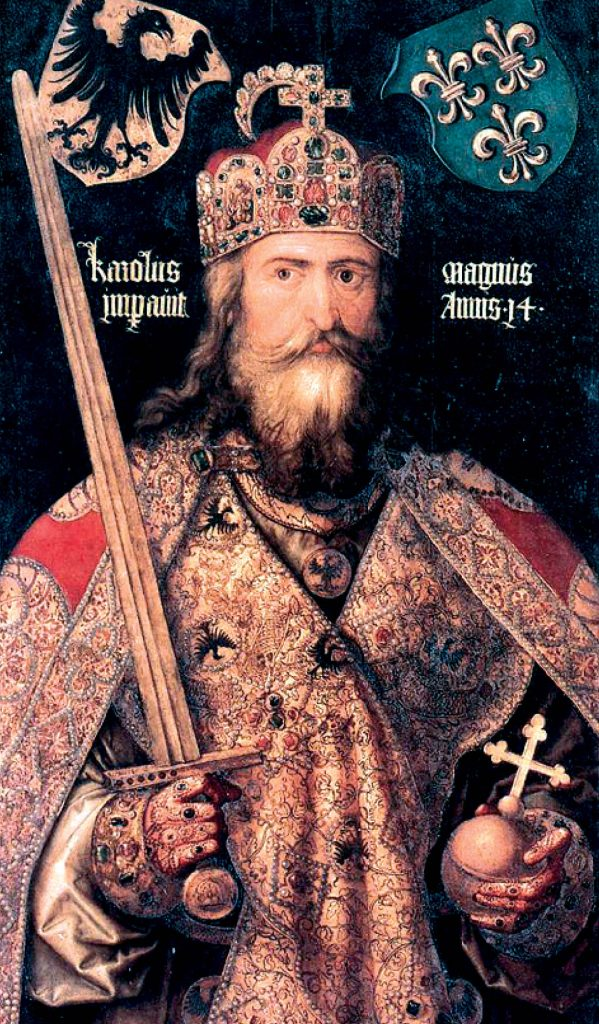
Charlemagne did not let the opportunity offered to him go to waste. At the head of a powerful army, he invaded Italy through the great pass of St. Bernard. Desiderius had taken care to fortify the exit of the pass, and there he awaited the Franks.
Charlemagne, however, sent a strong detachment through another pass, which appeared in the rear of the Lombards. The latter, together with their king, fled and closed in on the well-fortified Pavia. There they were besieged by a Frankish body.
At the same time, Charlemagne with the bulk of his forces moved towards Verona, which was guarded by the son of the Lombard king, Adelchius, who, however, at the sight of the Frankish troops, abandoned the city and the royal treasures kept there and fled to Constantinople.
Desiderius was closely besieged in Pavia, while none of his dukes assisted him. All of them submitted peacefully to Charlemagne. After ten months of resistance, Desiderius was forced to surrender.
In 774 the Lombard kingdom was officially dissolved and incorporated into Charlemagne’s empire.
A part of its land, however, was given to the pope, who founded the state of St. Peter’s Basilica, the present-day Vatican City, which at that time had Rome as its capital, and covered a large part of Tuscany and the territories of the former Byzantine exarchate of Ravenna.
Thus, the pope, in addition to being a spiritual, also became a secular ruler, a fact with enormous consequences for subsequent European history.
Charlemagne treated the Lombards with diplomacy. He let them govern themselves with their own laws, he did not question the authority of the nobles, and he even crowned himself king of the Lombards, with the famous iron crown of Lombardy.
The Lombard duchies
The kingdom of the Lombards was subjugated to the Franks, but the duchy of Venevento continued to operate independently. Theoretically it was under the suzerainty of the Frankish king, but in practice it was independent. It remained so for another century. In 839, however, a new civil war broke out that lasted ten years and resulted in the division of the duchy. Two Lombard states were then created, the duchies of Venedig and Salerno.
Divided, as usual, the Lombards were unable to face the Arab raids, and were saved thanks to the intervention of the Frankish emperor Louis. In the meantime, the duchy of Salerno, after a new civil war, was cut in two and a new state was created, the principality of Capua.
Throughout the 10th century, the Lombards fought among themselves, weakening their forces and preparing the rise of a new powerful power, the Normans. Taking advantage of this weakening, the pope and Byzantium began to occupy areas of the Duchy of Venedig.
In the 11th century the Normans arrived, who gradually destroyed all the Lombard states and imposed their rule. From 1098, when Capua fell, the Lombards ceased to exist. Only the name “Lombardy” remained, by which northern Italy is known to this day.
The Lombard conquest of Italy was a long process, which lasted about two centuries and its result was reversed as soon as it was completed. Nevertheless, the Lombards left behind strong roots, culturally and ethnologically differentiating the two parts of Italy into a German-dominated North and a Greek-dominated South.
This differentiation still exists today at the political level, as there is no shortage of voices in the neighboring country about the secession of the North from the underdeveloped South. The Lombards, of course, did not bring a higher civilization to Italy, because they simply did not have a higher civilization. However, they gave the tired Italian society of the 6th century a new vigor, a new dynamic that had been deprived of the Great Migration of Peoples of the 5th century.
The Lombard Army
The Lombards, like all ancient Germans, initially had a very “bad relationship” with the horse. They did not have cavalry, and this made them easy prey for the excellent horsemen of the Huns and Avars.
It was precisely their contact with these peoples that transformed the Germanic tribes into an army of elite horsemen.
At the time of the invasion of Italy, the Lombard army, feudal in its structure, with each lord gathering around him the warriors of his house, consisted of 2/3 cavalry and only 1/3 infantry. However, the infantry had abandoned the traditional German weapons (spear, shield, axe) and fought as archers, equipped with powerful compound bows.
The cavalry was distinguished into two categories, the noble Gastaldi and the followers. The Gastaldi were the lords and their companions, “professional” warriors. They wore breastplates, shields with a diameter of 60-80 cm. long swords 1 m long, spears and javelins. The followers were similarly armed, but usually did not wear breastplates.
The Lombard battle tactics were based on the impetuous attack of their cavalry, in order to overthrow the opponent. The infantry played an auxiliary role, either by holding important territorial bases, something that the cavalry could not do by its nature, or by preparing the cavalry attack with its arrows or in sieges.
The attack of the Lombard cavalry was particularly terrifying, as reported by Byzantine writers.
After the conquest of the Italian cities, local infantry were also recruited, armed with spears and shields. However, the Lombards did not have much confidence in these units and used them in special cases.
After submission to the Franks, the Lombard dukes of the South used, in addition to their own troops, many mercenaries (Arabs, Hungarians and Normans).


