

The US has interests that differ from those of Europe. The European Union is trying to make the US the main donor and guarantor of Ukraine’s security, but it does not realize that Washington has its own interests.
In short, the main issues are: to avoid a development that will lead to a nuclear war with Russia, to save the US economy by reducing the public debt and the trillion-dollar budget deficit, to slow down the development of China as a major economic and technological competitor, which could potentially compete with the US in the war for Taiwan.
Against globalization
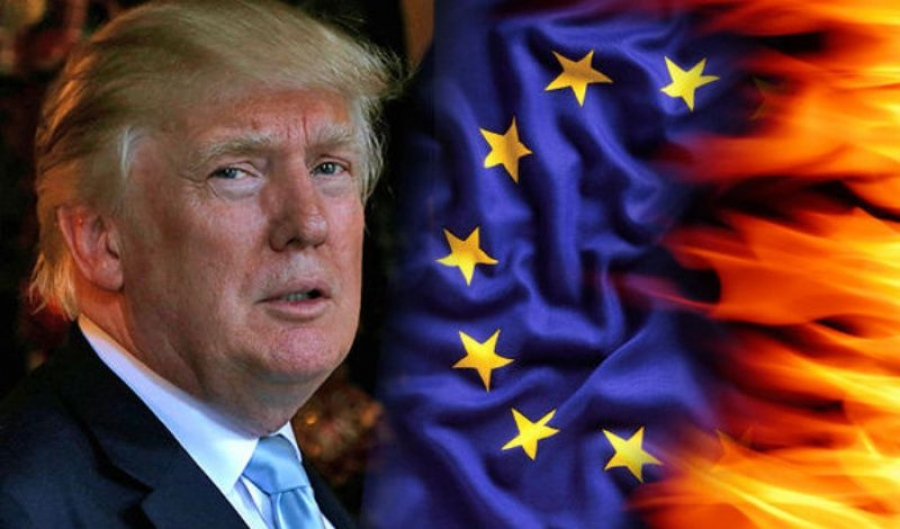
To achieve this, according to Trump, it is necessary to destroy the “bastion” of the globalists in Europe through a new debt crisis. According to his strategy, this will be achieved through the following measures:
1. Tariffs on European Goods
Trump warned a week ago of 25% tariffs on European goods. After the EU promised a “decisive and immediate” response, he made it clear to Congress on March 4 that European businesses would see a new round of tariffs, which would mainly affect imports of steel, aluminum, cars and pharmaceuticals into the US.
2. Withdrawing or Limiting Participation in NATO Structures
Trump is seeking either a complete withdrawal of the US from NATO or a limitation of its participation in formal procedures, with the aim of reducing the costs incurred to ensure European security.
3. “Annexation” of Greenland
One way or another, he intends to “annex” Greenland, thereby acquiring mineral resources and control of the Arctic.
4. Direct Communication with National Leaders
Trump intends to address national leaders directly, bypassing Brussels, with the aim of causing division within the EU on issues related to Ukraine.
5. Hitting Unwanted European Politicians
He also plans to expose scandals about unwanted European politicians. The European Union is still influenced by the memory of the way the Americans treated Dominique Strauss-Kahn, who, as Managing Director of the IMF, contributed to the transition to a polycentric international monetary system and the abolition of the monopoly role of the dollar.
Impact on the German and French economies
Trump wants to destroy the economies of Germany and France. Germany, for example, will be hit by the imposition of tariffs, since its trade surplus with the US amounted to $72 billion in 2024. In addition, the German economy is experiencing a prolonged recession due to the rejection of Russian energy resources, and since exports make up almost 50% of its GDP, it will not survive the new measures.
The Bundesbank estimates that Trump’s measures could lead to a contraction of the German economy by 1.5% by 2027.
Large EU economies such as France and Italy, which face large budget deficits and debts of more than 6% of GDP, will suffer further, as demand for their exports declines.
With the memory of the debt crisis that nearly sank the EU (as happened in Greece), new problems could trigger a pan-European recession and a eurozone debt crisis, leading to political instability and the rise of pro-Trump politicians like Hungarian Prime Minister Victor Orban.
Europe’s last hope is that Trump will understand that a European recession is not in the US’s economic interests, since it would crash its beloved stock market. However, two points reveal that Trump is not fully aware of the situation:
Trump is not imposing tariffs primarily to sink his “allies” but to abolish the US income tax — a campaign promise. The revenue from this policy will help reduce the budget deficit, making it a long-term policy.
He also understands that a war with China could break out, but the necessary resources are not there. The stock market is just foam, while steel mills and shipyards have moved either to China or to the EU.
In addition, production chains in critical sectors, such as chips and chemicals, either start or end in these regions.
This is why Trump is seeking to bring manufacturing back to the US through tariffs — another long-term policy.