



Bitcoin has a good correlation with the stock market, and we are now seeing it outperform the stock market. Since January 20, 2025, when it hit a new all-time high above $109,000, it has fallen by almost 24%, now trading below $84,000 – and that’s what we call a bear market!
On Tuesday, February 25, Bitcoin’s daily chart broke its first major support, and continued lower the next day (red horizontal line).
Trust Economics, reports that we are likely to see a temporary rise to the $80,000 support area. The cryptocurrency may then fall to the $74,000 area, as this corresponds to the 61.8% Fibonacci retracement level of the previous rise from September to December 2024 (blue horizontal line, “X”).
The MACD indicator (bottom, red arrow) has given a strong sell signal since late January and continues its downward trend.
Of course, there will be opportunities to hunt lower prices, causing short-term bounces, but excessive leverage suggests that large liquidations are possible when margin calls are triggered.
Questions for Cryptocurrency Investors
Cryptocurrency investors should ask themselves:
- Are Bitcoin and other cryptocurrencies truly “assets”?
- Are they a medium of exchange?
- Is it a real currency, legalized and recognized by major countries as “money”?
- Can you go to a supermarket and buy groceries with it?
- Or buy something simple like a beer at a bar?
The answer to all of the above is no. Bitcoin, along with other cryptocurrencies, is simply a digital record. This is why we consider Bitcoin to be the greatest speculative asset.
Even its name is misleading, as it is called a “coin,” when in reality there is no physical currency, only an image of it.
If you use $1 million in real money to buy Bitcoin, all you get is a digital key, which supposedly confirms that the “asset” is yours. What a bargain for the seller!
Ask Bitcoin advocates:
- What happens if your digital wallet, where you store your Bitcoin, gets hacked?
- Where is the complaint department or technical support? This has already happened many times since the creation of cryptocurrencies, leading to billions of dollars in losses.
- What are your legal protections?
The Biggest Cryptocurrency Loss in History
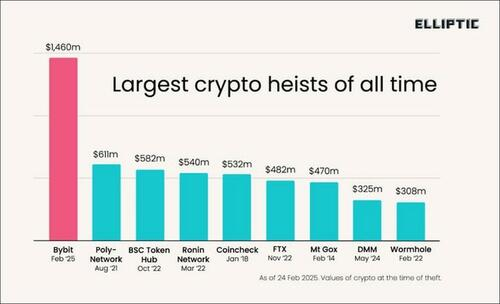
In fact, the biggest cryptocurrency theft in history just happened on Friday, February 21st, with more than $1.5 billion stolen from Bybit, a major Dubai-based cryptocurrency exchange.
The cyberattack was reportedly carried out by a North Korean cybercrime group called Lazarus.
The amount of cryptocurrency stolen from Bybit last Friday is more than double the previous record for cryptocurrency theft in August 2021, when the Ploy Network saw around $611 million stolen.
It’s worth checking out the excellent chart below of the most notorious cryptocurrency attacks in recent years (via elliptic.com):
Trust Economics has repeatedly explained that while investing in stocks naturally has risks, investing in cryptocurrencies has many amplified risks.
- When your digital “currency” gets stolen, is there a “customer support” department you can call?
- Who’s backing it?
- Is it “Satoshi,” the mythical alleged inventor of Bitcoin who has never been seen or heard from?
- What if the US, or any other government, makes Bitcoin illegal because it competes with legal tender?
The US has such a law. Only the US Treasury is allowed to create currency. It could be activated at any time against cryptocurrencies.
Investing is difficult enough in itself.
With cryptocurrencies, all you have is the hope that none of the above will become a problem. But hope is a very poor tool in investing.
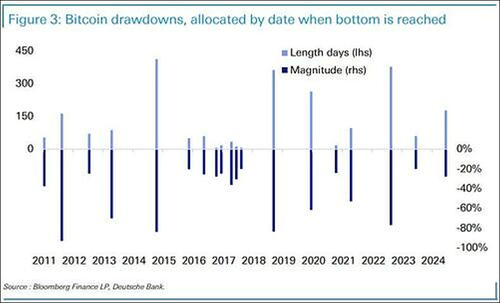
The cryptocurrency system is based on “blind trust” that everything will be legal and will preserve wealth. In today’s world, that’s a risky bet. Look at Bitcoin’s volatile run. Below is a chart from Bloomberg:
“Downtrends: Despite the ongoing uptrends, significant declines (19 episodes since 2011) are common, with an average decline of 44% in 123 days. Since 2018, these declines have deepened (-50% vs. -41%) and have been prolonged (194 vs. 82 days on average).” Imagine, the “average” correction has reached 44%. About 4 declines since 2011 were around 80%.
Although the media hides this fact, Bitcoin sellers tell you that it is a good investment and only talk about the big profits. This is a trap for the innocent!
We remind those who buy cryptocurrencies that Bitcoin has no intrinsic value. But an investor would pay about $100,000 in real money (last week) for one Bitcoin. In a few days, he would have lost over 17%.
The real money could be used to buy a nice Mercedes or a down payment on a house. The digital key to Bitcoin does not buy him anything, unless he sells his Bitcoin to someone else.
But he has to ask himself, if something happens to the cryptocurrency exchange (as we saw with Bybit last week), or to his digital wallet, where can he turn? Is there a complaints department or technical support?
This is why anyone investing in cryptocurrencies should be aware not only of the potential rewards, but also of the enormous risk that comes with them.
Successful investors always think about the risk first, before considering the potential gains.
Conclusion
Remember what we said at the beginning: Bitcoin’s movement is well correlated with market movements.
Therefore, if Bitcoin’s bear market continues, investors in the stock market should be very careful in the coming days and weeks.

