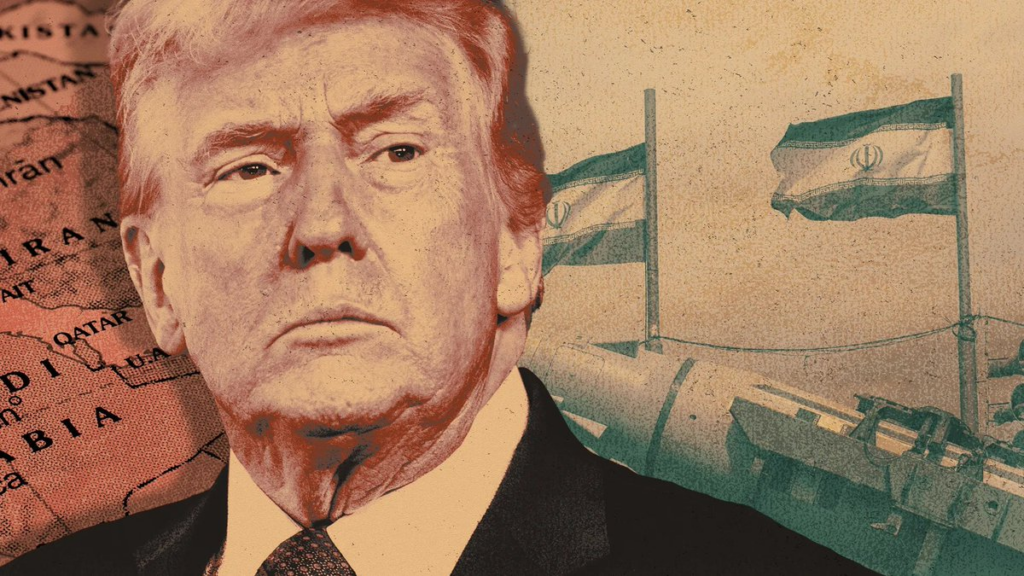
The economic impact of the so-called “maximum pressure on Iran” will be significant, as US President Donald Trump has set a target of zero exports.
On Tuesday, Trump signed a directive reinstating the “maximum pressure” policy of his first term, warning of “catastrophic” consequences if Tehran fails to reach a deal on its nuclear program. His goal of eliminating Iran’s oil exports is particularly worrisome for Tehran, as it would eliminate nearly half of the government’s revenue during a seven-year economic crisis.
In a first, the US Treasury Department on Thursday imposed sanctions on an international trading network, alleging that it facilitated the shipment of Iranian oil to China. In a coordinated move, the Treasury Department and the State Department announced sanctions targeting networks involved in transporting Iranian oil to China. The measures cover multiple countries, including China, India, and the United Arab Emirates, and affect several ships involved in Iran’s oil exports.
The impact of this order, if fully implemented, will be significant on Iran’s oil exports, but there is doubt whether it will actually reduce oil exports to zero or to the levels seen in 2020, the final year of Trump’s previous presidency. In 2017, before the US sanctions were imposed, Iran exported 2.5 million barrels per day (bpd). By 2020, that number had plummeted to about 350,000 bpd.
As Biden took office in 2021, Iran’s oil exports rebounded, peaking at nearly 1.9 million bpd in the summer of 2024. After President Biden’s administration imposed sanctions on dozens of tankers involved in Iranian oil trade, exports fell by 500,000 bpd in the last quarter of 2024.
However, in January of this year, exports rebounded to 1.6 million bpd.

Tanker Trackers, a ship-tracking company, told Iran International that the recent fluctuations in Iran’s oil exports are typical, noting that such fluctuations are common. “We saw a similar decline in the last few months of the Biden presidency, followed by a recovery. There is nothing unusual about this. The average for crude oil exports over the past year is 1.572 million barrels per day, and since January, it has been 1.567 Mbpd. So it is too early to draw conclusions,” the company said.
United Against Nuclear Iran (UANI), a non-profit group dedicated to preventing Iran from acquiring nuclear weapons, has, in partnership with tanker tracking companies, identified nearly 400 ships involved in the Iranian oil trade, collectively known as the “shadow fleet” because they attempt to smuggle Iranian oil covertly by disabling their Automatic Identification Systems (AIS).
However, fewer than half of these ships have been sanctioned.
Currently, China is effectively Iran’s only oil customer. However, it does not buy oil directly from Iran. Instead, Iranian oil is sold through intermediaries and has its ownership documents changed, rebranded as oil from Iraq, the United Arab Emirates, Oman, and most notably Malaysia, before being sold to small, independent refineries in China.
China has repeatedly said that importing oil is a matter of national security, regardless of the source.
Wood Mackenzie said that “given the recent US sanctions against China and Beijing’s retaliatory tariffs, we do not expect China to comply with Trump’s ‘maximum pressure’ policy on Iran.”
Iran’s daily oil exports stood at 1.66 million bpd last month. However, it is predicted that due to the reinstatement of Trump’s maximum pressure policy, exports could fall to around 500,000 bpd in the coming months. The extent of this decline depends on Beijing’s cooperation with the US sanctions.
China and the US trade $750 billion in annual goods and services, which heavily favors China. However, Trump recently ordered an increase in tariffs on Chinese imports, leading Beijing to threaten retaliation.
While China has repeatedly said it does not recognize the unilateral US sanctions against Iran, its recent ban on ships subject to US sanctions from docking at its ports suggests it is taking Washington’s sanctions somewhat seriously.
Iran’s share of China’s oil imports exceeds 10%, with an annual value of about $40 billion. China is also the largest buyer of Iranian sanctioned products, including metals and petrochemicals. In addition, a significant portion of Iranian refined oil products, such as fuel oil (mazut) and liquefied petroleum gas (LPG), is shipped to China.
Iran’s customs data show that, excluding crude oil, the country exported goods worth $12.3 billion to China and imported $14.4 billion from China during the first ten months of the current Iranian calendar year (which began on March 21, 2024).
Therefore, the reduction of Iranian exports, even “to zero” as Trump expects, depends basically on China. And it is obviously part of the general trade war between the US and China. The above strongly smells of developments on the “Taiwan front”.