




On Friday, January 31, gold opened on the London market at an all-time high of $2,845 per ounce. Gold is a solid investment vehicle for hedging against currency and political risk.
More precisely, it has become a unique safe haven against systemic risk, separating itself from other assets with which it has been correlated – foreign currencies and other metals, for example, as well as inflation-linked bonds. This should worry policymakers in Washington.
“I will end the war in Ukraine, stop the chaos in the Middle East and prevent World War III, and you have no idea how close we are…” were the pledges made by Donald Trump during his election campaign.
He promised to end the war in Ukraine within a day of taking office, but the end of the war is nowhere in sight as he does not appear to have a plan that covers Russia.
The West will not accept Russia’s basic demand for Ukrainian neutrality. Meanwhile, Russia continues to make steady gains on the battlefield.
What will the United States do if Russia achieves a decisive military victory over Ukraine? No one knows, and the risk premium for total disaster continues to rise.
Gold’s record is historically unique in three ways.
1. Gold has stopped trading in proportion to other precious metals, including silver, copper, and other industrial metals. This relationship prevailed from 2007 to the end of 2023. Over the past year, gold has soared, while other metals have risen little.

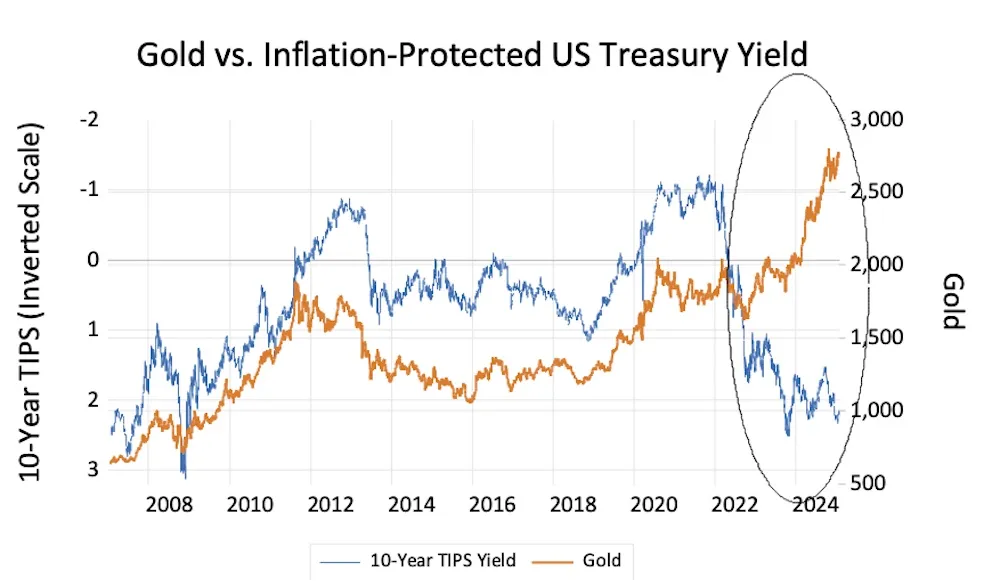
2. Αs we have often noted at Liberal Globe – gold trades in line with the yield of US inflation-protected Treasury bills, or TIPS. Both are forms of insurance against rising inflation and a severe depreciation of the dollar.
However, gold became decoupled from TIPS yields in March 2022, after the US and its allies seized $300 billion of Russian foreign exchange reserves. An asset that can be seized at will by a buyer is less attractive than gold stored in a central bank’s vaults.
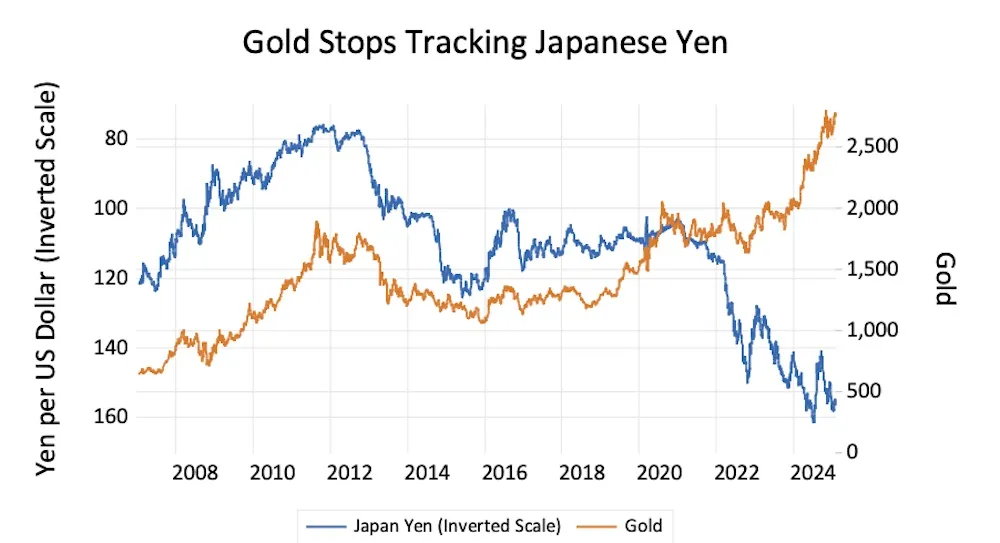
3. Other currencies used to act as hedges against the dollar. The price of gold has broadly tracked the Japanese yen, an alternative to the dollar. But that relationship also broke down in 2022. Because
A. Japan’s public debt is now 250% of GDP (double the U.S. rate of 120%), and the central bank holds more than half of that debt.
B. Japan’s inflation has risen, eroding consumer purchasing power and weakening the country’s political institutions. The yen is no longer a safe haven for dollar investors. Nor is the euro, which relies on weak and deficit-ridden economies like France and Italy.
With an annual trade deficit of $1.2 trillion and a net international investment position of negative $25 trillion, the United States must sell more than a trillion dollars in assets to the rest of the world each year.
Foreign investors stopped buying U.S. debt five years ago, and the U.S. is covering its trade deficit by selling technology stocks to foreigners. A stock market rout would have implications for the dollar.
Treasury Secretary Scott Bessent noted during congressional hearings that the U.S. federal deficit of between 6% and 7% is unprecedented for a historical period without war or recession. The deficit can be admitted by Trump’s greatest enemy.
Foreign central banks are reducing their holdings of U.S. bonds, leaving U.S. banks to finance the bulk of the U.S. government deficit from 2020.
However, financing the still-huge deficit will require either lower interest rates to support bank bond markets—which would add to inflationary pressures—or higher yields on government debt to attract cost-sensitive private investors.
Both the strategic balance and the global economic picture are becoming increasingly precarious. Gold has become a unique hedge asset, and its price performance is a worrying measure of the rise in risk throughout the financial system.


