



One of the unfortunate realities of the American foreign policy debate is that few American citizens pay much attention to what the elites are saying. This general level of ignorance in the public debate makes it much easier for the American foreign policy elites to then feed the American public propaganda, lies, and the regime’s agenda.
This has certainly been the case with the current US proxy war against the Russians in Ukraine. In the early months of the Russian invasion of 2022, there was seemingly no end to the deep state propaganda that tried to convince us that Putin was the new Hitler, that Moscow would soon recreate the Soviet Union, and that anything less than starting World War III was tantamount to “appeasement” as was the case with the Munich Agreements of 1938.
So what is motivating the Russian state’s actions in Ukraine?
To help you understand the answer to this question, we can turn to a new book by Sumantra Maitra, The Sources of Russian Aggression. Maitra’s goal here is to show how Russia’s foreign policy over the past thirty years has followed a fairly predictable pattern that can be well explained by the ideas of a structural realist.
Furthermore, Maitra goes on to show how Moscow’s behavior in the international arena is that of a conservative and defensive great power based on realist assumptions. Far from being a Hitlerite regime aiming for global domination, Moscow has very specific and limited goals.
Moreover, these goals could have been foreseen by Washington and the current conflict could have been avoided.
Russia and the Realist Model of Geopolitics
Among international relations scholars, realists have become some of the most vocal critics of American policymakers obsessed with confronting the Russian “threat.”
John Mearsheimer is perhaps the best-known realist scholar at the moment, and he has become notable for his prescient observations about how NATO’s relentless eastward expansion has precipitated unnecessary conflict between NATO and Moscow.
It should come as no surprise, then, that adherents of the realist school are not exactly popular in Washington. Ultimately, the only acceptable narrative in Washington is one in which the US is the great nation engaged in a moral-political crusade under the banner of liberal democracy and every other regime is either paranoid or symbolizes “Luciferian” forces that desire global domination while in essence what is threatened is the unipolar world.
In contrast to the convenient narrative, Maitra shows how Moscow’s behavior in the international sphere is that of a status quo power. That is, the Russian regime’s foreign policy interventions are oriented towards the maintenance of the current regime and are not a revisionist force.
Through his detailed analysis of the events that led to the current war in Ukraine, Maitra shows how Moscow’s actions were quite predictable and rational within a realist framework.
What exactly is realism?
As used here by Maitra, it is the “structural realist” or neorealist theory that makes certain assumptions about the behavior of great powers (i.e., the United States, Russia, China).
Central to all of this is the assumption that great powers will essentially always “balance” against the threats posed by the dominant great power.
In today’s world, the dominant power is the United States, and we can expect all other great powers to seek ways to counterbalance US power.
This behavior does not depend on the stated moral or ideological framework of each great power. Rather, great powers act to maintain their power and their place in the international system, regardless of their internal systems of governance.
Maitra shows that Russia is what is called a “security maximizer” rather than a “power maximizer” or revisionist actor. As we might expect within a defensive realist framework, Russia seeks to maintain its level of power relative to other states, but this does not require Russia to become a hegemon.
Maitra also notes a key aspect of balancing: “states actually balance against threats, not just power.”
From this we can draw an important conclusion. And he continues: “Perceptions of the Russian threat [depend] on overall power and offensive capabilities as well as perceived aggressive intentions. The greater the perceived threat, the greater the balancing action that can be observed.”
Thus, the mere existence of the United States or NATO has never been enough to provoke an aggressive response from Moscow. Rather, it is the extension of the threat by NATO and the US that has led to an escalation of tensions, culminating in the current military response from Moscow.
30 Years of NATO and US Escalations
Maitra does a significant amount of historical analysis here, focusing on NATO enlargement during the 1990s and early 2000s, and finally culminating in 2008 with the Russo-Georgian War.
She documents how US Secretary of State James Baker negotiated German reunification by promising the Soviets in 1990 that NATO would not move “an inch eastward.”
By 1992, however, NATO enlargement had become a sought-after goal for both the US and some European states.
Once again, NATO reassured the Russians by claiming that even after Poland and Hungary joined NATO, no military hardware could be stationed in these new member states.
This commitment was subsequently broken.
Thus, a pattern emerged in which NATO, a military alliance that was de facto oriented toward containing the Russian state, moved military power ever closer to the Russian border.
Ultimately, this combination of increased power, coupled with NATO’s ever closer proximity to Russian territory, meant that the range of “balancing actions” that Moscow had to take continued to grow.
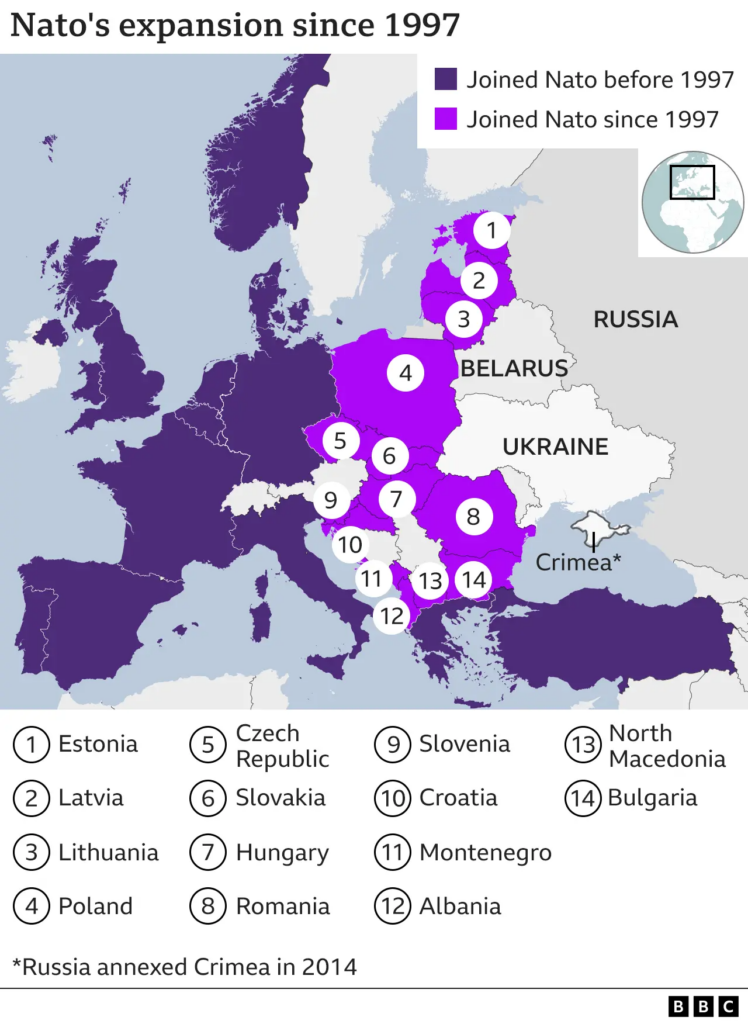
This process eventually provoked a genuine military response to NATO’s open and explicit efforts to bring Georgia into the alliance.
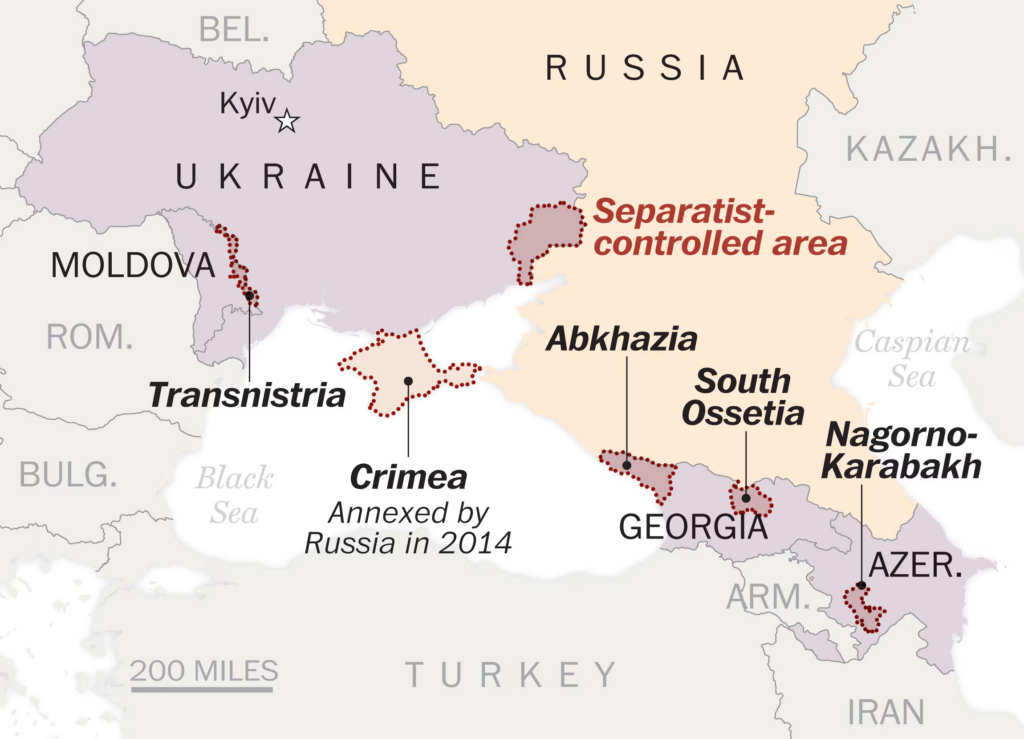
Maitra shows that unlike other previous NATO members, Georgia was seen by Russia as key to Russian security interests. A Russian military response therefore seemed justified to Russian foreign policy elites when, on August 7, 2008, Georgian forces bombed Russian allies in the breakaway region of South Ossetia. This led to open combat between Georgian forces and Russian peacekeepers.
Significantly, however, once Moscow achieved its goal of halting NATO expansion into Georgia, Moscow ended hostilities and settled for what are called “frozen conflicts” in the region. This, according to Maitra, is characteristic of an existing state that is oriented towards the maintenance of the status quo and is not a revisionist force.
The war in Georgia turned out to be something of a prologue to the Russo-Ukrainian war, although the war in Ukraine developed on a much larger scale.
In 2014, after yet another “color revolution” and the rise of anti-Russian policies shaped by the US and NGOs in Kiev, Russia realized that it could permanently lose access to military resources that were considered absolutely necessary by Russian elites. In particular, Maitra reports that Russian military assets in Crimea – especially the naval base that hosts the Russian Black Sea Fleet – were not something Moscow could afford to lose.
The annexation of Crimea soon followed in 2014
Maitra notes that other Russian interventions in Ukraine focused on preserving other assets that Moscow deemed necessary.
Russia’s military logistics networks relied on close ties to eastern Ukraine.
For example, Maitra writes that “critical Ukrainian components and their servicing constitute up to 80 percent of Russia’s strategic missile forces.” Thus, from the Russian perspective, “without eastern Ukraine, Russia’s nuclear deterrence strategy and naval forces would collapse.”
All of this, combined with the need to preserve Crimea’s naval assets, effectively guaranteed that Moscow would greatly escalate its efforts to counterbalance NATO expansion.
These details also explain why Russia has not responded with the same level of resistance to NATO expansion into Finland or even the Baltics, both of which are on Russia’s main borders, outside of Kaliningrad. Simply put, the threat of NATO expansion into Ukraine poses a much greater risk to Moscow than NATO expansion into other Central and Eastern European states.
So what should we learn from all this?
Central to Maitra’s conclusions is the demonstration that Russia is a status quo power, not a revisionist one.
In the examples presented, Russian aggression is an attempt to preserve the current system and the Russian state’s access to key strategic territories and resources.
As in the case of Georgia in 2008 and Crimea in 2014, Russian intervention ended once Moscow was satisfied that it had prevented significant changes in the international order in Russia’s immediate abroad.
None of this is to say that Moscow is “the good guy” in the current international order. When dealing with states—especially great powers like the US and Russia, both of which wield staggering amounts of coercive power—there is no room for good manners…
On the other hand, revisionist states like the United States—always promising new wars for “democracy” and “fighting terrorism” while bombing half a dozen countries at any given time—pose a truly global danger.
The capricious attitude toward nuclear war by the US establishment—in response to conflicts that have nothing to do with protecting core American interests—has been particularly dangerous.
Obviously, Maitra’s interpretation poses a challenge to the many narratives that argue that Russia is a revisionist power seeking to reconstruct Eastern Europe, or perhaps even Eurasia.
Which narrative prevails in Washington and among members of the public will determine the kind of intervention that Washington can demand the American people tolerate and fund.
If Russia is a defensive realist power, then this further reinforces the idea that the United States has no interest in “containment” of Russia or further expanding NATO.
Unfortunately, many of the most influential voices in Washington continue to push for greater escalation and the narrative that Russia is the new Nazi Germany.
It remains to be seen whether the incoming Trump administration, which has proclaimed a more realistic position toward Moscow, will counter the establishment’s drive for war.
The principles of Thucydides that Vladimir Putin espouses and which shaped his geopolitical thinking are that the strong act according to their power and the weak according to their need.
