Within eleven days, the Islamist rebels of Hayat Tahrir al-Sham (HTS) and their allied organizations, advancing from their stronghold in Idlib province, captured Damascus. The Syrian army collapsed and the regime of Bashar al-Assad was overthrown.
Assad’s former supporters, Russia and Iran, were unable to save him, as they had done in 2015. Both showed that they could not defend their allies, and their international prestige was undermined.
Approximately 20,000 jihadists without heavy weapons, with only portable weapons and machine guns on semi-trucks and some drones, destroyed an organized army that had tanks, heavy artillery, missiles and had the support, at least in the initial phase of the conflict, of the Russian air force.
The rapid developments in Syria constitute a strategic victory for Turkey, which sees its vision of reconstituting the Ottoman Empire, which had dissolved in 1918 with the end of World War I, being realized.
The Turkish triumph was achieved without the direct involvement of Turkish troops, but through Ankara’s proxies, jihadists that it itself protected, maintained, financed and armed in the northwestern province of Idlib.
The Damascus government, Russia, Iran and Hezbollah, who fought on Assad’s side, agreed with Turkey in 2016 that this province would remain under the latter’s control.
Eight years later, they are paying the price for their strategic mistake. Once again, history confirms that any agreement with the Turks will be valid as long as it suits them and they will overturn it as soon as they find the right opportunity. Let this be a lesson to Messrs. Mitsotakis and Christodoulides.
The new geopolitical map of the Middle East will force all players, big and small, to readjust their stance. No one will be able to ignore the upgraded Turkey.
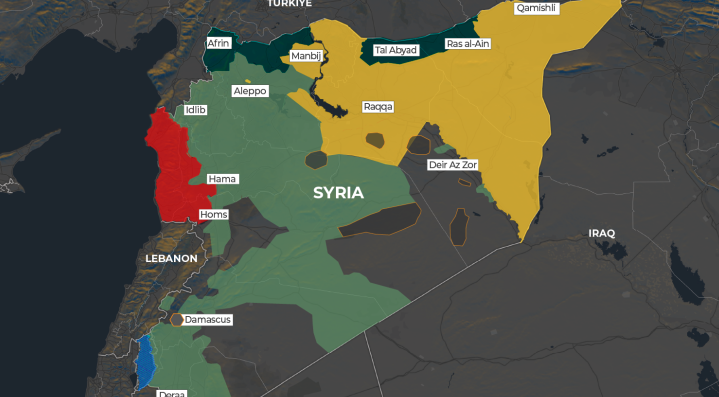
– Russia will seek, for the time being, to maintain its naval base (Tartus) and its corresponding air base (Hmeimim-Latakia) on the western coast of Syria. They are the only military bases it has in the entire Mediterranean. But what in return will it be forced to give Turkey? So far, the jihadists have stayed away from the areas of the bases. In the medium term, however, Ankara will seek to remove the Russians from its “soft underbelly”. In this, it will have the full support of the West.
– Iran will attempt to rescue the forces of Hezbollah and other allied paramilitary organizations as well as the military equipment it has on Syrian soil. In the event of future Turkish objections, it will be forced to withdraw men and equipment to Iraq. However, the “Axis of Resistance” against Israel has been disorganized.
– The US and NATO in general are completely satisfied to have gotten rid of Moscow’s hated ally, Bashar Al-Assad. However, they are particularly concerned about the intentions of the new regime, especially towards Israel and the Kurds who control eastern Syria.
– Israel is pleased to see the dissolution of the Shiite “Axis of Resistance”. It hopes that Hezbollah’s supplies from Iran will be cut off, but it is concerned by the fact that the Turkish-controlled jihadists have reached its northern border, in the Golan Heights.
In Jerusalem, they are asked to assess how quickly the threat from the Shiite Hezbollah of Lebanon will be replaced by the Sunni jihadist threat from Syria? For Israel, the new regime should not be stabilized and strengthened. For this to happen, however, it will have to come into conflict with other forces within Syria, such as the Kurds.
– The Syrian Kurds (SDF-YPG), who control, with the help of limited American forces, northeastern Syria, realize that they will be the next target of Turkey – the jihadists. The first clashes have already begun. The question is whether the Americans and the Israelis will defend them in the long term. A great bargain will soon begin between these forces for the fate of the Kurdish people.
– All the other players in the Middle East (Egypt, Saudi Arabia, UAE, Iraq, Jordan, Lebanon) must reconsider their position in the face of the upgraded Turkish power. Turkey, Azerbaijan and Syria will form a new axis of alliance.
– The various national and religious minorities (Christians, Alawites, Druze, etc.) in Syria will be systematically exterminated once the new regime is stabilized and internationally recognized. The Assad regime may have been authoritarian, but it was secular, but the jihadists will be ruthless with Islam.
Greece and the Republic of Cyprus must immediately review their policies pursued to date towards the geopolitically upgraded Turkey.
Appeasement, supposedly well-intentioned dialogue, and appeals for Ankara to show goodwill are not only ineffective, but also dangerous.
There is an urgent need to upgrade the political, diplomatic and especially military power of Hellenism, as well as alliances with those forces that consider the strengthening of the Turkish axis a direct threat to their own existence.