
On November 27, the jihadist forces, led by the Hayat Tahrir al-Sham (HTS) organization, formerly Jabhat al-Nusra, formerly the Islamic State, launched Operation “Repelling the Aggression,” where they launched a sudden attack from Idlib province on the jewel of Syria, Aleppo, and captured almost all of it.
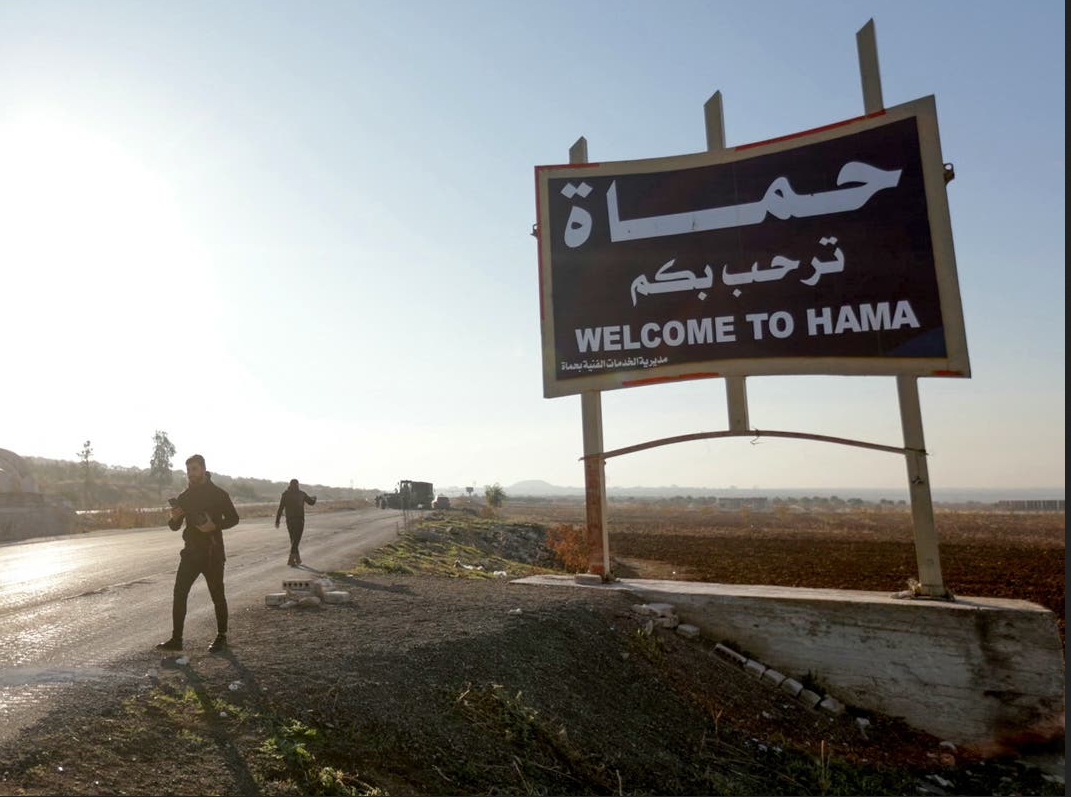
Then, with the momentum of surprise, ferocity, and the withdrawal of the Syrian National Army without resistance, they advanced south, controlling the all-important M5 highway that connects Damascus with the North and the border with Turkey.
The jihadists rushed from the Idlib region, a region in western Syria, which, after the Astana Agreement in September 2017, between Russia, Iran and Turkey, reached an agreement on the Idlib issue and demarcated the fourth de-confliction zone, the Idlib region.
There they gathered the defeated jihadist terrorist Islamist organizations, along with their families, resulting in the formation of a jihadist “dump”, with responsibility, supervision, and supply from Turkey.
Idlib
Turkey, assuming control of the dark and dangerous region, knew both the risks and the benefits it would gain from the control and influence it gained over the fanatical Islamists, especially the Sunnis, for any difficult, dangerous and of course illegal action that would be required to implement its geostrategic goals.
And Turkey, for any black or dirty operation anywhere, has so far used the jihadists of Idlib, who for a little money could carry out any mission, anywhere in the world.
A typical example is Turkey’s involvement in Libya, with the dispatch and use of experienced and war-ready fanatical Islamists from Idlib, who achieved what it sought. The containment of General Haftar’s forces, to save Tripoli and now to fully control Western Libya.
The communication channels, the food imports (and not only), the exits from this peculiar jihadist dump were basically done by Turkey, which benefited financially from these transactions.
The survival of the terrorist group depends on sponsorships from Arab states, such as the Gulf countries, the Turkish intelligence service MIT, the smuggling of weapons and drugs and especially the artificial amphetamine Captagon, the so-called “pill of the princes”, which is produced in abundance in Syria and is also trafficked with the participation of Hezbollah.
The Invasion
And now we come to this sudden invasion, which seems to have taken the Syrian government by surprise, although it should not have, and Iran, which is the leading force of the so-called “Axis of Resistance”, of which Syria is a member, as well as the Shiite militias of Iraq and of course the well-known terrorist organizations, Hezbollah, Hamas and Houthis.
The attackers are the Islamic extremist organizations of HTS, the SDA (Syrian Democratic Army), which is the Syrian-led opposition, as well as other Islamist extremist organizations, as well as a Turkmen Brigade created and armed by Turkey, where with a lightning attack, equipped with Turkish weapons, ammunition and vehicles and guided by Turkish commanders, they managed to capture most of Aleppo and through the M5 highway they reached Hama within a few days, as the government forces retreated, without offering any substantial and dynamic resistance, occupying the area (approximately the size of Idlib), which is shown on the map below, in green and with lines.
The blue areas in the North are the areas inhabited by the Syrian Kurds of the YPG, which Turkey had occupied and still maintains and I estimate that it will never surrender. Also the yellow area east of the Euphrates is controlled by the Kurds of the YPG, the black scattered areas are islands of jihadists and the red area of Syria, which is controlled by the legitimate government of Syria and President Assad.
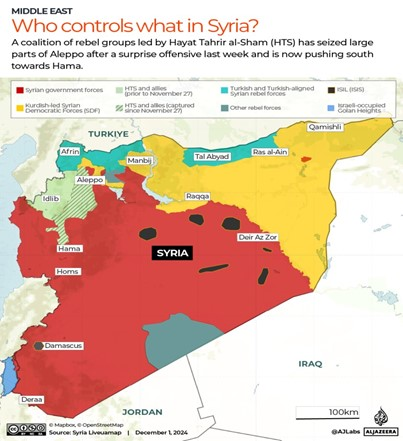
The rebels’ rapid gains – the most significant since 2016 – are bringing rapid developments to the Middle East region and the existing alliances that exist.
The questions are many and the answers are not easy. The main question is whether the intelligence services knew about the preparations that were taking place in the Idlib region and when the attack would take place. If they did, what did the direct stakeholders such as Syria and the Kurds of the region do?
Why did it happen immediately after the ceasefire agreement between Israel and Hezbollah and is it related to this operation? Did Turkey know about it and has an important role in the operation? Ultimately, what are the objectives of this operation and who is responsible and who loses?
Turkey behind everything
In response to these questions, it seems that Turkey is behind all of this, which prepared, trained and planned the operation in question with the knowledge of the US. According to information from Middle Eastern media, the planning and training had begun at least two months ago, it was planned to take place in March, but was accelerated to take place now, due to the ceasefire agreement between Israel – Lebanon and Hezbollah.
Turkey had many reasons for this attack. It was noted at a sensitive diplomatic moment: the diplomatic rapprochement between Damascus and Ankara has been delayed for years, with the aim of maintaining the territories occupied by Turkey in the North, something that Assad refuses not to discuss, but even to meet with Erdogan.
The areas that Turkey occupied during the war in Syria are with the operations:
A. “Euphrates Shield” in 2016-17, occupying the Jarablus region, where the Turkmen ethnic group was present.
B. “Olive Branch”, in 2018, which occupied the Afrin province, a purely Kurdish region, from which they were expelled.
C. “Peace Spring”, in 2019, occupying the Tel Abyad-Ras el Ain region, east of the Euphrates on the Turkish-Syrian border, which was inhabited by Kurds.
Russia and Iran are calling for a de-escalation, but Damascus is demanding the withdrawal of Turkish troops deployed in northern Syria along the border with Turkey, which means it could intervene, while Assad, with the help of the Russian air force bombing the invaders and his allies in Iraq and Iran, has vowed to crush the jihadists in a war to the end.
For Caroline Rose of the Washington-based Newlines Institute, the measured response from Damascus’ allies may be “a way to force the Assad regime to negotiate from a weaker position and in the absence of any sign of support from the Russians and Iranians,” she wrote in X. Perhaps the Russian bombings are simply deliberate and of course to prevent the jihadists from approaching the West, who have their two bases in Latakia and Tartus.
The purpose of Turkey implementing this operation is to neutralize any plan to implement the Kurdish Rojava, that is, a Kurdish state on the northern borders of Syria. And this is because the Turkey’s nightmare maps, by Ralph Peters and Robin Wright, have recently been re-released, which refer to the reshaping of the borders in the Middle East and the creation of a Kurdish state in Syria and Iraq.
Furthermore, this entire region in Northern Syria is included in the National Oath Charter (Misak I Milli), which also includes Aleppo, the city that Mustafa Kemal dreamed of. Another factor that enters the equation is Ukraine.
According to the Kyiv Independent newspaper, Ukraine trained jihadists in Idlib and provided UAVs (Unmanned Aerial Vehicles), of course in consultation and cooperation with Turkey.
Winners and losers
This attack is Turkey’s resounding message to Assad for negotiations and, from a position of strength, to impose on him the consolidation of the territories he occupied. Now it wants the Aleppo region as well, on the one hand to unite the regions of Idlib, Afrin and Jarablus into a single area and on the other hand to settle the Syrian refugees who have accumulated in Turkey.
Israel is also among the winners. Syria belonged to the “Axis of Resistance” and on its territory there were facilities and units of the Iranian Revolutionary Guards, who trained, planned, provided supplies and weapons systems to their allies and many times attacked Israeli territory with fire (please also read the analysis titled “The shape of the Kurdish state after the collapse of Assad“).
The supply routes for Hezbollah, but also for Hamas, passed through Syrian territory.
Furthermore, in a change of the “Status Quo” in Syria, Israel consolidates and “wins” the Golan Heights, which it occupied since the 1967 war. Of course, it also has a loss, due to the alliance and support of the Kurdish YPG, which is in a difficult position and its aspirations for state creation seem to be unfavourable for the time being.
The US was aware of the operation and gave its approval, due to the planned new Middle East, although this operation does not favour the Kurdish allies in Syria.
On the side of the losers, first and foremost are Syria and President Assad, who if he does not manage to respond victoriously to the invasion will lose other territories and possibly his power. The Kurds of the YPG are also in this phase, fighting at this stage against the pro-Turkish jihadists and hoping for tomorrow.
And the losers are all its allies, such as Iran, Hezbollah, Iraq and most importantly Russia, which with its two bases had set foot in the Mediterranean and the Middle East.
It may have had a substantial interventionist presence in the Syrian war in the 2020s and helped Syria confront the Islamic State, now with the war in Ukraine it is very difficult to get involved and significantly help its ally Assad and Syria in general.
So in conclusion we would say so far that the winners are Turkey and Israel, the US favorably neutral and the losers strategically and on the field are the Axis of Resistance, which is collapsing, from the successive strikes on the field and the administrative beheadings of its proxies, Hamas and Hezbollah.
It is too early to write off the Assad regime, says the BBC. It has a core of genuine support.
Some Syrians see it as the least bad option – better than the jihadists who dominated the uprising. But if other anti-Assad groups – and there are many – rise up, his regime will again find itself in mortal danger. And lest we forget, we do not see any condemnation from the “civilized democratic” West of this Turkish invasion by representatives, nor does Greece even speak, as it has a moral and national right, about the hundreds of thousands of Rum (Greeks, Greeks of Syria) Christian Orthodox in Syria, who are being exterminated in the area of operations by our “friends” the Turks, except for Ukraine.


