

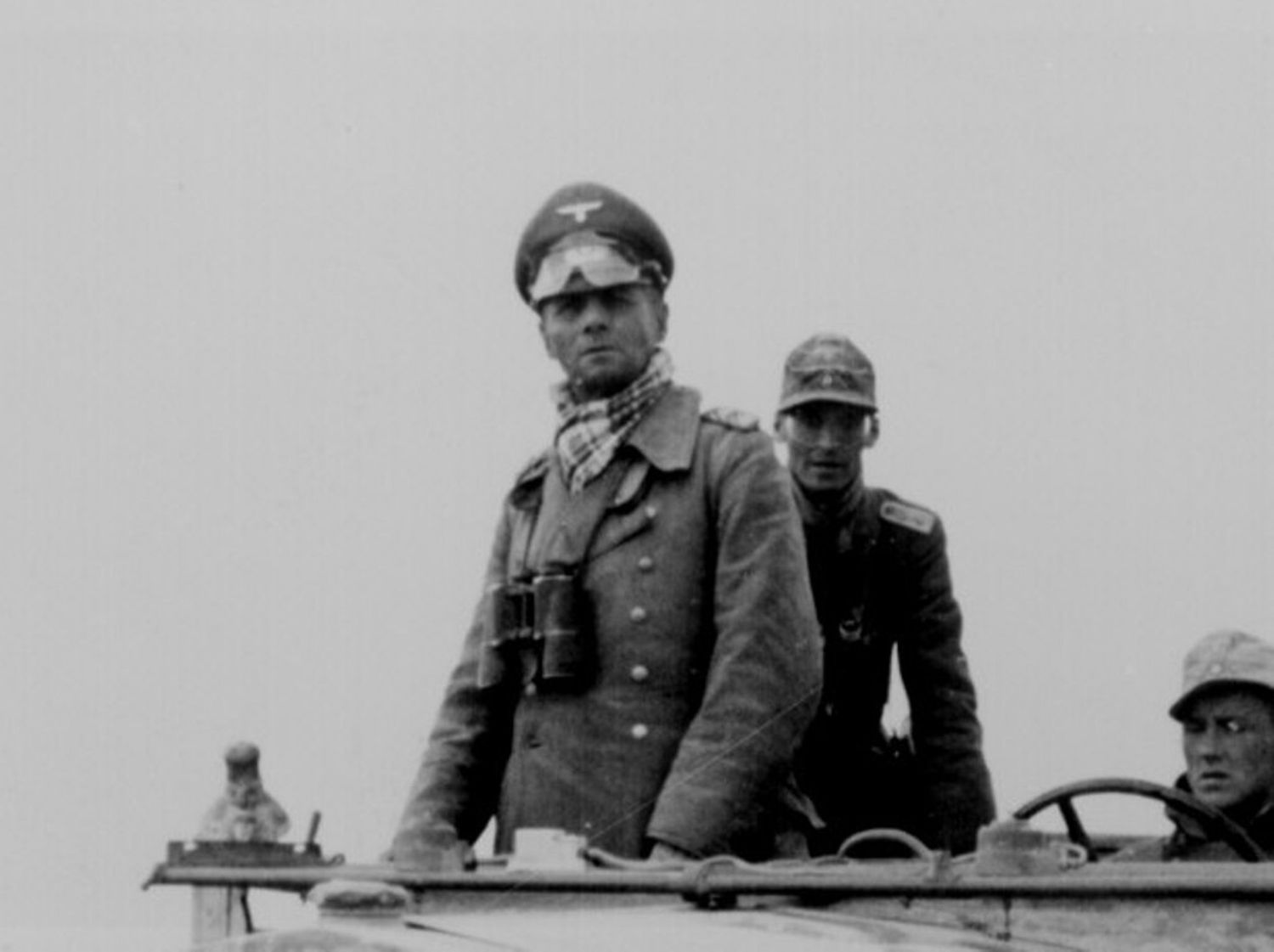
Using his mountain hunters in the way he would later use his Panzers, Rommel won the highest honor of Imperial Germany.
Rommel, after extensive action on the Western and Romanian fronts during World War I, joined the battalion in early October, after a short leave. At that time, the battalion was stationed in Carinthia, Austria. None of them knew where they were going to be sent.
But everyone imagined that their most likely destination would be the Italian front. There, since 1915, when Italy had betrayed its Central Powers allies and sided with the Entente, a forgotten war had been fought in the eagle’s nests of the Dolomites and Carnic Alps. The Austrians were on the defensive on this front, leaving the initiative to the Italians. The latter had launched a series of attacks against Austrian positions along the Isonzo River valley, which became known as the “Isonzo Offensives”.
By then, the Italians had launched eleven large-scale attacks, with the aim of breaking through the Austrian front, capturing Gorizia (Gerz) and reaching Trieste.
All of their attacks had ended in bloody failures, with the exception of the last, which gained ground towards Gorizia, capturing the city itself. In this battle, the 11th of the Isonzo, the Italian commander-in-chief Luigi Cadorna had thrown 50 infantry divisions into the battle, supported by more than 5,000 artillery pieces. Using the newly conquered territories as a base, Cadorna prepared for the 12th Battle of the Isonzo, which would result in the capture of Trieste.
But the Austrians were ahead of him. Due to their losses and lack of modern weapons, they admitted that they would not be able to withstand a new massive Italian attack. So they asked for German help, not to defend themselves, but to counterattack!
For this purpose, a new Austro-German army was formed, the 14th Army, with seven German and eight Austrian divisions. The German von Bülow was appointed its commander, with the German Kraft as chief of staff. By the same token, the four army corps had two German (Generals Stein and Berer) and two Austrian (Generals Kraus and Scotti) commanders.
Among the units assembled for the attack were the elite Austrian 3rd Division “Edelweiss” and the German “Alpinist Corps”, which, with a divisional size, was placed under the command of the 3rd Army Corps (Stein). The 3rd Corps occupied the central sector of the army, opposite Tolmino.
The Alpinist Corps, including the Württemberg Mountain Battalion, formed the left of the corps. The Italian command had some information regarding the attack, but did not give it any basis. Cadorna considered the possibility of launching an attack in the Tolmino sector to be completely impossible. If the enemy were to attack anywhere, he certainly thought it would be in the Gorizia sector.
Indeed, the Tolmino sector, in the heart of the Dolomite Alps, did not seem at first glance to offer advantages for an attacking army. First of all, the rough and difficult terrain did not allow either the concentration or the movement of large numbers of men and guns, an essential component for the success of any attack in World War I.
At most, according to the Italians’ reasoning, some small-scale attack, at the level of an Army Corps at most, could be launched from there, which would be countered by the forces guarding the sector anyway.
On this last point, the Italian command could be said to have been somewhat right, since in the sector from the Black Mountain to Tolmino, a distance of approximately 9 km, there were four of its divisions in the first echelon. Another guarded the sector from the Black Mountain to Pleso – a front of about 8 km. In a second echelon there were three more Italian divisions immediately available to General Capello, commander of the Italian 2nd Army, to deal with any possible accident.
With these considerations, the Italians “forgot” the Tolmino attack and got busy preparing their next attack on the Isonzo. The Germans and the Austrians decided not to cooperate! An “orthodox” plan of attack in the Gorizia sector promised only a gain of a few square kilometers of territory, at best. With this reasoning and being certain of the Italians’ inability to anticipate the attack through the mountains, they decided on it.
But the attack through such mountain ranges requires careful preparation and even more careful execution. First of all, it required great endurance and flexibility from the units, but also initiative from the local commanders. It was, in short, an attack perfectly adapted to men like the Stormtroopers of the German and Austrian armies, or like the mountain hunters!
On October 18, 1917, the Württemberg battalion began its march to the assembly area, on the outskirts of Kreinburg. From there, marching only at night, to avoid the Italian reconnaissance aircraft, the battalion, reinforced with a mountain artillery battery, moved towards Knesta.
It arrived there after a three-night march, through wretched, semi-desert roads, at an altitude of 2,000 meters. Many times even the pack animals buckled and the men were forced to carry the weapons, supplies, guns and ammunition on their shoulders. Knesta was located 8 km behind the front line. This mountain village was designated as their assembly area.
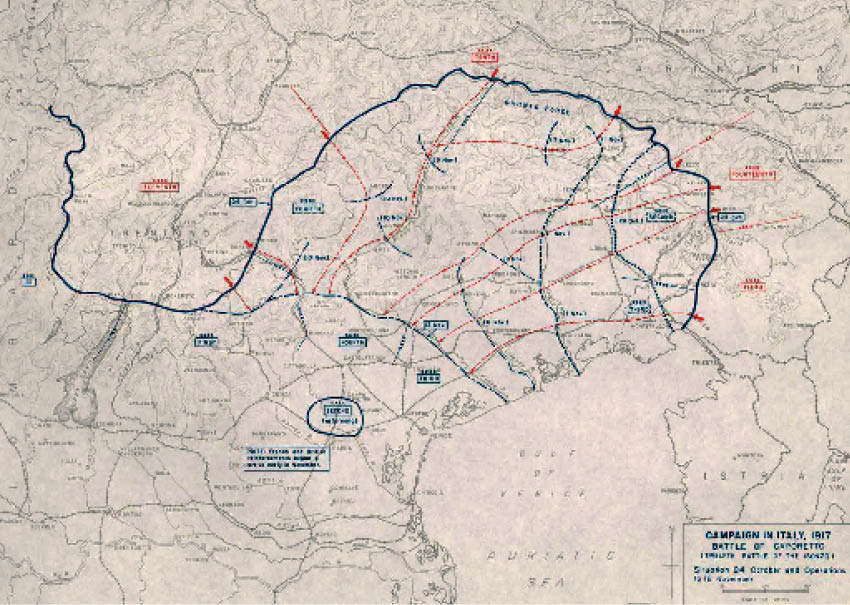
On the afternoon of October 21, Rommel, along with Major Spreser and the other detachment leaders, went to reconnoiter their attack area. They reached Hill 509, 1,500 meters from Tolmino. From that hill they would set out in three days, with the aim of breaking through the Italian front.
The Italian positions were higher up, on a plateau with an elevation of 1,360. From there they had a magnificent view of the Austro-German positions, as a result of which the fire of their mountain artillery was continuous and particularly accurate. Rommel was not happy when he saw the location.
He told his major that there was not even enough space for the divisions to stand. How could eleven companies of infantry and machine guns and an artillery battery remain on a small, steep peak, which was even exposed to enemy observation and was attacked at regular intervals?
The answer he received was evasive. That was precisely why they would operate from there, from where the enemy could not even imagine that they could be attacked. And yet the Italians had their last chance. That night a Czech officer of the Austrian Army defected to the Italian side, carrying with him a precise map of the prepared attack. The Italians considered the event a trick of the enemy and did not react.
The attack, however, could no longer be postponed, and on the evening of October 22nd, the battalion took up its positions on the line of departure, on hill 509. The Italians from the opposite hill shed light on the darkness with huge searchlights and, as soon as they spotted the slightest thing, their artillery began to fire in torrents.
Loaded with all their equipment on their backs, the Württembergs began to march along the mountain paths. As soon as the light of a searchlight approached them, they lay down on the ground and remained motionless. Many times, however, the weight of their equipment betrayed them and the men did not have time to fall to the ground. The Italian artillery then began to attack fatally.
Their shells ricocheted off the sharp rocks, making their fragments as dangerous as the fragments. The pack animals had been left behind, as the unfortunate animals, which are not distinguished by human paranoia, would immediately betray their movements.
Rommel, at the head of three companies of hunters and a company of machine guns, marched just as heavily loaded as his men. After a long, arduous and dangerous march, they reached the staging area. They had no time to rest.
By dawn they had to have dug trenches, to cover themselves and hide from enemy observation. The next morning the Württembergs and their equipment were now invisible! The Italians of course bombed Hill 509 as a precaution, for 15 minutes, but also all the surrounding hills, as they did every morning.
From the height Rommel ventured to take a look at the Italian front. The first Italian position was low in the Isonzo valley, which he “intersected” at one point, then continued to the southeast.
The position looked strong with many layers of barbed wire, in front of the trenches and machine guns. The second Italian position, almost parallel to the first, was also intersected by the river, as at one point it “descended” towards the valley. However, in Rommel’s sector of attack the Italian trenches of the second position were at an altitude of about 600 meters.
The third and strongest Italian position followed the ridges at an altitude of 800 to 1643 meters. As mentioned, the Alpine Corps had been placed under the 3rd Army Corps. The Corps – actually a division – consisted of the Bavarian Guard Regiment, the 1st Rifle Regiment and the Württemberg Mountain Battalion. The Bavarian regiment’s mission was to capture the Kovác and Hévnik heights and the Kolovrat pass.
The final objective was to capture Mount Matagio (height 1643), behind the third Italian position. The 1st Rifle Regiment was to initially capture Mount Knoll (alt. 2415) and then help in capturing the Kolovrat pass. The Württemberg Battalion, finally, had the mission of covering the Bavarian right flank and reinforcing them when necessary.
On the afternoon of October 23rd, everything was ready. Heavy rain was falling and a cold wind was howling over the steep cliffs. Rommel and his detachment had long since taken up positions. Now all they had to do was wait for the signal to attack. At midnight the rain intensified.
Rommel, perfectly satisfied with the ideal weather for a surprise attack, tried to make out the enemy positions in the damp darkness. Two hours passed, and suddenly the sporadic fire of the Italian artillery was extinguished by a new storm that had just broken out, a storm coming from the barrels of 1,000 Austro-German guns. The attack was beginning! But the infantry would have to wait a little longer. The guns had the say.
The Austro-German artillery, which for so many days had only fired harassing fire against the Italian positions, now succeeded, thanks to the successful identification of the targets, in silencing the enemy artillery. Immediately afterwards, its fury was turned against the positions of the Italian infantry, its advanced depots, its command posts.
The preparatory artillery fire continued until dawn. Then the artillery began to fire rolling barrages, 100 meters in front of the attacking friendly infantry.
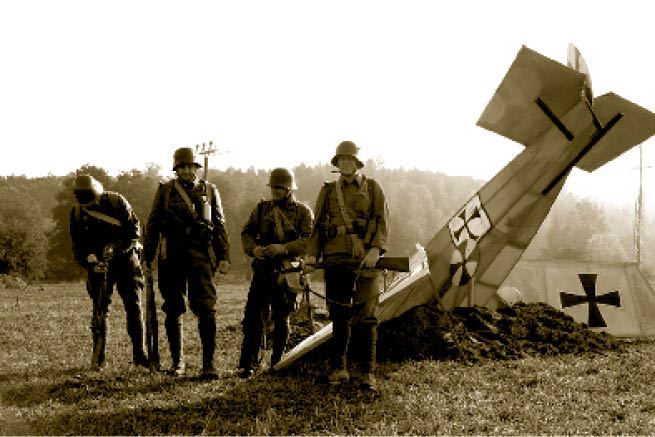
At the same time, the Württemberg Battalion also set out. It descended from the high ground and moved towards the bank of the Isonzo, towards the first Italian line of defense, with parts of the Bavarian Regiment on its left. At 08:00 exactly they set out.
But when they reached the first Italian trenches, they found only a series of pits, dug by the shells of the heavy artillery, and a few trembling human figures with their hands raised.
The artillery and mortars had reduced the Italian trench to powder. They continued to move forward, directly against the second Italian position, despite the fire of the Italian machine guns. While the Bavarians were attacking the eastern slope of Mount Hevnik, the Württembergs were charging from the northeast.
Rommel’s detachment formed the vanguard of the battalion. They were moving along a path on which two men could hardly stand side by side. However, the path was completely invisible to the enemy, lost in the dense forest that covered the mountain and the damp fog. Suddenly, however, they found themselves in front of an Italian machine gun. The Italians opened fire, wounding five men. The detachment stopped.
Rommel observed the Italian positions, which were located directly on the path and found that it was impossible to capture them, due to the narrowness of the space. So he decided to outflank them, climbing a cliff!
Slowly and carefully the heavily laden men crossed the cliff, with only Rommel injured, who was hit by a loose rock. Despite all this, he continued to command from the front line and personally supervised the order of the detachment’s heavy weapons, behind the Italian positions.
Rommel, without being able to know it, had already broken through the second Italian position. He realized this very soon, when he discovered a communication trench forgotten by the Italians. Following it, he arrived just behind the Italian machine gun, which blocked them from the road.
But the machine gun was just an “appendix” to the Italian defensive line, one of the many strong points of which it was composed. Rommel then decided not to attack the machine gun. He wanted to achieve more. Instead of declaring his presence to the Italians, he would try to neutralize the garrison of the entire Italian defensive sector! The machine gun was neutralized completely silently by a group of eight men.
All 17 Italians guarding it were captured. Then the Germans began to neutralize the garrisons of the adjacent Italian trenches just as silently, opening a 100-meter-long breach in the enemy position. Two more companies passed through the breach and joined Rommel’s detachment.
With five companies of chasseurs and one company of machine guns under his command, Rommel again took a bold action. Instead of continuing to neutralize the Italian positions from the flank, he considered it advisable to advance even deeper into the enemy position, completely disorganizing it. “I did not worry about the safety of my flanks. Six companies of Württemberg were able to protect their flanks,” the daring German later declared.
With all their weapons and equipment laden on their shoulders, officers and men continued their forward movement, climbing the mountainside. The machine gunners, who were carrying 43-kilogram loads, suffered especially.
The German column moved relatively quickly, overturning one Italian position after another and capturing enemy soldiers. After capturing two enemy batteries, they continued their climb and finally joined the 3rd Battalion of the Bavarian Guard Regiment, having made contact with the third Italian position, on Hill 1066, a few meters away from 1114 and the Kolovrat Pass.
In the early hours of 25 October, everything was ready to launch an attack on the final enemy position. Rommel, at the head of two companies of chasseurs and a company of machine guns, would have the honor of attacking first. He had already reconnoitered the terrain since the previous afternoon and had determined that the Italian positions were too strong to be broken by a frontal attack.
So, he decided to maneuver almost parallel to the Italian barbed wire, along the mountainside, hoping to manage to penetrate the location unnoticed, taking advantage of the terrain.
Sliding between the Italian outposts, Rommel’s detachment managed to move 2 km. parallel to the enemy location, without being noticed. It even neutralized an Italian outpost with 40 men and two machine guns, without making the slightest noise. This particular outpost had the mission of protecting the main location from over-the-top maneuvers.
This success made Rommel bolder. He gathered their three companies at a distance of 100 meters from the Italian positions, within a dense stand of trees. From there he sent a group of five men, which managed to penetrate the enemy location, without a shot being fired. Rommel immediately followed the group with his entire detachment and crossed the enemy barbed wire. He was now behind the third Italian position.
The Germans immediately began to widen the gap, attacking the Italian trenches on both sides of the gap by surprise. Soon, hundreds of Italian prisoners were in their hands. At one point, however, one of the detachments that was clearing the Italian trenches came under heavy fire from Hill 1192. The Italians had organized a reserve defense line on its slopes, which also covered Mount Cook, a mandatory crossing point for Mount Matagior, their objective.
Meanwhile, strong Italian forces, about the size of a battalion, had attacked the 2nd Company and had almost surrounded it. The company, with 80 men and 6 light machine guns, would not hold out for long. Its collapse would mean the end of Rommel’s detachment, but would also nullify their success up to that point.
Rommel, however, maintained his composure. He himself took command of the 3rd Company and two heavy machine gun elements, maneuvered and managed to find himself in the rear of the Italian battalion, which was forming an attack formation against the 2nd Company. The two German machine guns opened fire first and then the 3rd Company rushed forward. The Italians then turned against him, changing front.
However, this was not enough to save them, since the commander of the 2nd Company, seeing the development, also ordered an attack against the Italians. Thus, an Italian battalion found itself surrounded by two German companies and was disbanded. Those Italians who survived surrendered – 12 officers and approximately 500 men – to less than 200 Germans! The new “batch” of Italians brought the number of prisoners captured by Rommel’s detachment to 1,500. Soon, however, the detachment would surpass this achievement.
Pursuit
Despite its success, Rommel’s detachment was still in danger of being annihilated. Rommel was alarmed to see that strong Italian forces – two battalions – were beginning to gather around them again. However, the Italians did not attack. Instead, they began to dig trenches on the slopes of Mount Cook.
Thus, they gave Rommel the opportunity to plan his own attack. After requesting artillery support and forming a fire base with six light machine guns and a company of heavy machine guns, Rommel began the operation. At 11:15 the artillery opened fire on the Italian positions on Mount Cook and on Peak 1192. Rommel’s machine guns immediately joined the firefight.
At the same time, the Württembergs rushed out. Rommel attacked along the slope of Hill 1192. The detachment moved around the mountain and reached the village of Ravna, which was on its rear. All the Italian units in their path were neutralized. At the same time, a company of Württemberg troops was also attacking Mount Kuk. From Ravna, Rommel could observe the entire Italian position. To their right was the small village of Luiko, in which there was a large number of Italians.
Rommel decided to neutralize it! He ordered his men to move quickly and seize the road behind the village of Luiko. This they did. The Württembergs, always led by their daring lieutenant, hurried to open trenches along the road, cutting all the enemy telephone wires they found.
The Italians at first did not suspect anything. Thus, a convoy of cars that started from the village fell upon Rommel’s detachment. Taken by surprise, the Italians surrendered, without being able to notify the rest of the village. Fifty trucks and a hundred prisoners were Rommel’s prey. A little later, another car appeared. A burst of machine gun fire stopped it. Four Italian officers immediately got out of it. The three immediately surrendered, the fourth escaped.
A few minutes later a large column of Italian infantry appeared on the road, coming from the village towards their positions. Rommel was frightened. He had only 150 men at his disposal at the time, and the Italians seemed to number in the thousands. The Italian division approached within 300 meters. It was marching in a marching formation. They had obviously not seen the Germans. Rommel decided that it would be advisable to ask them to surrender. The Italians, however, were not convinced and opened fire only to be mowed down by German machine guns.
The strange battle lasted about 15 minutes. Then the surviving Italians laid down their arms. In total, 50 officers and 2,000 men of the 4th Versailles Brigade, the most elite corps of the Italian Army, surrendered to 150 Germans! The “score” of Rommel’s detachment, since the beginning of the attack, was already approaching 4,000 prisoners. Rommel boarded an Italian car, on which he mounted a light machine gun and invaded the village, which he captured without a fight.
At that time, the rest of the battalion was also entering the village, along with parts of the Bavarian regiment. Rommel immediately met with Major Sprecher and asked him for permission to attack Mount Kragonza. The capture of this hill, the last before Mataggiore, was imperative and would have the immediate effect of cutting off and destroying the many Italian batteries that had taken up positions in the sector. The major immediately gave his approval and Rommel, leading three companies of chasseurs, three companies of machine guns and a company of communications, moved towards his new objective.
When night fell, the detachment was near the village of Jevstek. There, in a clearing, they stopped for the night, having exceeded the limits of human endurance. In front of them was another Italian defensive position. The detachment settled in the clearing and, after setting up targets and launching patrols, Rommel and his men enjoyed a few hours of sleep, until midnight. Then Rommel woke up to hear a patrol leader report that the village of Jevstek was about 800 meters northwest of their camp. The village had been fortified by the Italians. However, the Italian soldiers of his garrison were organizing new positions south of the village.
Rommel immediately rallied the detachment. They would charge and capture the village before its garrison returned from its work in the south and manned the fighting positions in the village itself. Rommel’s detachment moved through a forgotten corridor in the Italian wire fence and managed to enter the village without being noticed. But there his luck changed. It was the village dogs that noticed their presence. Immediately an Italian detachment turned towards them and opened fire in the darkness.
But the Germans did not respond and soon everything was quiet again. Without making a noise the detachment occupied the northern part of the village and settled in the houses there. The Italians, unconcerned, continued to dig in the southern part. Rommel, meanwhile, studied his map by candlelight. Then he realized, based on the information his patrols had collected, that the village was part of the new defensive position that the Italians were gradually trying to form, after the breakup of their front at Tolmino. This line began east of the village and continued to Mount Kragonca, a few hundred meters from the peak of the mountain.
At 04:30 on the morning of 26 October, Rommel received another patrol report, according to which both the southwestern part and the slopes of the mountain were clear – the enemy was not there. The same was not true for its summit, however, where strong Italian forces were stationed. At 05:00, four German companies left the village in exemplary order and absolute silence, and headed towards the mountain. Two other companies fortified themselves in the village.
Dawn found the Germans on the move. The Italians from the summit finally saw them and opened fire on them. Rommel ordered a machine-gun company to cover the movement of the remaining three companies with its fire, which was done successfully. Rommel then led three groups, each equipped with a light machine gun, through a gap in the Italian trenches.
The few Germans flanked and routed the Italians, capturing another 37 officers and about 1,000 soldiers prisoner!
The attack continued. Soon the Italian forces at the top were surrounded. Their neutralization was only a matter of time. The next target of Rommel’s detachment was Hill 1356. In the meantime, at 08:30, the Italians at the top of Kragonza also surrendered.
Rommel was at the same time trying to gather his overextended forces near Mount Kragonza, with the aim of launching his attack on 1356. Moving alone from position to position, he found himself at one point in front of a group of Versailles troops, whose men opened fire on him from point blank range. Only his jumping skills saved him. He ran back to the German positions.
At 10:00 the detachment was ready to attack Hill 1356. The Germans moved cautiously, fired upon by the Italian machine guns, on the crest of the hill. After they had crossed several meters, the Italians appeared in front of them – Rommel estimated them to be two or three battalions. The Italians stood motionless, terrified. Rommel decided to try his luck. He approached them and began waving his white handkerchief, calling for them to surrender. They did not answer him.
Instead, they began to shout at each other, the officers and soldiers began to argue. Rommel was now alone, 150 meters from the enemy regiment, holding a handkerchief in his hand. Suddenly the Italians threw down their weapons, rushed at him, took him on their shoulders and began to shout “Eviva Germania!” (“Long live Germany!”). An officer who tried to resist was killed by his men. In total, over 1,500 Italians surrendered there, to a German officer.
The morale of the Italian Army was certainly not at a high level. However, the morale of the Württembergs was very good and Rommel decided to take advantage of this by continuing the attack to Mount Mataggior with only his detachment, ignoring the battalion order calling on him to retreat so as not to be cut off. “The battalion order was given without knowledge of the situation”, he justified himself, and proceeded to implement his plans.
His men successively attacked the Italian positions on the slopes of the mountain, from altitude 123, to 1424 and 1467. They flanked and bypassed the Italian trenches and headed towards the summit. At 11.40, exactly three flares announced to the following Austro-German units the capture of Mataggior as well. Rommel’s detachment had captured the objective of the 3rd Army Corps, almost single-handedly! In 28 hours it had broken through six Italian defensive lines, captured almost 10,000 prisoners and captured 81 guns and much other material.
Even for an officer like Rommel, the achievement was great. However, he would repeat it in the following days, pursuing the Italians all the way to the Po, and a few years later, as head of the “ghost” 7th Panzer Division in France.
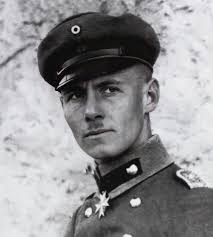
In early 1918, Rommel abandoned his mountain hunters. As a reward for his exploits, he was promoted to captain and awarded the Pour Le Merite, the highest decoration of the Imperial Army, which had been established by Frederick the Great. The new captain was transferred to a staff position.
There he found the end of the war and defeat. But he himself, naturally unsubdued, continued to believe in his homeland, without fanaticism, as a soldier whose duty it was to fight for it.