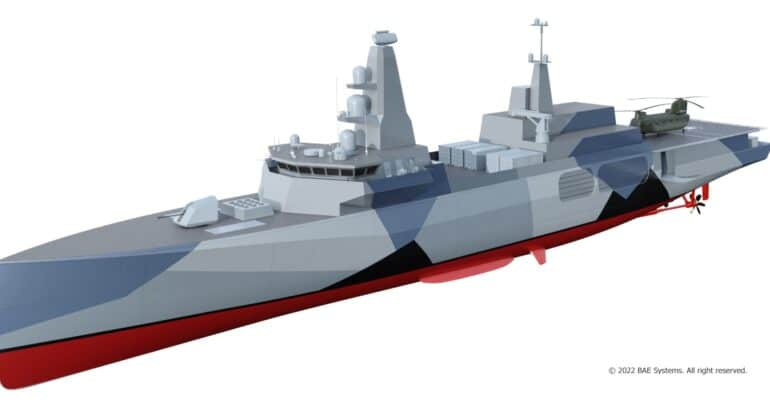
In an era where navies are called upon to respond quickly and effectively to a variety of challenges, the need for adaptability is more pressing than ever. In this context, BAE Systems presented at the Euronaval 2024 defense exhibition the Adaptable Strike Frigate (ASF), a frigate design optimized for high-risk operations near littoral zones.
The development of the ASF departs from traditional frigate designs, and incorporates the principles of the “system of systems”. Where having the ability to reconfigure, it adapts to the threats and needs of each business. Thus, the vessel has a modular architecture that facilitates the efficient use of various weapons and equipment modules with quick exchange, achieving at the same time a reduction in the costs required by specialized ships.
A central element, of course, is the real-time correlation and integration of data from each sensor, whether the vessel itself, or remote (and satellites or HALE/MALE UAVs). Essentially, the ship is designed to act like an F-35 on the surface, with advanced information fusion capabilities while having a sophisticated digital management system to share processed data with other units and control centers, enhancing both the effectiveness and safety of missions.
This approach allows the Adaptable Strike Frigate to engage in combat not only with its weapons (potentially the design allows for a large number of missiles of each type), but to “share” targets and missions to escort ships, aircraft and drones as well, maintaining a “war cloud” of common reference.
In the spirit of the times, the Adaptable Strike Frigate is of course based on launching and collecting all kinds of autonomous unmanned systems. So it enhances the picture of the operational situation, even very deep in the enemy’s hinterland, while it can respond to threats approaching covered by the coastal relief.
Ability to carry weapons
At Euronaval 2024 BAE Systems presented a mock-up of the vessel with relatively limited bow armament, with 24 CAMM/CAMM-ER anti-aircraft missiles and a Mk41 8x launcher. The latter is likely intended for RGM-109 Tomahawk missiles that will perform strike missions, while other launcher configurations are apparently on offer. The ship also carries the well-known 57 mm Bofors gun, as well as auxiliary guns for self-defense.
But the interesting thing is the 4 containers he brings to the mezzanine. All kinds of missile launchers can be placed on them, either cruise or ballistic, as well as launching drones. It is thought that in the future, containerized launchers and weapon carriers will become standard on warships.
Then, about 40% of the surface of the vessel, towards the stern, resembles a special operations ship. There is a helipad for organic helicopters as well as for vertical take-off UAVs, for which there is also extra storage space in the mezzanine. It also has space laterally for 4 smaller boats, where special forces groups can be boarded, while these can also be hybrid submarines, e.g. such as the British VICTA (which our page first presented). Finally, under the helipad there is a large area for storage and launching through a ramp of other vessels, manned or unmanned, surface and submarines, e.g. for minelaying or minesweeping missions. In this area there are also large side doors, for quick loading of various small boats, or other equipment in standardized containers.

Green propulsion
Today, Western navies are looking for ways to move towards a more sustainable operation in keeping with climate change (as funny as that sounds for navies). Here the Adaptable Strike Frigate incorporates an innovative propulsion design with a combination of diesel, central propeller, plus two electric pods, allowing for high maneuverability and performance, yet with a reduced greenhouse emissions footprint.
In any case, the Adaptable Strike Frigate is not just a new frigate, but a platform based on an open architecture of weapons and sensors, so its payload itself can change and evolve with innovation, so it is constantly responding to any missions assigned to her.
We should not forget that BAE Systems already has the Type 26 frigate in production. In British service it is a multi-role ship, but the Australian and Canadian versions are aimed more at anti-aircraft protection. According to the information on our page, the ASF may be offered at a lower price than the Type 26, perhaps hoping to attract orders from the British Navy first.