



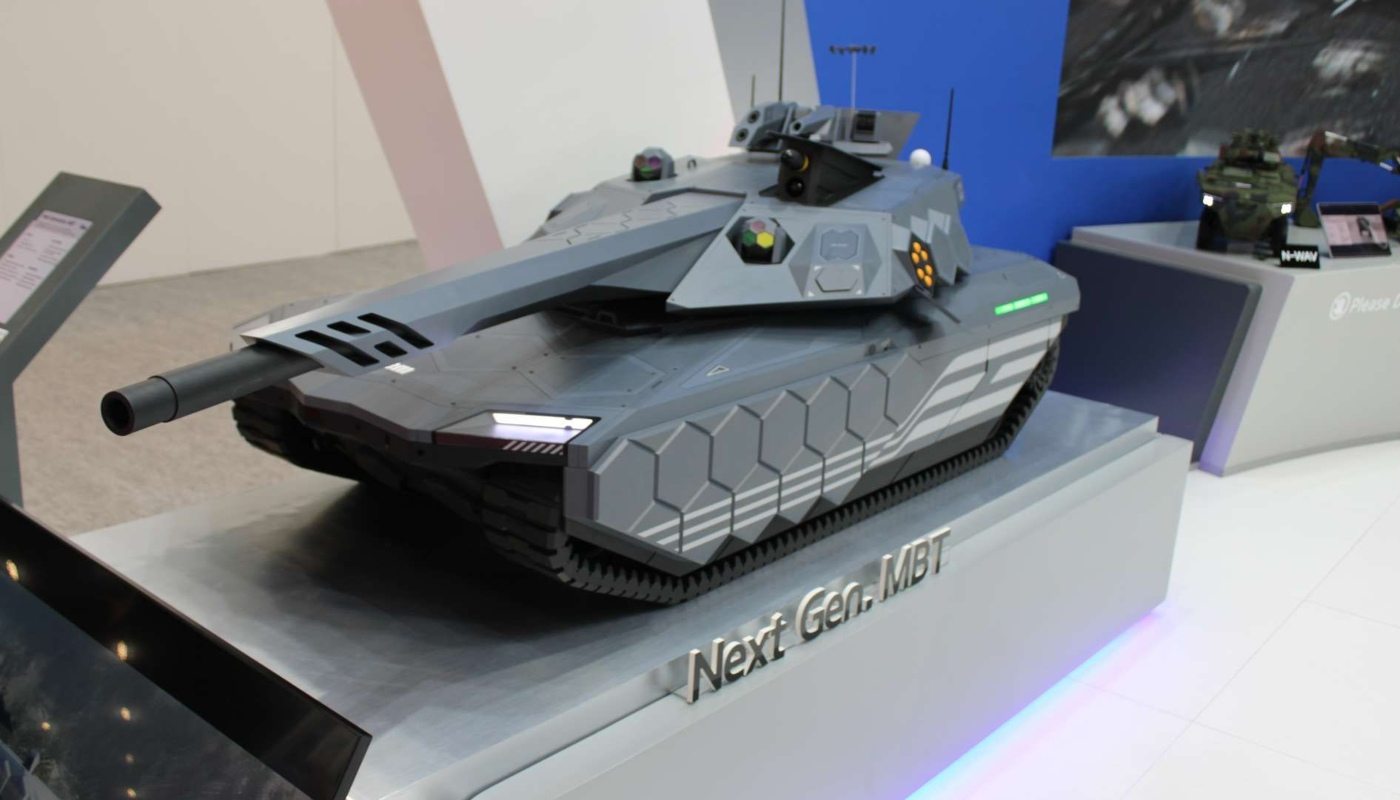
On October 23, Hyundai Rotem announced that its under-development K3 main battle tank will incorporate a hydrogen engine. The hydrogen engine is based on fuel cells (Fuel Cells) in which the chemical reaction of the engine takes place. There are no moving parts, but a chemical reaction that produces the energy. The hydrogen fuel enters the cell from the tank and mixes with oxygen, producing water. This chemical reaction produces the electrical energy required by the vehicle’s electric motors to operate and the vehicle to move. According to Hyundai Rotem, the hydrogen engine has a number of advantages over electric motors. First of all, their refueling is faster, they do not produce harmful emissions, since water is produced from the chemical process of the cells, the autonomy of the vehicles approaches that of vehicles with diesel engines and they produce less noise. The K3 is being developed under the NG-MBT (Next Generation Main Battle Tank) program of the South Korean Army. It will be a modular design so that it can be easily adapted to the customer’s requirements, have financial support and ease of upgrading.
The three-man crew (driver, leader, gunner) will be located at the front of the tank, within an armored section, for greater safety and protection, while the engine will be located at the rear. Particular attention will be paid to the low silhouette of the tank and the reduction of the infrared footprint it will produce. Apart from the 130mm main gun, it will have an automatic loading system, while the other armament (machine guns, laser gun and anti-tank missiles) will be integrated within the turret and deployed when needed. The factory armor will be an alloy of steel, ceramic material and other synthetic materials. On top of the factory armor, it will be possible to add floating, removable armor, while the K3 will also incorporate an active self-protection system. The tank will incorporate the latest technology in both sensors and tactical situational awareness. The combat weight of the K3 will not exceed 55 tons. The desired maximum speed, on the road, is 70 kilometers per hour, while off-road 50 kilometers per hour. Its desired, typical range is 500 kilometers. According to Hyundai Rotem, the K3 prototype will be ready in 2030. Tests and evaluations will follow, and its entry into service is expected around 2035.

