


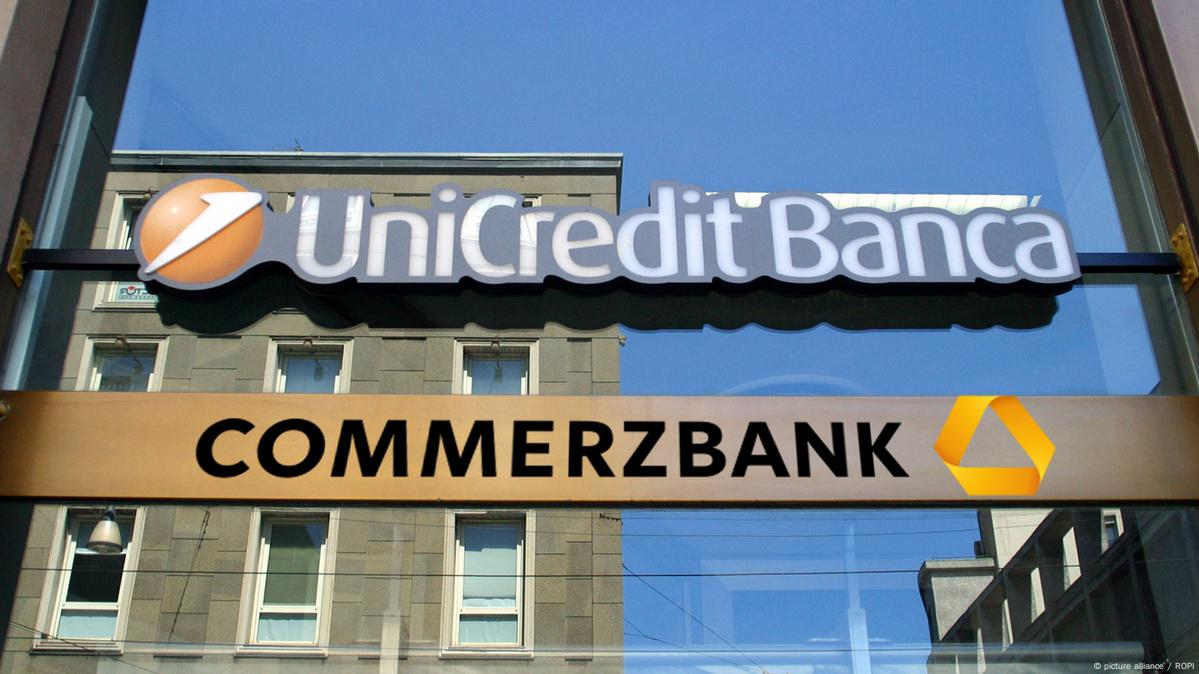
UniCredit increased its stake in Commerzbank from 9% to 21% in a maneuver that mirrored the tactics made notorious in hostile takeover battles more than a decade ago, building up its stake in secrecy.
The loophole in EU disclosure rules that existed for the legal obligation, which existed in the past, to disclose positions created through derivatives that guaranteed access to shares only at a later point in time
has been closed, making it impossible to create large-scale secret locations.
Tighter disclosure rules for financial derivatives provided a different opportunity: UniCredit was able to disclose a 21% stake in Commerzbank while complying with rules that currently block it from owning more than 10%.
The basis of this plan is based on proprietary and arbitrage trade.
The proprietary & arbitrage trade
Eurozone laws governing bank ownership-proprietary and control mean that no one can buy more than 10% of a bank without first getting the go-ahead from the European Central Bank.
The approval may be typical for an EU-based bank such as UniCredit, which has already said it would seek the ECB’s consent after acquiring its first 9% stake.
But the process can take months, allowing competitors to build their own positions, hedge funds to acquire shares and a target to back their defense.
However, the ECB’s approval is only required for UniCredit to take control of the voting rights attached to the Commerzbank shares.
The rules neither prevent the Italian bank from acquiring a financial position in the target in advance nor prohibit signing contracts now to receive the shares after central bank approval.
Stock ownership disclosure rules in the securities laws enacted after the Porsche and Schaeffler disputes have a different focus: they require an investor to disclose the position when he owns — directly or indirectly through derivatives — a 5% stake or when they reach higher thresholds, one of which is 20%.
That discrepancy allowed UniCredit to unveil a huge jump in its stake in Commerzbank, turning it from a minority investor to the single largest shareholder.
Its position is also large enough to make it difficult for potential rivals to make a counteroffer for the German bank, should it decide to pursue a takeover.
The “Cavalry”
At the core of the transaction are the contracts that UniCredit has entered into with Barclays and Bank of America.
Both investment banks entered into so-called total return swaps with UniCredit, effectively pledging to replicate the financial performance of Commerzbank’s stock.
If the German bank’s shares rise or the bank pays its dividend, counterparties will pay the change in value to UniCredit.
If the stock falls, UniCredit has to make up the difference.
Barclays and BofA also pledged to physically deliver the Commerzbank shares to UniCredit at a later date if the Italian bank still wants them.
The two investment banks will earn 12 million euros in commissions and other income from the trading, which has a notional value of 2.3 billion euros.
The revenue each bank stands to receive could rise to 40-50 million euros if the contracts are extended beyond 2026 or otherwise modified.
It all started in 2023
Preparations to take over the German bank began in 2023, when the Italian bank quietly built up a direct stake of just under 3%, which was below the first disclosure threshold for direct holdings.
In August 2024, when rumors began to circulate that the German government may soon start selling its 16.5% stake, UniCredit acquired another 1.7% through a much smaller total return swap, still below limit of 5%.
Then on the night of September 10, the Italian bank bought another 4.5% from the German government when it offered financial investors in a block trade, reaching the 5% disclosure threshold for the first time and then disclosing its position in 9%.
By Sept. 23, he had converted the original, smaller total return swap into shares.
On the same day, UniCredit introduced two much larger total return swaps, related to stakes of 5% and 6.53%, due in 2026.
A two-year exercise period — much longer than the expected six-to-12-month time frame for gaining regulatory approval — shows the Italian bank is “patient.”
UniCredit traded the derivatives without external advisers, relying on in-house expertise.
Total return swaps can come with risks.
UniCredit has eliminated this risk with another level of financial engineering.
It uses a so-called “collar” to hedge Commerzbank’s position against falling share prices while giving up large parts of the upside.
The structure – consisting of opposite call and put options – essentially locks in last week’s Commerzbank share price.
The careful build-up of stakes served to underline the Italian bank’s seriousness in gaining control of Commerzbank despite political opposition.
UniCredit’s trades have also made it much more difficult for potential rivals such as Deutsche Bank, BNP Paribas or ING to build a similar derivatives position in Commerzbank.
While Commerzbank is a highly liquid stock, almost a third of the total market capitalization is linked: 12% owned by the government and 21% controlled by UniCredit.

