

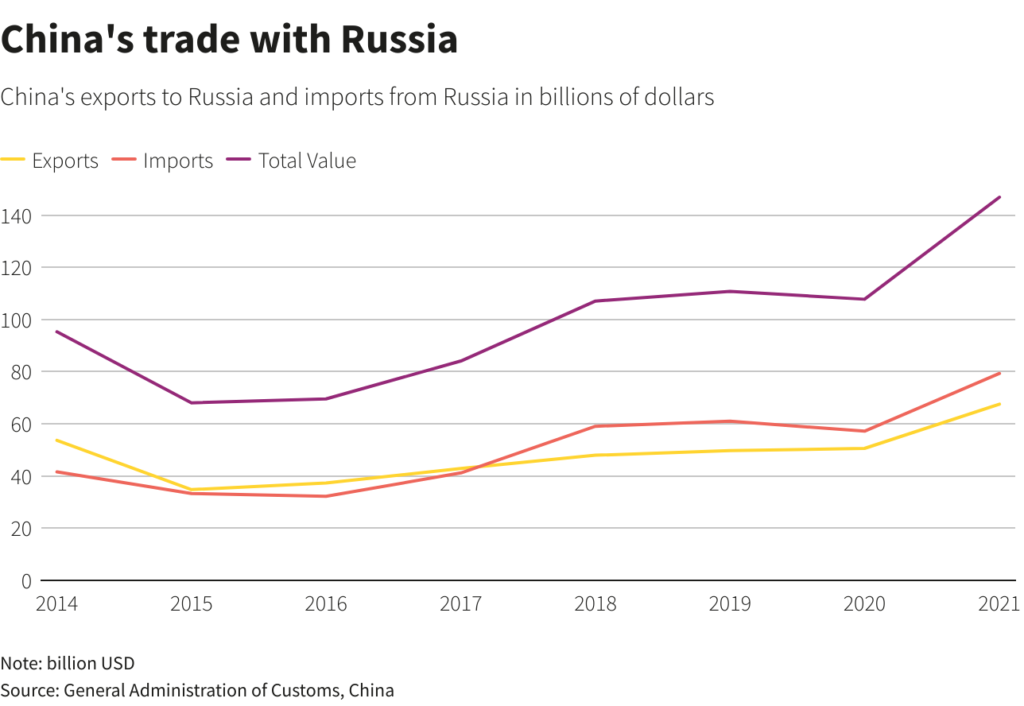
The war in Ukraine after the Russian invasion has been going on for more than 900 days, and since then, China and Russia have strengthened their economic and defense ties. Under the radar of the West, however, economic relations could expand even further in the future – with the help of an old (as old as the economy…) tactic.
Russia is the most sanctioned country in the world, but in many areas, Moscow manages to circumvent Western restrictions: It takes everything from semiconductors to household appliances such as washing machines, diamond exports go through new trade routes, and financial transactions with in China continue in the border areas under the radar of US sanctions.
The monetary barrier
However, bypasses are associated with high costs and payment problems remain. It is becoming increasingly difficult for Russian companies to make cross-border payments in Chinese yuan.
According to the Russian financial newspaper Kommersant, around 80% of yuan payments currently go back to Russia – making foreign trade extremely difficult.
In addition, the West had recently made the sanctions regime much stricter. Now Russia and China are apparently reactivating a millennia-old system to eliminate payments problems: countertrade.
Barterism or barter economy or barter trade is defined as that economy within which the exchange of goods (material and immaterial) between economic units takes place without the intermediation of money – that is, without the need for Russia to hoard yuan.
According to this, the new system could start as early as the fall of this year with businesses in the agricultural sector.
Metal for machines – the “machine” of exchanges
There have already been agreements to exchange goods between Russia and China in the past – but the last time was about 30 years ago.
Beijing, on the other hand, is still good in practice: In 2019, China traded US$150 million worth of palm oil from Malaysia for construction services, raw materials, and civilian and military equipment.
Iran supplied China with two million US dollars worth of peanuts in 2021 and received Chinese auto parts in return.
Such a counter-dealing tactic can therefore reduce exchange rate risks and limit Western trade acumen.
In January, the Ministry of Economy in Moscow published instructions to Russian companies on how to implement swap transactions, Forbes Russia reported.
This type of business is a good way to avoid international trade settlements and cash.
And there were specific instructions for example in terms of estimates of the value of goods.
Currently, Moscow and Beijing are apparently negotiating the export of metal from Russia in exchange for machinery from China.
Will China and Russia have their own payment system?
Shortly after the start of the war, Russia was blocked from the SWIFT payment system. Moscow and Beijing have their own payment systems, but they are not yet connected.
The only “bridge” it currently serves is SWIFT or remote banking services.
Experts do not expect a connection between the Russian Financial Intelligence Service (SPFS) for financial transactions on the one hand and the Chinese CIPS banking system on the other before 2028. A separate payment system for BRICS countries or members of the Shanghai Cooperation Organization is also being discussed ( SCO).
The new sanctions will destroy the basis of the international monetary and financial system based on the US dollar, Moscow said in April.
Therefore, “a separate financial messaging system and the creation of an independent BRICS rating agency” are planned, Russian Finance Minister Anton Siluanov said at the time.
Russian President Vladimir Putin praised the growing use of national currencies instead of the dollar at a SCO summit in Kazakhstan in July. He also called for a new payment system within the group. This would be a more modern solution to the payment problems between China and Russia. But it may take some time before that happens.


