


The occasion for this specific analysis is the recent statement about the main areas of concern of the Financial Stability Board (FSB) that was issued by the head of the global supervisor Klaas Knot. In particular, this statement focused on vulnerabilities in non-banking financial intermediation (NBFI), the so-called “shadow lenders”. More specifically,
“Vulnerabilities in non-banking financial intermediation (NBFIs), including pockets of hidden or excessive leverage, remain a potential source of systemic risk. Combined with rich asset valuations in some markets, these vulnerabilities increase the potential for sharp price corrections in the event of a shock. Such shocks could be more likely amid heightened geopolitical uncertainty, which underscores the importance of international cooperation. Recent incidents of market stress and liquidity pressures have shown that NBFIs can create or amplify systemic risk. Many of the vulnerabilities that contributed to these incidents are still largely present, leaving the global financial system vulnerable to shocks. Addressing vulnerabilities related to leverage in NBFIs is another important aspect of our work to promote financial stability. Non-bank entities have received additional leverage through off-balance sheet exposures, which have grown significantly over the past decade.“
Shadow lenders
The Liberal Globe has published several articles on shadow lenders & shadow economy and US banks’ exposure to these entities, as well as topics on the off-balance sheet exposure of both banks and shadow lenders. In summary:
- In fact, off-balance sheet exposures are a major issue more than two years ago.
- The growth of shadow lenders has been increasingly intense in the last decade.
- The “remarkable” growth of non-banking institutions is the biggest threat to the stability of the Eurozone financial system.
- Part of solving the problem is to pay due attention to these non-banks.
Archegos Capital
The Archegos Capital case showed that the bankruptcy of a shadow lender could spell big trouble for the world’s biggest banks.
We recall that banks lost almost $10 billion from Archegos Capital’s default, with Credit Suisse recording the most losses, amounting to $5.5 billion, on a notional exposure of more than $20 billion. At the time, Credit Suisse’s tangible capital amounted to 38 billion francs.
In other words, its exposure to Archegos Capital was more than half of its equity. The bankruptcy of Archegos Capital was one of the main reasons for the collapse of Credit Suisse and its acquisition by UBS.
Loans to shadow lenders made by US banks reached $1.15 trillion at the end of June, according to the Fed. Loan growth to these entities has been increasingly strong over the past decade.
As the chart below shows, these loans have soared more than 200%, from about $300 billion in January 2015 to $1.1 trillion in June 2024. They account for nearly half of all equity in the industry.
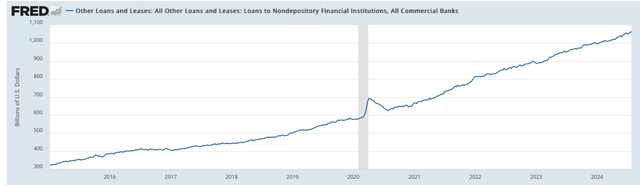
By comparison, total bank loans and leases grew by about 60% over the same time period, or less than 60%, excluding loans to shadow bankers.
Probably the most interesting part of this story is that loans to shadow bankers made by the 25 largest US banks have grown at an even higher rate, increasing by more than 265% since January 2015.
As the chart below shows, nearly 70% of these loans to shadow banking intermediaries were made by the 25 largest US banks.

In conclusion
Believe it or not, there are more important issues on larger bank balance sheets than smaller banks.
Therefore, in our view, the current banking environment presents even greater risks than we saw during the Great Financial Crisis of 2008.
Additionally, if you think the banking issues have been addressed, I think New York Community Bancorp (NYCB) reminds us that we’ve probably only seen the tip of the iceberg.