



Donald Trump’s 2025 Plan, which he has drawn up with the help of the Heritage Foundation, has laid out a risky monetary plan to weaken the dollar in order to stimulate American manufacturing, which is on the brink of disaster, but also to reduce the burden of interest payments on the federal budget (which in 2027 is expected to exceed massive defense spending!).
In their article the Financial Times (25/7) announce (for the well-known reasons that everyone imagines) the failure of the plan citing investor testimonies. But is it so? Or, on the contrary, have Trump and his economic staff deeply understood the developments that have taken place in the monetary level and financial markets and are attempting to deal with their negative consequences for the American economy? That remains to be proven.
China and Bitcoin
At the same time, the US presidential candidate in a speech at a bitcoin conference on Saturday July 17 said that the US must dominate the crypto sector or China will become a hegemonic power in a major shift in its policy towards in the industry which in the past, in 2021, he had described “as a fraud”. Both of the above moves, combined with measures such as increased tariffs, are expected to disrupt the functioning of the global financial system in its current form.
Speaking at the Bitcoin 2024 conference in Nashville, Trump said he would pursue a pro-crypto policy ahead of the Nov. 5 presidential election, saying he would make the U.S. the leading global power in cryptos and adopt a friendlier regulatory framework than the Democrats’ — this prompted an outpouring of donations from the billionaires of the market and Silicon Valley at a lunch where attendance even reached $80,000!
The Republican Party has promised friendlier regulation of cryptocurrencies, and Trump has criticized Democrats’ efforts to regulate the sector. “If we don’t embrace crypto and bitcoin technology, China will, other countries will. They will dominate and we cannot let China dominate. They are making too much progress as it is,” the former president pointed out.
China has banned cryptocurrencies and there are strict controls on the movement of capital across its borders. But people there can still trade digital currencies like bitcoin on crypto exchanges, and Chinese investors can also open overseas bank accounts to buy crypto assets.


We do not sell Bitcoins
Trump said he would create a crypto market council and create a national bitcoin “reserve” using cryptocurrency currently held by the US government, which has been largely seized in law enforcement actions.
“Never sell your bitcoin,” Trump said. If elected, it will be the policy of my government, the United States of America, to hold in the future 100% of all bitcoins currently owned or acquired by the US government,” he said. He added that he would like to see widespread bitcoin mining by US companies. The price of bitcoin initially fell after Trump’s speech, but then recovered and rose 0.94% to $68,182 (7/27).
Countries around the world, including the US, have expressed concern that highly volatile digital currencies could undermine government control of financial and monetary systems, increase systemic risk, promote financial crime and hurt investors in the long run.
Digital asset advocates say cryptocurrency users are becoming a growing political force this election cycle, though it’s unclear how many users would prioritize crypto over other issues at the ballot box.
Some cryptocurrency advocates support Trump, and any move by the US to create a monetary reserve in bitcoin will likely be seen by them as a major move to legitimize cryptocurrencies.
He promised that the country would never sell any of the bitcoins it currently holds. “If elected, it will be the policy of my government, the United States of America, to retain 100% of all bitcoin currently owned or acquired by the US government in the future,” he said. “This will actually serve as the core of the strategic national Bitcoin reserve.”

Exchange reserves in Bitcoin and Gold
The US government currently holds about $14 billion worth of bitcoins, mostly acquired through Department of Justice seizures. As Fundstrat’s Chief Digital Asset Strategist Sean Farrell predicts, the implementation of plans not to sell any of the country’s existing holdings will support bitcoin’s price.
The new bitcoin campaign promise came a day after presidential candidate Robert F. Kennedy Jr. he made promises that went even further.
RFK Jr. told TheStreet Crypto in an exclusive interview that he will direct the US government to buy bitcoin until its reserves match its gold reserves. “I’m going to build a basket of hard currencies, platinum and gold and other hard currencies and start issuing at least one class of Treasury bills that are anchored to hard currency,” he said.
“I would like the federal government to start buying Bitcoin during my term as well, and eventually have an equivalent amount of Bitcoin that we have gold.”
The role of BRICS and de-dollarization
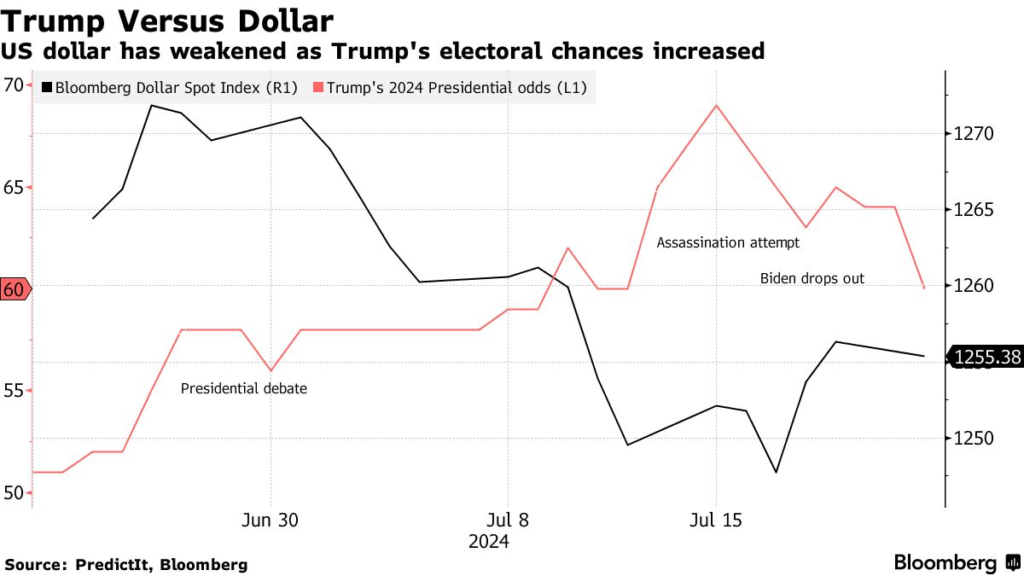
This will have, according to analysts, significant consequences for the global financial system and indirectly help the rise of the BRICS. A weaker dollar may help BRICS nations become less dependent on the US currency, but it could also lead to a realignment of global trade relations. The strategy of the dollar which is causing a lot of turmoil inside the US.
The former president and his vice president, JD Vance, believe this move will boost American manufacturing and reduce the huge trade deficit. Trump has described it in his speeches as the “big currency problem” affecting American manufacturers.

A weaker dollar for a stronger economy?
Republicans see a weaker dollar as an immediate way to make American goods cheaper and more competitive abroad. However, not everyone is convinced that this plan will work.
- Investors and hedge funds have sounded the alarm.
- They argue that the devaluation of the dollar can be costly and may not last long.
- Trump’s other policies, such as imposing tariffs on imported goods and cutting taxes, could counter the effects of a weaker dollar.
- JD Vance laid out the plan for a weaker dollar during his speech at the Republican National Convention.
- According to the plan developed with the Heritage Foundation, this strategy could help rebuild American manufacturing and reverse a decades-long trend of companies fleeing overseas.
- Since Joe Biden took over the US presidency in 2020, the dollar has gained 15% against other currencies.
- The US trade deficit, meanwhile, has soared, reaching $773 billion last year.
- Vance and Trump argue that a stronger dollar makes American goods more expensive abroad, contributing to that deficit and destroying domestic production, while causing a mass flight of jobs to countries with a countervailing advantage.

Does this constitute a victory for the BRICS group?
But a deliberate devaluation of the dollar could have some unintended (for the US) consequences.
- First, it could accelerate the BRICS’ efforts to move away from the dollar. These countries are pushing for de-dollarization of the global economy, seeking to reduce dependence on the dollar.
- A weaker dollar could make the BRICS currencies more attractive for international trade and the creation of foreign reserves, helping them achieve their goals.
- A huge drop in the value of the dollar could create volatility in global markets.
- It may disrupt existing trade relations, particularly for the BRICS states involved in dollar trade, but also the petrodollar.
- The long-term success of de-dollarization efforts depends not only on the value of the dollar, but also on the economic strength of these countries and the development of alternative financial systems.
In yet another reversal of the tenets of American economic orthodoxy, Trump has made public his views on US interest rates. He warned Federal Reserve Chairman Jay Powell not to cut interest rates. Trump has previously said that if he wins, he would allow Powell to finish his term, but only if he believes he will pursue the right policy.
Will he fire Powell?
Trump may try to politicize the Fed, particularly if Powell does not align with his economic strategies. Powell is seen as having guided the Fed through a difficult period, including a major inflationary one – and he is also claiming more leeway to set monetary policy through the 2025 plan.
Inflation is slipping back towards the Fed’s 2% target, leading to discounts on a possible rate cut in September, just weeks before the election. Trump does not hide his dislike for the head of the Federal Reserve – although he himself appointed him – because he supported the failed policies of the BIden administration. He has made it clear: At one point in a speech, he even questioned whether Powell was a greater enemy to America than China’s President Xi Jinping.

