




The notion of widespread adoption of electric vehicles anytime soon is a dangerous fantasy based on political science, certainly not engineering science. Yet governments, the media, academia, big companies and celebrities are hyping up an impending “transition” to electric vehicles as if it were preordained by some possessive being and trying to orchestrate our consent to a fraud of almost unimaginable proportions.
A simplifying note in advance: If the average household in Europe were to adopt electric vehicles, this would equate to an additional energy consumption equal to 25 refrigerators per household. The current and future network in almost all European countries, and especially in Greece, is not able to support every house with 25 refrigerators.
Below are three reasons why something ominous is happening with the big push for electric vehicles. But first a necessary clarification.
No doubt we have all heard of the term “fossil fuels”. When the average person hears “fossil fuels,” they think of a dirty technology that belongs in the 19th century. Many believe that in the great depths of the wells they burn dead dinosaurs to fuel their cars. They also believe that “fossil fuels” will destroy the planet within a decade and run out soon, despite the fact that, after water, oil is the second most abundant liquid on this planet. None of these ridiculous notions are true, but many people believe them. That is why we propose to eliminate this propaganda term in favor of “hydrocarbons”, a much better and more accurate word.
A hydrocarbon is a molecule composed of carbon and hydrogen atoms. These molecules are the building blocks of many different substances, including energy sources such as coal, oil and natural gas. These energy sources have been the backbone of the global economy for decades, powering industries, transportation and homes.
Now let’s address the three reasons why electric vehicles are at best a giant fraud.
1. Electric vehicles are not green technology
The central premise for electric vehicles is that they help save the planet from carbon because they use electricity instead of natural gas or oil/gasoline. It’s surprising how few think to ask, what generates the electricity that powers electric vehicles?
Hydrocarbons produce over 75% of electricity in Europe (in Greece over 85%). This means that there is an excellent chance that oil, coal or natural gas is behind the electricity that charges an electric vehicle. On the occasion it is important to emphasize that carbon is an essential element for life on this planet. It is what people breathe out and what plants need to survive. After decades of propaganda, the Malthusian hysteria (see Thomas Malthus theoretical argument) has created a perverse perception in the minds of many people that carbon is a dangerous substance that must be reduced to save the planet.
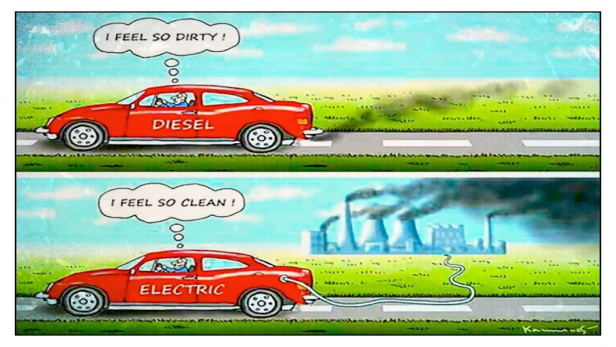
Let’s adopt this hysteria for a moment and assume that carbon is bad. Even by this logic, electric vehicles don’t actually reduce carbon emissions. They just rearrange it. In addition, mining and processing the exotic materials needed to build electric vehicles requires vast amounts of power in remote locations that only hydrocarbons can provide. Also, electric vehicles require a huge amount of rare elements and metals, such as lithium and cobalt, which companies mine in conditions that could not be considered environmentally friendly. Analysts estimate that each electric vehicle requires about one kilogram of rare earths. The mining and processing of these rare elements produces a huge amount of toxic waste. In short, the idea that electric vehicles are green is ridiculous.
2. Electric vehicles cannot compete with conventional ones without state/government subsidy
For many years, governments have heavily subsidized electric vehicles through rebates, sales tax exemptions, loans, grants, tax credits and other means. In addition, governments impose burdensome regulations and taxes on gasoline-diesel vehicles to make electric vehicles seem relatively more attractive.
Even with this massive government support, electric vehicles can barely compete with conventional vehicles, the average electric vehicle still costs at least 20% more than the average petrol/petrol vehicle. Without government support, the electric vehicle market is out of reach for the vast majority of people. So the question arises, why do governments go out of their way to promote an apparently anti-economic scam? Are they corrupt thieves and just plain stupid, or is there something more sinister going on?
3. Electric vehicles are all about citizen control
Electric vehicles are spy machines as they collect an unimaginable amount of data about us, data that governments can easily access. Analysts estimate that electric cars generate about 25 gigabytes of data every hour. Governments could integrate electric vehicles into a larger high-tech control network, or worse, abuse such a system.
Governments whose vision and agenda is globalization do not want the average citizen to have real freedom of movement and access to independent sources of energy. They want to know everything, keep us dependent and be able to control everything, just like a farmer would control his sheep. They think of us in similar terms. This is why petrol/diesel vehicles have to go and why they are trying to drive us to electric vehicles.
In summary, electric vehicles are not green, cannot compete with conventional cars without massive government support, and are potentially a critical piece of the emerging high-tech control grid.
But it is a symbol of the rich elites, who want with their electric vehicles to signal that they are saving the planet, while at the same time financing the indirect control of humanity, while claiming the power of global control bring humanity closer to nuclear destruction.

