



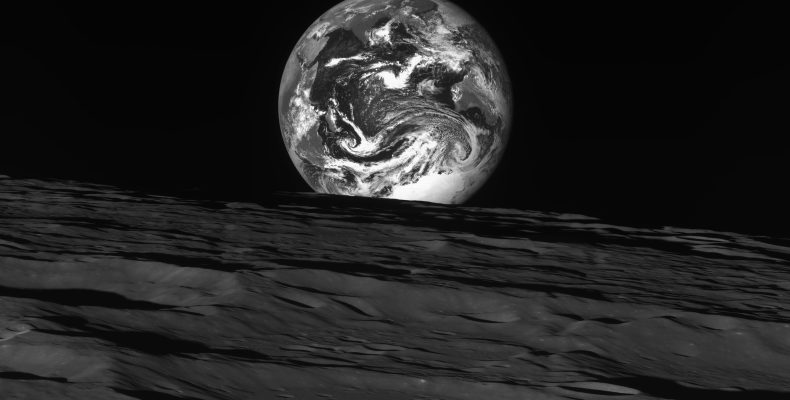
A probe launched by China in early May has landed on the dark side of the Moon to collect samples, a development that marks a new milestone in the progress of the country’s ambitious space program, which is trying to reach the two countries with a dominant position in the field. .
The Chang’e 6 probe, which lifted off from the Wenchang Space Launch Center on the tropical island of Hainan (south), touched down in the vast South Pole-Aitken Basin, one of the largest known impact craters in our solar system system, China News reported, citing the Chinese space agency. The 53-day mission, which began on May 3, is expected to allow, according to the official Chinese news agency, to collect samples from the dark side of the Moon, an area of the Earth’s satellite that is rarely explored, for the first time.
The probe will attempt to collect lunar material and conduct experiments in the landing zone. For this, the vessel will use a drill to collect samples below the surface, as well as a robotic arm to collect samples from the surface. The process is expected to be completed within the next two days, New China said.
Chang’e 6 will then attempt to depart from the dark side of the moon. In 2019, China had already sent a spacecraft to the dark side of the Moon, which, however, did not proceed to collect samples. Scientists believe the dark side of the Moon — so called because it’s invisible from Earth, not because the Sun’s rays don’t reach it — holds great promise for research, as the craters on it have not been covered as much by ancient lava flows as those of the side that is closer and visible.
It can thus collect samples that will help understand how the Moon formed. The samples collected by Chang’e 6 will have a geological age of about four billion years.
Big ambitions
China has greatly expanded its space program under the presidency of Xi Jinping, spending billions of dollars to catch up with and possibly even surpass the two leading countries in the field, the US and Russia. It has already recorded several successes, perhaps the most spectacular being the construction of the Tiangong (“Heavenly Palace”) space station, where a new team of three astronauts was sent in April. China was also able to send a space vehicle (small self-propelled rover) to the surface of Mars.
It is the third country to send a man into space by its own means. Beijing aims to develop a manned mission to the Moon by 2030 and build a lunar base. The rapid progress of China’s space program, however, is causing concern in Washington. In April, Bill Nelson, the head of NASA, said the US was in a “race” with China, testifying before the House Appropriations Committee in Washington.


