In the American stock market, there are risks of creating a bubble and extreme valuations, at unprecedented levels, due to the over-optimism of the market participants.
The barometer index of the US stock market S&P 500 has broken a series of records this year, regaining strength in recent sessions after a weak April. However, the rally is largely due to “impatience and fear of missing out on returns among investors, so-called FOMO – while internal market data looks unfavorable.
The stock valuation ratio, which is the fraction of non-financial market capitalization divided by corporate gross value added, shows that the S&P 500 is priced at its most extreme levels since 1929, just before that 89% market crash the period.
The S&P 500 is expected to outperform U.S. Treasuries by 9.3% annually over the next 12 years, according to his firm’s internal metrics.
That’s the worst performance in at least 12 years, and it’s a long way from 1929, when market insiders estimated the S&P 500 would underperform Treasuries by 6% annually.
Statistically, current market conditions look more like a major bullish peak than at any point in the past century, with the possible exception of the 1929 peak. This is no assurance that the market will sink, nor that it cannot go any further. However, given the combination of extreme valuations, adverse domestic markets, and dozens of other factors that are among the most “extreme” in history, we are fine with a risk-averse, even bearish outlook.
Stocks appeared to be in the most extreme speculative bubble in US economic history. In this case a 65% collapse would not be surprising.
Stock Market Fall is coming
It would not be paradoxical to see a fall in the share market of the class of 1929, 1974 and 2008. This is due to the fact that the scenarios for recession, which have started to disappear from 2022, are increasing.
This estimate is explained by the inverted yield curve of the US 10-year versus 3-month maturities, which takes place for more than 500 days.
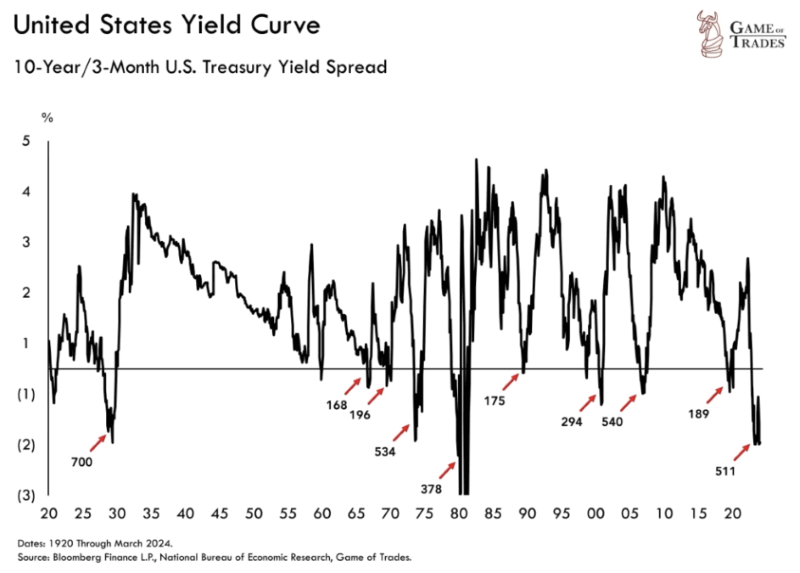
This phenomenon has occurred only three times in the past: 1920, 1929, 1974 and 2008. On all three occasions the markets fell more than 50%. However, we expect one last rally to occur before the end begins.
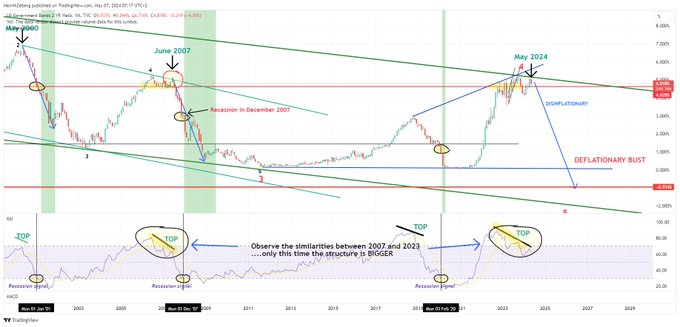
The upside is running out
Stocks are overvalued while a recession is out of the question. Stocks are very, very expensive right now, relative to both corporate earnings and assets like Treasuries.
If one of these days we find out that a big company is in trouble there will be a huge sell off in stocks.
The price-to-earnings ratio for the S&P 500 is about 35% higher than its long-term average, indicating that stocks are overvalued. A handful of stocks make up a large chunk of the stock market’s current value. This type of concentration is classified as “dangerous”. This is a wildly speculative type of market. The evolution of the “Magnificent Seven” technology stocks is reminiscent of the “Nifty Fifty” bubble of the early 1970s centered on names like Winnebago and Polaroid.
Against this backdrop, the S&P 500 could fall 20% to 30% — though the drop could be even more than that.
The index is quite likely to fall below 3,500 points – a 32% drop from its current level of around 5,100 points.
Rampant speculation looks set to bring a big fall,” he wrote, when bitcoin is considered the mother of all pure profit vehicles.
The three signs
The Federal Reserve is caught in the middle of a difficult situation. If the Fed pushes interest rates higher, interest payments on the $34 trillion in US government debt will fall. dollars could spiral out of control and bank balance sheets would be in even worse shape than they are now.
First Republic got its first taste of putting literally thousands of other small and medium-sized banks at serious risk. So it would be suicidal to raise rates at this point.
But if the Fed were to cut interest rates, that would be like adding fuel to a raging fire. The ongoing inflation crisis is crushing everyone, especially those on low incomes.
So the Fed seems very reluctant to cut interest rates because that would make inflation even worse. Essentially, the Fed is caught in a moment where it doesn’t know which way to go.
But staying on the path he’s currently on will only end in disaster.
Meanwhile, there are even more signs that the overall US economy is actually slowing. For example, Rue21 is set to close all 543 of its stores. Rue21 — the teen fashion chain that’s a fixture in malls across America — is set to close all 543 of its U.S. stores.
Customers will be able to bid while the company clears out its stock over the next four to six weeks – but then the 40-year-old chain will be gone forever. At its peak it had 1,200 stores.
Across America, however, stores are closing, businesses are leaving core urban areas, and busy office buildings are sitting empty. The Chinese certainly understand the direction things are moving.
After all, its authorities are buying gold like there’s no tomorrow.
China unquestionably drives the price of gold. The flow of gold in China has gone from solid to an absolute torrent. The country’s gold consumption rose 6% in the first quarter from a year earlier, according to the China Gold Association. This increase follows a 9% increase last year.
Chinese consumers are voraciously buying gold because their own economy is collapsing and they can see what is happening to the global economy as a whole. At the same time, China’s central bank is gobbling up gold at an unprecedented rate.
Another major buyer of gold in China is the country’s central bank. In March, the People’s Bank of China added to its gold holdings for the 17th consecutive month. Last year, the bank bought more gold than any other central bank in the world, adding more to its reserves than it had in nearly 50 years.
Beijing has been buying gold to diversify its reserves and reduce its reliance on the US dollar, long considered its most important reserve currency. China has reduced its holdings of US Treasuries for more than a decade.