

Technology can reach up to Plato’s tomb, enter his imposing gardens, and see elements of his life that are now accurately authenticated. Thanks to the new method of reading the papyri, Italian researchers not only locate the place where the ancient philosopher seems to be buried, but also offer us valuable information about his life, such as that he was not sold as a slave on his return from Syracuse in Sicily as we considered until today, i.e. 387 BC, but much later, when the Spartans conquered Aegina, in 404 BC. However, the Italian scientists who read the damaged papyri agree with the few testimonies that support that the philosopher died at an old age – more than 80 years old – and that he is buried in the wider area of the Academy, which after this terrible discovery is now located with precision in the gardens of the school founded by the philosopher and known throughout the world.
What does the great discovery shows?
For years now, researchers have been trying to decode the papyri destroyed by the eruption of Vesuvius – in 79 AD – using the famous “bionic eye”, whose advanced use, compared to the previous one that had again applied the 90s, helped to identify even more words and put together a rudimentary text. According to the text of the papyri, we are now clearly given the information “Plato was buried” and with the research led by the Italian papyriologist Graziano Ranocchia it is clarified that the philosopher was buried in his Academy – specifically in the gardens near the Temple of the Muses.

We know that this sanctuary existed in Plato’s Academy from Eratosthenes of Alexandria, who gives us the dates of Plato’s birth and death, but also from different reports, mainly by neoplatonic philosophers, such as Olympiodorus who wrote the “Life of Plato » in the 6th century AD Valuable, although not so reliable, is the biography of Plato by Apuleius that preceded it, while that of Diogenes of Laertius with “Bioi kaiὶ gnomei tonns en philosophia eudokimsanton” is undoubtedly valid. According to these sources, we know that Philosophy, Dialectic and Mathematics were definitely taught at the Academy, as well as that at the entrance there was the famous inscription that no one who is not trained in Mathematics and Geometry can enter (“«Μηδείς αγεωμέτρητος εισίτω»”).
It goes without saying that there are also numerous references to the texts of other historical philosophers, such as Cicero, Friedrich Nietzsche, the contemporary scholar Eric Voegelin, Plato’s biographer Alfred Edward Taylor, the late Michael Frede, and also the academic Simon Critchley.
With today’s papyri, however, and the new method of the “bionic eye” that managed to read a text of 1,000 words, we derive valuable information not only about the death but also the life of Plato in general. These are papyri and texts that come from the famous library of the Epicurean philosopher Peison (full name Lefkios Calpurnius Peison Caisoninos), father-in-law of Julius Caesar and one of the most prominent thinkers of the time, who held many different positions: from treasurer to praetor , prince, but also vice-principal in the Roman province of Macedonia.
The most important thing, however, was that Peison was the owner of the Villa of the Papyri in Herculaneum, where a library was saved with incredibly valuable writings that give infinite information about Epicureanism but also about Neoplatonic philosophy, about the life and days of the philosophers who supported it . It is said that Cicero’s texts, from which we have until today drawn information about Plato’s life and death, his extant rhetorical discourses and his correspondence, are directly intertwined with the papyri in Herculaneum. In this library we find a total of over 1,800 papyri with philosophical texts, mainly by Philodimus of Gadarene -whose patron was Peison-, most of which are kept in the National Library of Naples and are not exposed to the public because they are considered particularly “sensitive” archeological findings. So far, 340 papyri have been read, with 970 considered partially damaged, while around 500 are charred fragments. As can be seen, these are valuable treasures and an inexhaustible source of information about Ancient Greece and its thinkers.
What do we know about Plato’s death?
Although the information that Plato offers about the Athens of the time through his monumental dialogues is infinite, revealing his political beliefs and philosophical positions, he himself does not reveal much about himself or his personal life. An exception may be the Socratic “Apology”, where in the face of the devastation caused by the trial and the imminent death of his teacher, he appears as one of Socrates’ friends-students who urge him to request an increase in the fine from one to thirty months. A corresponding reference is also found in the wonderful dialogue “Phaedon”, where Plato almost apologizes for not being able to attend his great teacher in those last moments of his illness. Certainly the Neoplatonic philosophers such as Peison were the most careful to provide information regarding Plato’s life and work. There has been much debate about the information about the philosopher’s life that the famous Platonic letters provide, including the famous “Seventh Epistle”, which reveals Plato’s personality in his own words, since it allegedly tells a part of the life story of him, explaining his reasons for preferring philosophy to politics, as much debate has taken place as to whether he himself wanted to apply the principles of the “State” to Sicily.
Contemporary Platonic thinkers, however, such as the late Miles Bernyatt and Michael Frede, tore up their Platonic robes, declaring that the letter was a forgery because it contained none of the familiar, refined, ironic Socratic style identified with Plato’s early dialogues , not even the deep contemplative of the latter. However, his biographer Alfred-Edward Taylor in his extended biography of Plato (published in Greek by MIET) insists that the letter was genuine and that it provides us with valuable information about his adventures in Syracuse. What is certain is that Plato wanted to implement his political plans in Syracuse after the meeting he had with Dionysius the Younger in 367 BC, that is, shortly before his rise to power, after the mediation of Dion’s adviser , who had met Plato in Athens and attended his philosophical teachings.
This friendship, however, aroused the suspicions of the suspicious Dionysius, who began to suspect a conspiracy of the two friends against him, as a result of which he first took Plato to prison and then banished him to Athens. Returning to the Ionian capital the philosopher resumed the direction of his Academy, and these details are given us in the ‘Thirteenth Epistle, which is supposed to be a personal message sent by Plato to Dionysius. What is certain is that after these adventures, Plato ended up as a slave in Aegina, occupied by the Spartans, in 404 BC, which is now confirmed by the precious papyrus that Ranokia “read”.

What does academic Simon Critchley says?
Plato’s contradictions are many, which possibly confirms the authenticity of the letters, even in his philosophy itself, but also in his political positions. We know, for example, that in the 10th book of his monumental “State” he wanted to banish the poets from the ideal state of philosopher-kings, with Homer first of all, precisely as corrupters of men who pursue the real good, while we know that he was actually a poet himself, especially in his younger years.
But Nietzsche also supports this belief, underlining with emphasis that Plato slept at night with the works of the great comic poet Aristophanes under his hard mattress. Perhaps because of this, but also because of his well-known distaste for the rhetorical school and the sophists who flourished in his time, the most favorable accounts of Plato are not from his contemporaries, but from the later students of the Academy and the Neoplatonist philosophers of the Hellenistic times.
Countless legends
The legends surrounding his life and name are, as can be expected, countless: Seneca insisted that Plato died on his birthday at the great – for the time – age of 81, while Neanthis said that he died later , at 84. An account of dubious validity by Apuleius, cited by the academic Simon Critchley in The Book of Dead Philosophers, says that Socrates once dreamed of a swan chick sitting on his knee.
Suddenly, his feathers flared up, he immediately spread his wings and soared into the sky chirping sweetly. The next day Plato’s father presented his newborn son to Socrates, who exclaimed: “This is the swan I saw!” In the same book Critchley mentions that according to Cicero Plato died while he was writing. But Hermippus says that he died at a wedding feast at the age of 81 and that he was buried in the grounds of the Academy. The Renaissance Neoplatonist Marsilio Ficino adds that Plato died on his birthday and comments that the number 81 has enormous significance as it is the ultimate, the product of 9 times 9 and the sum of 8 plus 1.
But a different version states that Plato died plagued by lice. However, “whosoever spreads such a wretched story is deeply affected,” concluded the eminent Thomas Stanley in 1687 in the “History of Philosophy”, Critchley concludes.
The excavations
What we have known so far from the sources, and the papyri that were read with the “bionic eye” confirm, is that Plato wanted to be buried in the grounds of the Academy after forty years of teaching, which was actually in his place of origin and residence. Colonos was then considered an aristocratic suburb, something that also showed the origin of Plato, who wanted to set up his Academy returning from Syracuse to the same spot in 387 BC.
The area was not coincidentally identified with a considered holy place, as according to the myth Theseus had hidden Helen there and was then identified with the Dioscours, while it is also the point from where the torchlight procession to Dipylos started, in honor of the fallen who were buried at the Public Sign, that is, where Pericles delivered his famous speech for the dead of the Peloponnesian War. At this very spot Plato wanted to set up his peculiar spiritual “headquarters”, knowing that it would be protected against enemies due to its sanctity: it is no coincidence that even the Spartans respected it when they invaded Attica in 413 BC .
The first to appear to plunder it is Leucius Cornelius Sulla, who, according to Diogenes Laertius, “laid his hands on the sacred groves and plundered the Academy which was situated in the most wooded suburbs of the city, as well as the Lyceum”. . It was such an overwhelming disaster that the Platonic Academy was unable to reopen in the same place and was transferred to the Aristotelian Lyceum, which is confirmed by Cicero who visited it.
It was finally closed for good in 529 AD. -after Justinian’s decree- and the precious papyri with Plato’s philosophical writings were transferred by the students and the few members, such as the Neoplatonist Simplicius, to the court of Chosroes I in Persia.
According to the sources and the data up to date, the most likely location of the entrance of the Academy is where the church of Agios Georgios is today, while the site of the Academy according to the (re)examination not only of the texts but also of other types of finds extends in a wider area, beyond the current Plato Academy. As the archaeologist Efi Lygkouri mentioned in her speech on “The ancient Academy. The history of the site and the excavations” in the Association of Greek Archaeologists: “The excavation data to date demonstrate that the suburb of the ancient Academy with the sacred grove that was dedicated to Athena, with the altars of the gods and the famous Gymnasium near which he founded Plato’s Philosophical School, is not limited within the compatible limits of today’s proclaimed archaeological site of the Academy.
In ancient times, the area must have been much more extensive to the west (towards Hippo Colonus) near the banks of ancient Kifissos. However, despite the excavations in the area, the issue of the identification and dating of the monuments that have come to light still remains open”.
As for the excavation part, most of the surviving antiquities of Plato’s Academy, such as the statues that adorned the temple, etc., came to the surface thanks to the excavations carried out by Aristophron, a fanatical reader of the philosopher from Egypt, who excavated the area at his own expense at the beginning of the last century. His aim was not only to bring to the surface the Academy and Plato’s tomb, but to revive his school as a whole according to ancient standards, aiming at the “Commonwealth of the Academies”. He even managed to convince to establish the Academy of Athens, as a symbolic place, where the valuable findings of the excavation activities were announced in 1933.
Excavations continued after his death in the area from 1955 until 1963 by the archaeologist Stavropoulos, but were halted several times along the way due to the monstrous housing exploitation of the area, with apartment buildings forever obscuring any hope of finding anything resembling Plato’s tomb.
The theories
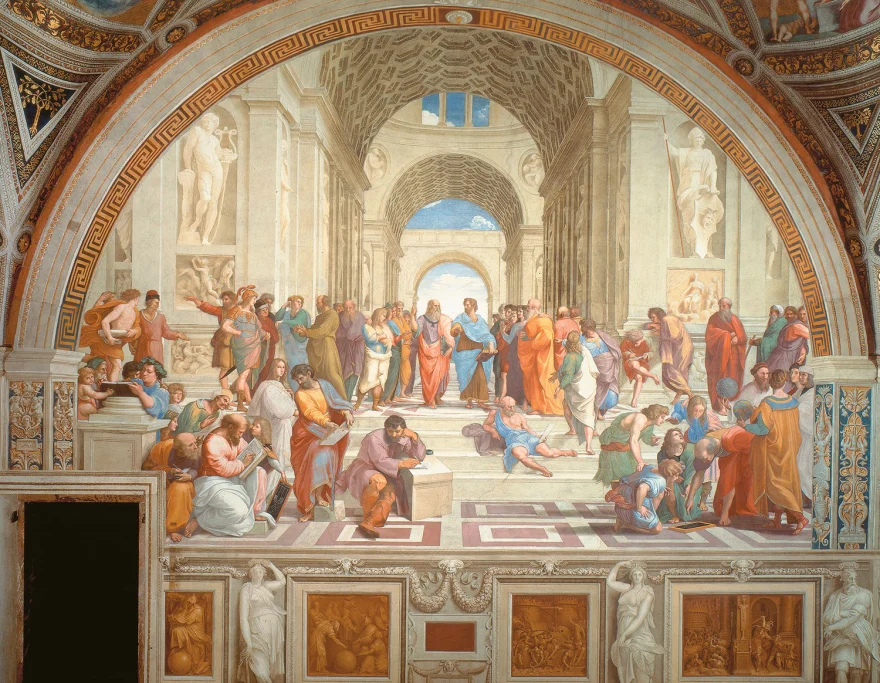
After great struggles by the Archaeological Service, a 150-acre site was designated as archaeological, reaching the current vision of the Third Ephoria to manage to establish a museum at this point – the famous Museum of Athens – that could house the relevant antiquities. And while nothing is yet certain about the course of these works, theories about the exact location of the Academy seem to be expanding and locating it in a currently built-up area towards Kifissos. In a mosaic from Pompeii, a detail pointed out by the archaeologist Efi Lygouri, now in the Naples Museum, like the famous papyri, Plato is shown conversing with other philosophers in an open-air space under the great trees of the Academy .
Some of his contemplative students hold papyri and sit on a semi-circular bench, and near them is a casket that was used to keep the papyri. In the background on the right, the walls of Athens with the Parthenon are depicted, which, according to the archaeologist, shows the distance of the Academy from the city of Athens, overturning the perceptions of this specific area, in the area of Plato’s Academy and Bythula.
Regardless of the specific place, what is certain is that the Platonic spirit still roams the heart of Athens, causing many discussions among the devotees of his thought as well as the present-day Athenians, who cannot believe that under the most degraded areas of Athens is buried the leading philosopher of the city, a theory roughly resembling a Socratic irony, or an irony of the city’s own history.