




The beginning of the end for the unipolar world that has emerged since the fall of the Soviet Union in 1989 may have begun for some. In addition to the tragic developments for the West in the Ukraine field, a potentially bloodier and wider currency war is being waged – in the sense that the survival of societies is at stake in terms of, for example, energy and food security.
What follows is that the international act of affairs as dreamed by liberalism as a peaceful utopia where those who trade do not fight is expiring. The “narrative” of the West is now being actively challenged – particularly in the financial sector which regulates the planetary flow of capital and goods – by new forces that wish to participate on their own terms in the new landscape that will be shaped by the ongoing transformation in power balances.
Old strategies and the zero-sum game
Amid rising global tensions, there are legitimate concerns that the international order is crumbling and that other priorities have displaced the pursuit of financial stability as a global public good.
Old strategies to win a zero-sum game (like the one that gave rise to the related mathematical theory in the context of the Cold War) are reappearing, with ominous echoes of the twentieth century. Since global financial stability is to be considered a public good, many Western institutions are supposed to be dedicated to creating the conditions for its maintenance.
This is the practical application of the principle of a rules-based international order. Geopolitical conflict, however, often brings about a transformation in thinking: suddenly, instability becomes a useful tool for protecting one’s interests in a zero-sum global competition.
The use of the dollar as a geopolitical weapon has left little room for those who resist US hegemony – even its allies are having second thoughts. In the current era of trade wars, cross-border supply chains and restrictions on access to key technologies – we might call it “geo-technopolitics” – a newer version of this familiar dynamic of currency wars is emerging. If history is any guide, economic war has already been declared.
Beyond the dominant narrative
A misleading picture and the overall narrative is that the geopolitical West looks fine: Japan’s Nikkei, along with European and US stock markets, are showing strength, and commercial real estate woes have not led to any form of generalized panic. Moreover, Western institutions increasingly pride themselves on ensuring economic and financial resilience.
It is hard to think of any way that geopolitical rivals could implement a collapse in the wider West. There is no obvious equivalent to the 1930s bank of Amsterdam that dropped the French franc in a precisely timed attack designed to hit the enemy before an invasion.
All That Remains Is Rhetoric – Like so much else, economics follows constructed narratives that can change abruptly, causing an overhaul of our picture of the world.

Putin’s new narrative
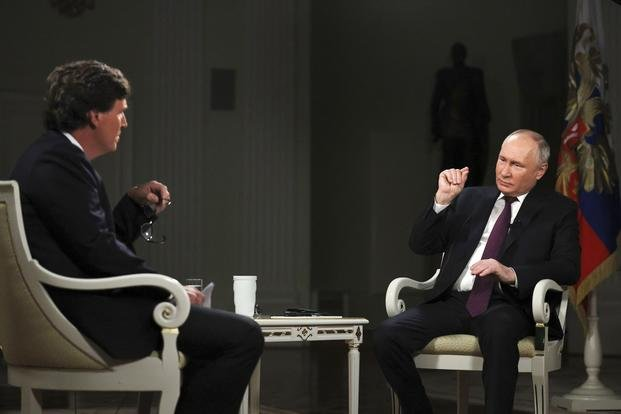
The most fascinating — and revealing — part of Russian President Vladimir Putin’s interview with right-wing American pundit Tucker Carlson this month wasn’t his incredible review of a millennium of Russian history. It was his apparent attempt to rewrite the financial market narrative.
Putin characteristically began by observing that “the dollar is the cornerstone of the power of the United States.” He then outlined a scenario in which the world gets rid of the dollar and will be tangible evidence of a weakened America: “But they won’t stop printing.
What does the $33 trillion debt tell us? This is about printing money without value”… Make no mistake… this was a call for an attack on America’s dominant economic position.
It is true that it is easy not to take Putin’s position seriously, as one part of the media suggests. He did something similar to his earlier threats of nuclear war, and the force of that threat was quickly forgotten. However, this time things are different with global financial vulnerabilities sure to continue to rise, hostilities in this theater of hybrid warfare seem far more plausible than the use of nuclear weapons.

The experience of the short 20th century
- In the twentieth century, both world wars were preceded by the formation of rival blocs and an increase in targeted economic attacks. As diplomatic tensions escalated, each side sought to undermine the other’s capabilities through an economic war of attrition.
- Economic mobilization therefore preceded military mobilization before 1914. For example, during the Second Moroccan Crisis of 1911, France responded to the deployment of a German gunboat to the coastal city of Agadir by orchestrating a rapid divestment of German bonds, which caused a financial panic in Germany.
- At the same time, Austria-Hungary, whose businesses wanted to tap the French capital market, abandoned its German ally and sided with Paris. As a result, Germany felt less secure in Austrian support and more determined to invent economic issues that would force the Habsburg Empire back to its side.
- The march to war in 1939 was also marked even more distinctly by acts of economic warfare. The Great Depression had shown how market panics and bank failures could weaken and destroy entire countries, and strategists had an obvious weapon at their disposal.
- Since collapsing bond prices or currency outflows would force governments to adopt austerity as a fiscal countermeasure, creating an economic crisis was an effective way to reduce an adversary’s defense spending (always the largest budget item ).
- Thus, from 1936, German economic leaders repeatedly used an Amsterdam bank to launch attacks on the French franc, eventually succeeding in curbing France’s military budget. This economic attack on the war set the trap that had weakened France when Nazi Germany invaded in 1940.
Amid heightened global tensions following the COVID-19 pandemic and Russia’s military operation in Ukraine in 2022, it is reasonable to worry that the international order is collapsing and that other priorities have displaced the pursuit of financial stability as a global public good.
Old strategies for winning a zero-sum game are resurfacing, and economic warfare is back with a vengeance in the form of sanctions. Indeed, it seems only a matter of time before market manipulation joins the arsenal of hybrid warfare, alongside cyber-attacks and mass disinformation. A tighter interest rate environment has made bond market turmoil more likely. Conditions are ripe for economic hostilities – and the West is more vulnerable than ever.

The vulnerabilities of the financial system
Vulnerabilities are evident worldwide. The low interest rate regime of the last 15 years fueled the property boom around the world, but COVID-19 has changed living and working standards, leading to an unspecified change in expectations about how buildings and related infrastructure are used (if are used at all…).
With the decline in office work in major city centres, commercial real estate has been left particularly vulnerable. We are already witnessing the spectacular collapse of leading property developers such as Evergrande in China and Signa in Austria and Central Europe.
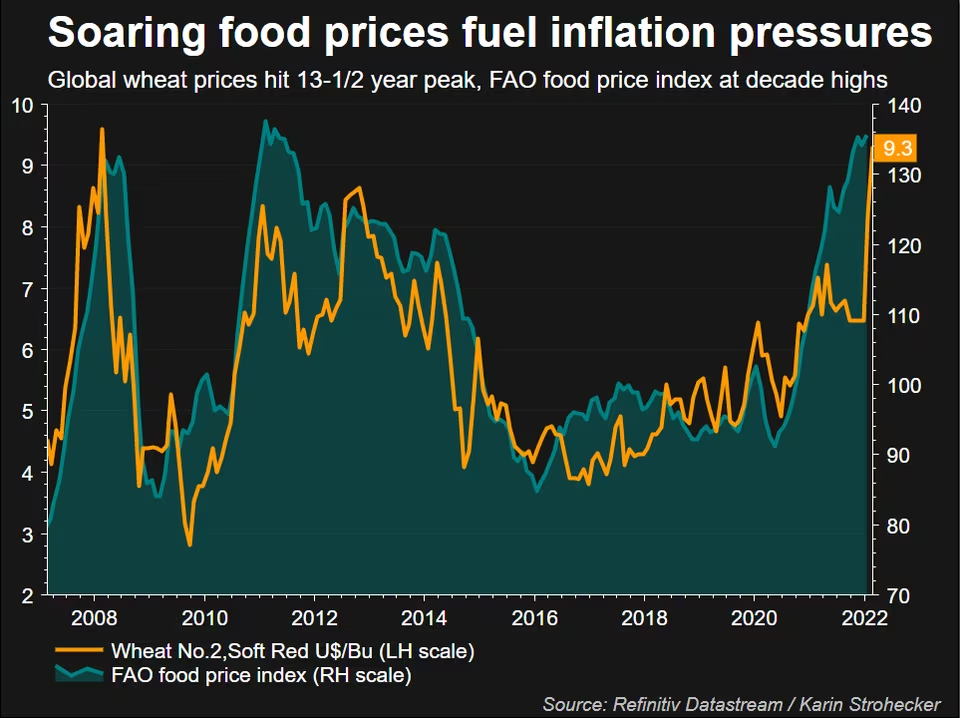
Turmoil also affects the stock markets
Russia’s MOEX index fell more than 50% in the year after October 2021 although it started to rally in October 2022, it is now faltering again. Similarly, China’s Shanghai Composite fell by almost a third from September 2021 to the end of January 2024.
Since then, Chinese authorities have intervened with increasingly sweeping measures to curb speculation and stem the collapse. The situation in Hong Kong – the key financial intermediary between China and the world – looks even worse.
One could interpret these market signals as an economic verdict against Russia and China. However, with global financial vulnerabilities sure to continue to mount, hostilities in this theater of hybrid warfare seem far more plausible than the use of nuclear weapons.
America’s adversaries will increasingly rely on the power of a new narrative to open cracks in major Western markets even as the adversary has shown that it is entering a period of decline.

