

If one observes the Ukrainian front today, one finds that the Russians follow “Stalingrad tactics” everywhere. In other words, the “tweezers” plan! (Tactics of the German Iron Cross Field Marshal Von Meinstein of the Third Reich). Advancing from the flanks, they surround the Ukrainians, who in the meantime bombard them relentlessly and finally storm and force them to retreat. Although the tightening is succeeding, it does not seem to be an end in itself to trap Ukrainian forces in order to increase the number of prisoners of war. Although de facto important forces are captured, they come out of the battle and have value at the negotiating table.
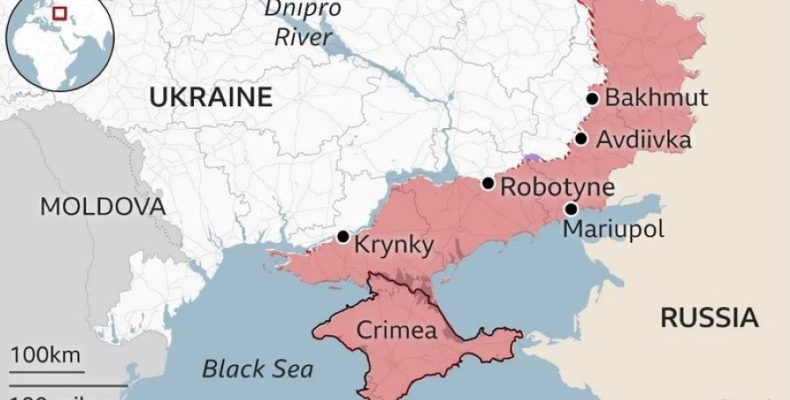
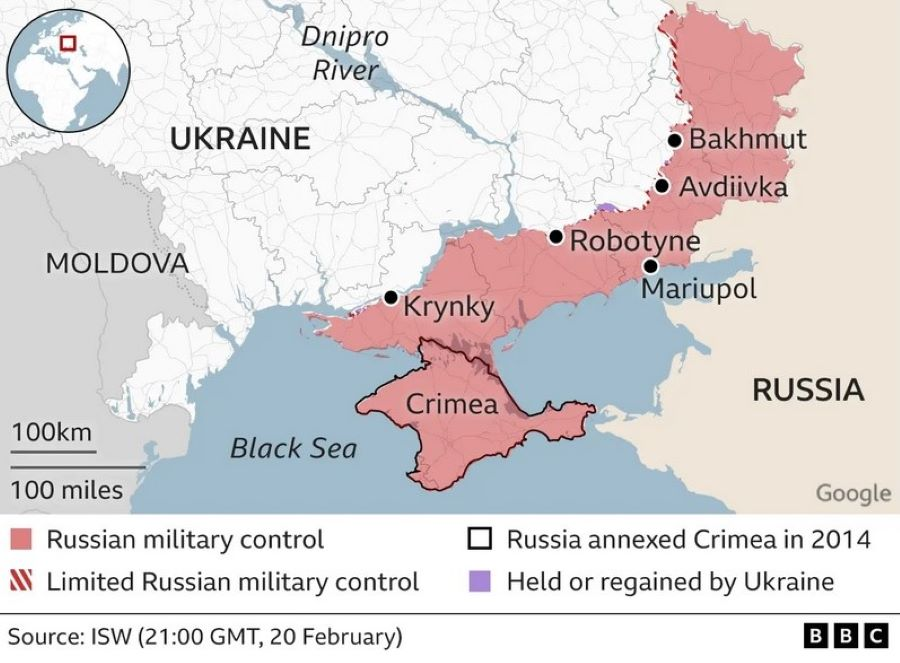
This is how it happened in Avdeevka, this is how it is happening in Bakhmut, Novomihailovka, Pervomaiskoye, Berditsy, Klisifka, Ivanivska, Belagorovka and now they are trying to do the same in Kupiansk. The same is happening on the Zaporozhye front, where the Ukrainians have infiltrated Rambotine and essentially trapped themselves. This results in Ukraine committing large forces to cope with the pressure in many places and straining themselves physically and mentally. In addition, it gives the Russians an advantage to choose who to move each time.
The Ukrainians’ only option for a land-based distraction is the Kherson region, where the Russians appear most vulnerable. That is why they maintain a pseudo-bridgehead on the east bank with huge losses. It now remains for the Russians to choose their next pressure point. Will it be in Kharkiv, Donetsk or Zaporozhye? Apparently they don’t reveal it by keeping the Ukrainian forces fragmented, who fear even an invasion from the territory of Belarus. The latest weapon at Kiev’s disposal is the acquisition of a large number of missiles and drones for strikes that can cause destruction and chaos in Crimea and Russian territory.
Vladimir Putin has three options:
1. The first is an attack from the north and the capture of Kharkiv (1 million 461 thousand inhabitants) or at least its encirclement. The attack is aided by its direct proximity to Russia while being closer to Kiev.
2. The second is in the center to advance to Donetsk. Here there are no cities the size of Odessa and Kharkiv, the largest are Slavyansk (pre-war 117 thousand inhabitants) and Kramatorsk (before the war 157 thousand inhabitants). But they have been well fortified, throughout the past decade. If the Russian army succeeds in reaching the administrative boundaries of Donetsk, Putin can say that he has achieved the objectives of the operation and we will be led to a cessation of war.
3. The third is in the south, towards Nikolayev (439 thousand inhabitants) and Odessa (1 million inhabitants) and recapture of Chersonos. It would certainly be the most ideal scenario for Russia, as it would exclude Ukraine from the Black Sea, and give access to Transnistria, creating conditions of suffocation in Kiev, but also a direct threat to NATO, now so close to Romania.
Of course, even if he has the ability to make the final push, he doesn’t necessarily want to. Perhaps it has more value in the form of a threat, in view of any negotiation. In other words, to diplomatically exploit the threat of a potential advance, sacrificing a declared capability, if the absolute priority is to find and agree new rules in the “game” with NATO. But everything is still unclear.
Although there is a friendly population in the south, the capture of the two major cities is a very difficult goal, which requires the collapse of the Ukrainian army. However, it is not excluded that an advance will be attempted, if this option is selected, bypassing the cities, which will be cut off from the center, in which case a settlement will be made through agreements by another Ukrainian leadership.
All of these are of course simple scenarios, which no one can predict will happen in this way. There may even be a reversal of the data by some unforeseen event. We are simply obliged to examine them because in themselves they also affect the movements of the belligerents…

