




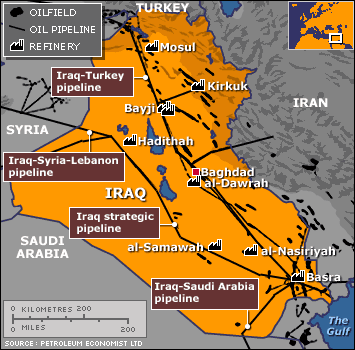
China is halfway to completing its strategically vital oil project at Iraq’s critical Nasiriyah energy hub, at the “heart” of the country’s largest oil and gas fields and close to Al Fao’s main export terminal in Basra. According to Iraq’s Ministry of Energy Planning, the China Petroleum Pipeline Engineering Company (CPPEC) is now more than 55% complete with the construction of the country’s largest crude oil storage facility, located in the city of Nasiryah in DhiQar province.
Tremendous work
This facility will act as a storage hub and feeder pipeline for 3.0-3.5 million barrels of crude oil that will then either be exported from the port of Basra, or transported via pipelines to refineries and power plants in central and northern Iraq .
It will also serve as the administrative center for all of China’s extensive oil and gas projects in Iraq and for the construction of multiple non-oil projects linked to the comprehensive “Iraq-China Framework Agreement”.
Oil supplies
Even before the huge strategic importance of the new Nasiriyah facility, China would benefit from a massively enhanced presence there in terms of increasing its oil supplies from southern Iraq, with DhiQar province home to several huge fields. The Gharraf field is one, with oil reserves of about 1.3 billion barrels and currently producing about 130,000 barrels per day (bpd), with plans to increase to 230,000 bpd within the next two years.
The main shareholder is Malaysia’s Petronas, which said last May that it wanted to sell its stake in the field. However, China already effectively controls what happens to the exclusive contracts secured by its companies.
China’s tactics
The acquisition of multiple contracts by Chinese companies in major oil and gas fields in Iraq has long been the preferred way for the country to stealthily gain control of a site without incurring the ire of the US while still maintaining a strategic interest in Iraq.
The contract for the Gharraf field
In the case of the Gharraf field, China Petroleum Engineering and Construction Corporation (CPECC) was awarded a US$308 million engineering, procurement, construction and commissioning contract. In 2015, Zhongman also received a $526.6 million drilling contract for Iraq’s West Qurna 2 oil field. In addition, on July 13 the Chinese group Zhongman Petroleum and Natural signs a separate study and construction project for Gharraf.
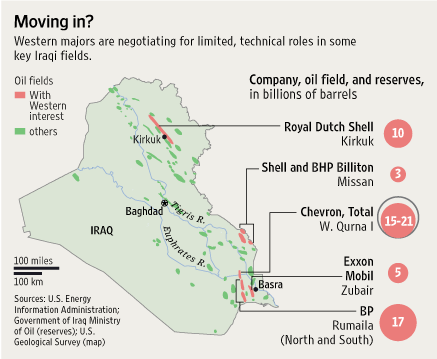
Further emboldened by the US withdrawal from Iraq at the end of its combat mission in December 2021, early this year PetroChina took over the role of lead operator in the neighboring massive West Qurna 1 oil field from US ExxonMobil. This was followed just a week later by the award of a major build-own-operate-transfer contract to a subsidiary of PetroChina for the development of the onshore Nahr bin Umar gas field.
The expulsion of competitors
At the other end of the development scale in DhiQar province is the massive Nasiriyah oil field, discovered by the Iraqi National Oil Company in 1975, with estimated reserves of 4.36 billion barrels.
In the first half of 2009, ENI, Nippon Oil, Chevron and Repsol, launched in 2009 and included in Iraq’s 2009-2010 fast-track plan, aimed at increasing its production to around 50,000 bpd ( barrels/day) on an engineering supply construction (EPC) contract basis, with a consortium comprising Nippon Oil, Inpex and JGC Corporation looking to win the contract before negotiations break down again.
The departure in 2014 of the divisive figure of Shiite Islamist Nouri al-Maliki as prime minister and his replacement by the apparently friendlier, though also Shiite, Haider al-Abadi led to optimism in Iraq that the Nasiriyah project could move forward again, but even these hopes were dashed.
The geopolitical pressure against the US
China has long viewed Nasiriyah as an important part of its overall plans for Iraq, which are essentially to turn it into a client state, as it did with Iran, to create a giant oil and gas station for it in the Middle East , which he can also use for geopolitical pressure purposes against the US.
In the case of Iran, China has so far succeeded in making this transformation from a sovereign state to a Middle Eastern equivalent of Hong Kong (a Special Administrative Region of China) through the all-encompassing “Iran-China Comprehensive Cooperation Agreement” 25 years.
This agreement, in turn, was an expansion in the scale and scope of the Oil for Reconstruction and Investment agreement signed by Baghdad and Beijing in September 2019, which allowed Chinese companies to invest in infrastructure projects to Iraq in exchange for oil.
Following this, Iraq approved nearly 1 trillion IQD (US$700 million) for infrastructure projects in the city of Al-Zubair in the Basra oil hub in southern Iraq. Al-Zubair’s announcement came around the same time as Baghdad awarded another major contract to another Chinese company to build a civilian airport to replace the military base in Nasiriyah. This airport project, China announced, will include the construction of multiple cargo buildings and roads that will connect the airport to the city center and separately to other key oil areas in southern Iraq, which it now controls.
In subsequent discussions included in the 2021 “Iraq-China Framework Agreement”, it was unanimously decided by both sides that the airport could later be expanded into a civilian and military dual-use airport. The military facilities could be used by China without first having to consult with whichever Iraqi government was in power at the time, a senior source working closely with Iraq’s oil ministry told OilPrice.com exclusively.


