Two years after the war in Ukraine, once a destination for American neo-Nazis, many in the underground far-right movement in the US are zealously repudiating it and advising their followers to stay away.
Extremists now see the upcoming election year as tailor-made for activism on the home front.
At the start of the war, the Department of Homeland Security (DHS) issued a briefing that far-right American extremists were heading into the conflict and could use it to hone their terrorist skills and bring them back to the US.
Following an open call for international volunteers, the Ukrainian army has attracted nearly 20,000 fighters from around the world. Within weeks, there were already so-called American “Boogaloo Bois” flying to Ukraine.
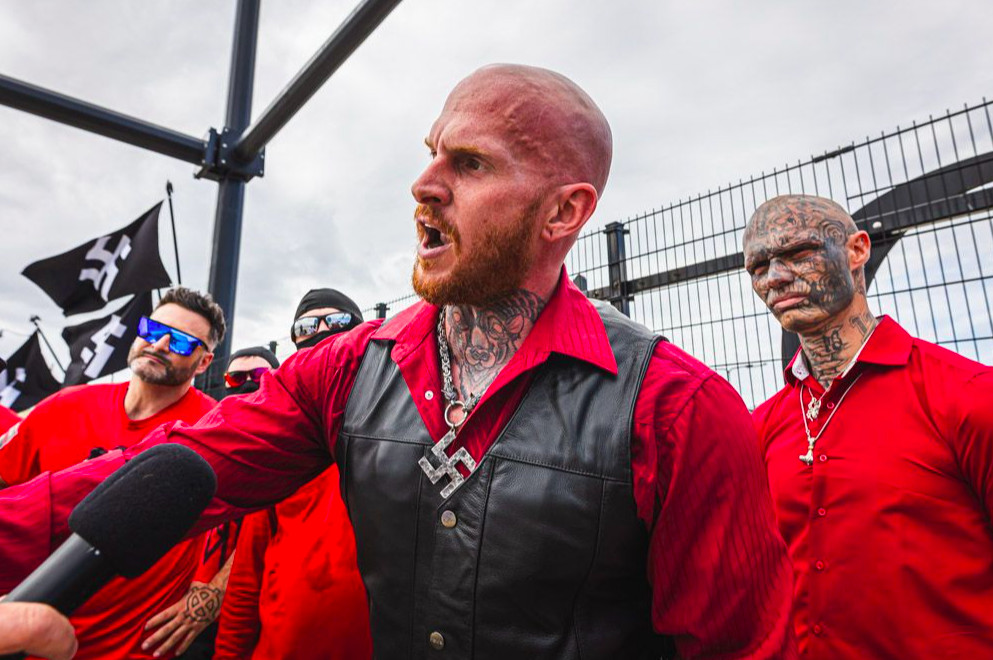
In a November 2023 Telegram audio message, ex-Marine Christopher Pohlhaus – the leader of the neo-Nazi Blood Tribe network known for its racist and homophobic protests across the US – told his followers that he does not allow “his children” to join the conflict.
“I will continue to support the people’s struggle there,” Pohlhaus said before explaining how a disagreement with his personal ally and leader of the Russian militia fighting for Ukraine, Denis Nikitin (to whom Pohlhaus pledged allegiance in the summer), caused the disruption of group relations.
“I am not going to allow the efforts and the blood of our people, my people, to go in the direction [of the war],” he said.
According to him, although several of his members were “super excited and ready to go to Ukraine”, they would direct all their money and resources to focus on domestic activism, particularly hate rallies, seeing no benefit in to fight on the Ukrainian front.
Some in the broader US neo-Nazi movement have used the war in Ukraine as a kind of live-action roleplaying to bolster their militant credibility, even if the stories of their exploits are not true.
Kent McLellan, an Italian who worked with Pohlhaus and goes by the nickname “Boneface,” was revealed to have lied about the Ukraine war over the summer.
For its part, the Kremlin has recruited neo-Nazis to its own cause – the co-founder of the mercenary group Wagner Group, Dmitry Utkin, not only named his organization after the Third Reich’s favorite composer, but had the logo of the Waffen- SS tattoos on both sides of his neck.
The war is also at a crisis point for Ukraine, with the Republican party blocking US aid to Kiev in Congress over demands to first shore up the southern border with Mexico and make draconian changes to the US asylum system.
Within the wider web of new-Nazi militancy, talk of Ukraine has all but evaporated, with the conflict in Gaza and domestic issues overshadowing what was once a well-watched world event.
Seeing no value in sending men to gain combat experience on the front lines, with a very high risk of death or capture upon return, US far-right extremists see Ukraine as a conflict with little payoff.
But just five years ago, Ukraine was considered a fertile training ground for far-right extremists. The threat of law enforcement also acted as a major deterrent to neo-Nazis who sought to join the Ukrainian war effort.
The situation is different for European new-Nazis
For European neo-Nazis, on the other hand, the conflict is on their doorstep.
Unchecked Russian imperialism is still seen by nationalist movements across the continent as a very imminent threat. They believe that Americans and Anglophones within their movement are ignorant of the reality of the Kremlin’s propaganda machine.
European right-wing nationalists from Scandinavia, Poland, Belarus and Russia, among others, have served on the front lines. But for many American extremists, the real prospect of engaging in conflict involves practical and logistical difficulties, as well as a great deal of risk to life and bodily integrity.
One of the most important inhibiting factors for Americans joining the war, compared to Europeans, is distance and language. It’s far away, they didn’t speak the language and it’s freezing in Ukraine.