



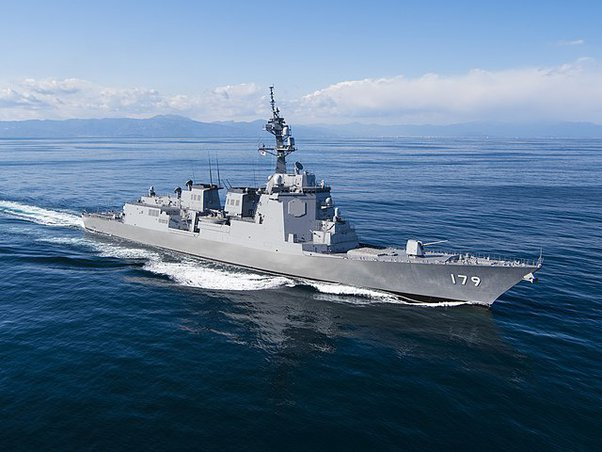
The two main area defense systems in the Western arsenal are the American Aegis and the European PAAMS.
1. AEGIS Combat System
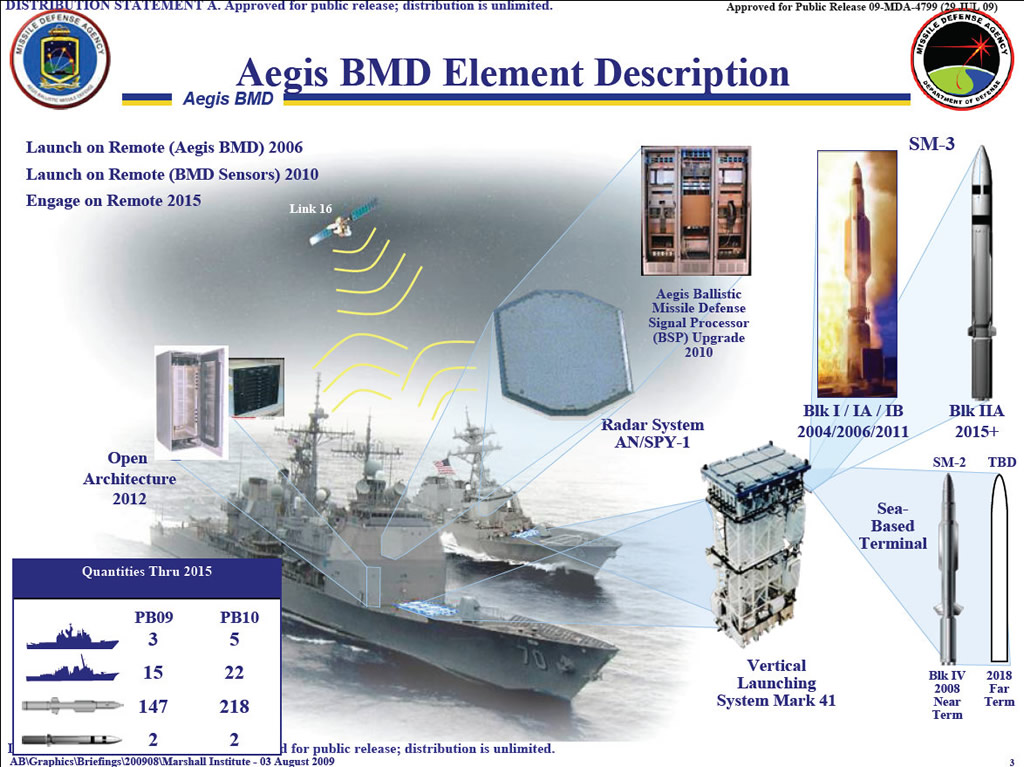
The American system first entered service in the 1970s with the Ticonderoga class cruisers. The heart of the system is the AN/SPY-1 array of radars that provide long-range target detection. The main components of the system are:
- The AN/SPY-1 passive (PESA) radar.
- The Command & Control system and control of the ship’s weapons
- The Mk99 homing radar
- Mk26 or Mk41 launchers with SM-2 medium/long range missiles.
Since the 1970s there have been ten versions of the system. The newest one in use today is Baseline 10 which contains all upgrades, new weapons, new radars as well as anti-ballistic defense capability.
Radar
The original Aegis system radar was the AN/SPY-1A carried by the first Ticonderoga class cruisers. In the upgraded baseline 2 version the system carried the upgraded AN/SPY-1B(V) radar. With the entry into service in 1991 of the first A.Burke destroyers, the AN/SPY-1D and AN/SPY-1D(V) radar was adopted on the Fight IIA ships. Accordingly the system was installed on the F100 frigates of the Spanish Navy, Nansen of the Norwegian Navy with the light AN/SPY-1F version of the radar. Finally, the system has been installed on the Hobart destroyers of the Australian Navy, the KDX III of the South Korean Navy and the Kongo, Atago and Maya class destroyers of the Japanese Navy.
In the latest version of the Baseline 10 system, AEGIS cooperates with the new AN/SPY-6 AESA radar. This radar will be worn by the A. Burke Fight III class destroyers, the new Constellation class frigates. Accordingly, the new Type 26 class frigates of the Canadian and Australian Navy will wear the lighter AN/SPY-7. That is, the system has already been installed in more than 100 naval units and is expected to be installed in another 70 units in the coming years.
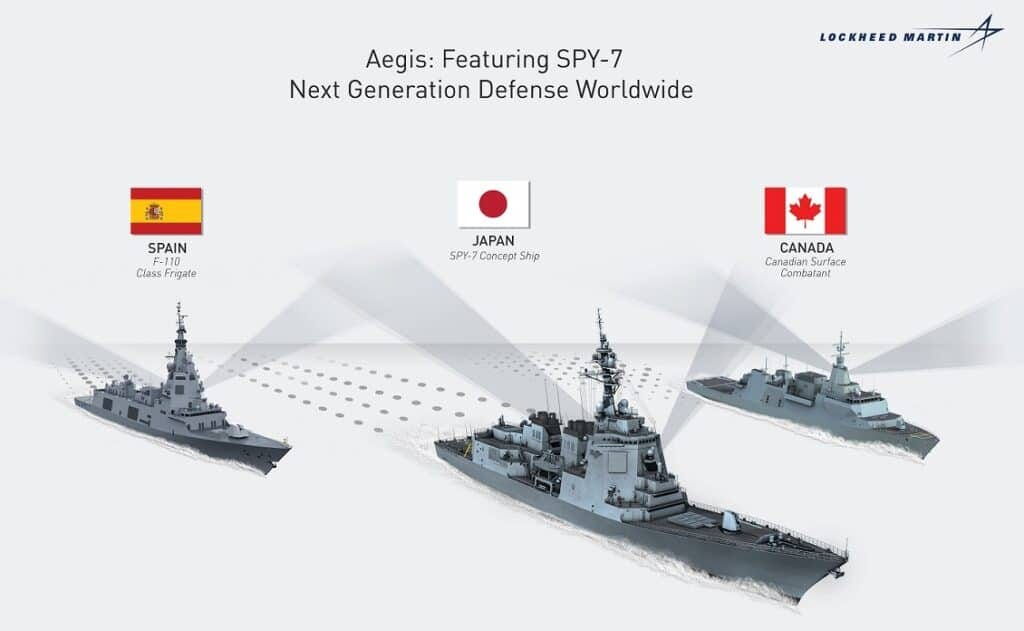
AN/SPY-1
Unlike US Air Force radars in the Navy the first fixed phased array radar was PESA (Passive Electronic Scanned Array) technology. It was the well-known AN/SPY-1A that was first worn by the Ticonderoga-class cruisers, leading, along with the introduction into service of the then new SM-2 AA missile and the AEGIS system, the AA area defense to another unprecedented level for the time.
- The AN/SPY-1A model was installed on the first 12 Ticoderoga-class cruisers (CG47-58) and is configured with four phase arrays each, two mounted forward and two aft. Each antenna is subdivided into 140 array units, each with 32 radiating elements. There are 4,096 broadcast items and 4,352 download items. The phase shifters incorporate highly accurate, temperature-resistant synthetic luminite crystals and are driven by four-channel driver boards, of which there are eight identical ones to ensure system redundancy and survivability.
- The AN/SPY-1B achieved initial operational capability in 1989 when USS Princeton (CG-59) was commissioned. It brought new smaller phase shifters allowing much lighter weights. Some basic anti-stealth features were also implemented, although full implementation had to wait for the SPY-1D(V). Also the ECCM capabilities of the system have been improved.
- The AN/SPY-1D (for Destroyer) is the –B model adapted for a destroyer-sized ship. It was worn by the first Arleigh Burke-class AAW destroyer DDG-51 in 1991 through DDG-91. The destroyers carry a single radar transmitter instead of two, and instead of the four target illumination radars on the CG-47 ships, there are only three.
- The AN/SPY-1D(V) model was worn by all other Arleigh Burke-class ships of the Flight IIA configuration until the arrival of the Flight III configuration which brought an entirely new radar. The AN/SPY-1D(V) was fully implemented with anti-stealth features. It introduced advanced waveforms that reduced background noise, allowing much better detection of hidden targets. New ECCM processing techniques were introduced to eliminate many types of spurious interference. Performance against targets with a land background was also significantly improved. It became operational in 2004 when USS Pinckney (DDG-91) was commissioned.
- The AN/SPY-1F model (for Frigate) was designed to be installed on frigate-sized ships so the diameter of each fixed element antenna was reduced to 2.4 meters and correspondingly the number of its elements to 1856 from 4350. this model has all the advantages of its predecessors with less volume and weight. It was successfully integrated into the F-100 class ships of the Spanish Navy and the Nansen of the Norwegian Navy.
- The last model in the series that was not fortunate enough to be installed on any ship class was the AN/SPY-1K which is an even smaller version capable of being fitted to very small displacement ships such as light frigates and corvettes.
- The AN/SPY-6 also known as the Air and Missile Defense Radar (AMDR) is an active 3D phased array radar that will provide comprehensive air and missile defense for Arleigh Burke Flight III class destroyers. Variants are under development for retrofitting Flight IIA Arleigh Burkes and for installation on Constellation-class frigates, Gerald R. Ford-class aircraft carriers, and San Antonio-class amphibious transport docks. The first delivery of the AN/SPY-6 to the USN took place on July 20, 2020.
The SPY-6 system consists of two main radars and a Radar Array Controller (RSC) for sensor coordination. An S-band radar provides volume search, tracking, ballistic missile defense discrimination, and missile communications, while an X-band radar provides horizon search, precision tracking, missile communications, and terminal target illumination. The S-band and X-band sensors will also share functions such as radar navigation, periscope detection, and missile guidance and communication. SPY-6 is intended as a scalable system, with each sensor array assembled from Radar Modular Assemblies (RMA), self-contained radar units.
The transceiver units will use new gallium nitride (GaN) semiconductor technology,[8] allowing higher power density than previous gallium arsenide radar units. The new radar will require twice as much electrical power as the previous generation, while producing over 35 times more radar power.
The radar is 30 times more sensitive and can simultaneously handle over 30 times the targets of the existing AN/SPY-1D(V), allowing it to deal with large and complex saturation attacks. It is estimated to have an improved sensitivity of 15 dB compared to the previous generation AN/SPY-1 radar, or otherwise capable of detecting targets half its size at twice the distance.
The weapons
The original system of the first Ticonderoga cruisers carrying the twin MK 26 missile launchers had only the SM-2 medium range missiles certified. With the Baseline 2 upgrade on subsequent ships of the class that carried the then-new MK41 vertical missile launchers the system was certified on Tomahawk cruise missiles and for anti-submarine warfare. Today in the latest version, according to the company, AEGIS is certified in 18 different types of missiles, including the SM-2 and ESSM for area and point air defense, the SM-3 and SM-6 for anti-ballistic defense, the VLA for anti-submarine warfare and the Tomahawks for a long-range strike. The system is also interconnected with the MH-60R helicopters’ tactical data link and uses data from the helicopter’s systems to enhance situational awareness.
2. PAAMS
On the other side of the Atlantic France, Italy and the United Kingdom decided to develop a corresponding system for the new anti-air warfare units that were to enter service in the 2000s. The new system was called PAAMS (Principal Anti-Air Missile System ) and led to the development of the new European medium- and long-range missiles Aster 15 and Aster 30. With the original ships cut in half, the system was eventually installed on just four Horizon-class destroyers of the Italian and French navies and six Type 45 Daring-class destroyers of the Royal Navy. The system consists of:
- The EMPAR radar on the Horizon and SAMPSON on the Type 45.
- The Command & Control system and control of the ship’s weapons
- The Sylver launchers
- The Aster 15 & Aster 30 medium/long range missiles.
PAAMS is designed to provide protection at sea against enemy aircraft, tactical ballistic missiles and cruise missiles. It is a 360-degree omnidirectional system that can provide multi-layered air defense to PAAMS-equipped vessels and area protection for a fleet of neighboring ships. The air defense system is capable of defeating saturated attacks from modern air threats, including anti-ship missiles, anti-radar missiles and fighter jets.
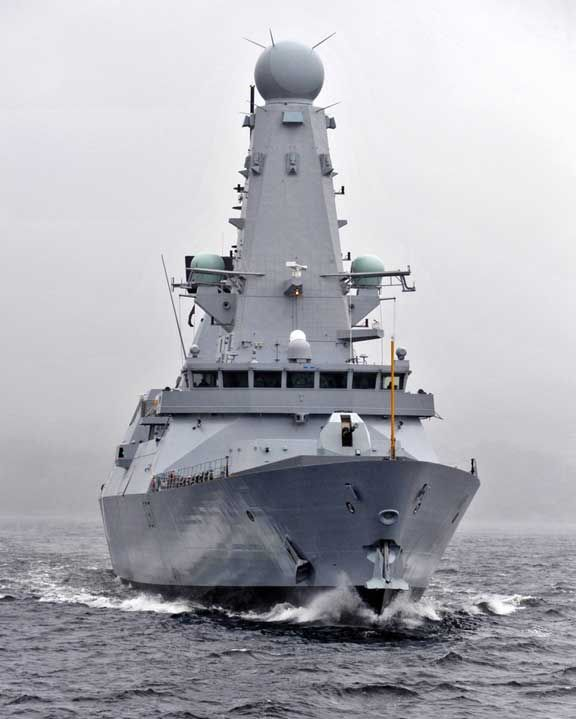
For long-range surveillance and tracking, PAAMS uses the S1850M radar, an upgraded version of the Dutch SMART-L radar, which allows PAAMS-equipped vessels to detect and track aerial threats. Once a threat is detected by the S1850M long-range radar, the fire control radar, EMPAR multi-function radar on Horizon-class destroyers and SAMPSON multi-function radar on Type 45 destroyers are activated to provide information on the target’s trajectory and calculate a solution shot.
Radar
The EMPAR multifunction radar operates in the C-band (4-8 GHz) with a frequency that rapidly changes to 5.6 GHz in the primary mode. The radar uses the principle of pulse compression of digital signals and a two-stage superheterodyne receiver connected to a unit of several Raytheon C40 series digital processors. The EMPAR radar has a water-cooled rotating passive electronic scanning antenna with a tilt angle of 30°. The radar with such an antenna has limited possibilities of action in conditions of mass air attacks when coming from different directions. However, these limitations are somewhat offset by the fact that Aster-30 does not require constant, but only periodic guidance correction in the middle part of the trajectory, and the final approach part is operated by active radar. All this frees the EMPAR radar from the need to be in contact with the missile throughout the process of intercepting the target.
The EMPAR radar antenna consists of 2,160 transmitting elements and forms a 2.6° beam with controllable directional pattern within 45° horizontal and 60° vertical. The radar can simultaneously provide single-pulse tracking for 69 high-priority targets and 2,311 low-priority targets, with the desired data rate adjusted for each target. According to the manufacturer, the maintenance of 50 high-priority targets can be provided with such accuracy and data acquisition speed that it will be sufficient to immediately intercept these targets, although not all targets at the same time. Some sources estimate that the EMPAR radar is capable of simultaneously controlling up to 24 missiles in flight. This radar is characterized by the following target detection ranges: 180 km for 10 square meter targets, 120 km for 2 square meter targets and 50 km for 0.1 square meter targets.
The multifunctional radar “Sampson” was created by the British company “Defence Evaluation” and the research organization DERA. The radar is intended for both surface and air target detection and flight path correction. The radar operates in the E/F band. The E-band has been used to detect air targets (at a range of up to 250 km) and sea targets (up to the horizon line). The F zone is used to determine target coordinates and correct the trajectory of the SAM system by periodically sending control commands to it.
The radar phase antenna consists of two round mirrors mounted “back to back” on a common rotating base, with a total of 5200 elements, of which 2600 are in the E and F bands. Each of the elements consumes 10 W, the total radiated power is about 25 kW per mirror. There are several channels in each range, which is provided by electronic scanning of the beam and allows to simultaneously detect up to 2000 targets, track 12 of them (including 8 – in the near zone) and correct the flight trajectory of 16 missiles. The weight of the antenna is 4.6 t and its rotation speed is 30 rpm. The antenna is located under a spherical dielectric cover, equipped with an air conditioning system, which allows maintaining the necessary climatic conditions.
The weapons
The Aster 15 and Aster 30 missiles consist of two parts, the main missile, a low-weight and ultra-high-maneuverability missile that MBDA calls the Dart, which houses the active seeker, the firing tube, the missile guidance system, the war warhead and the booster rocket engine and the second part which is the booster rocket engine which is deployed when the Aster attains the desired speed and direction to the target, a few seconds after launch. Rocket acceleration and sustaining speed is achieved by a two-stage solid fuel rocket motor as mentioned above and gives a speed of 3.5 mh to the Aster 15 and 4.5 mh to the Aster 30.
The key innovation of the missile is the steering system that MBDA calls PIF-PAF.
- PAF (Pilotage Aérodynamique Fort) i.e. fixed long chord type fins and movable tail fins for aerodynamic controls,
- PIF (Pilotage In Force) gas jet system applied to the center of gravity of the projectile for the final phase of target interception with zero response time, even at very high altitude.
This system gives the projectile unparalleled flexibility, which reaches 60g, in the final phase of intercepting the target, with the possibility of instantaneous turning and as a result expanding the “no escape zone” of the target.
The missile uses inertial guidance for mid-flight to the target that updates data from the ship’s radar via an up-link and active Ku-band seeker for the terminal phase of the intercept. In this way, the missile is considered fire and forget since it does not need continuous target acquisition by the corresponding radar of the carrier ship.
The initial version of the missile provided protection against the full range of aerial threats: hypersonic and subsonic missiles, anti-radar missiles, fighter jets, UAVs and helicopters, at short and medium distances and at heights of up to 20 km. The first upgraded version of the Aster 30 missile was the Aster 30 B1, this new version gave the carrier ship anti-ballistic protection when the missile became capable of hitting short-range ballistic missiles up to 600 km (SRBM). This version will also be carried by the Greek FDI type frigates. The newest version is the Aster 30 B1 NT (New Technology). The new version extends the ability to intercept ballistic missiles with a range of up to 1,500 km as well as detachable warheads.
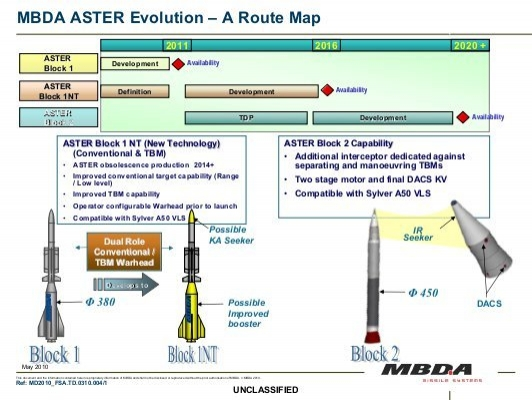
The Aster 30 B1 NT uses a new generation active Ka-band seeker and a new weapon control system. The young researcher confers:
- Increased target acquisition range.
- Addition of targets with low radar cross section.
- Finer angular resolution for greater target tracking accuracy.
- Increased direct hit chance.
The next version under development is the Aster Block 2. The new missile will expand the envelope of countering ballistic missiles with a range of around 3,000 km.


