



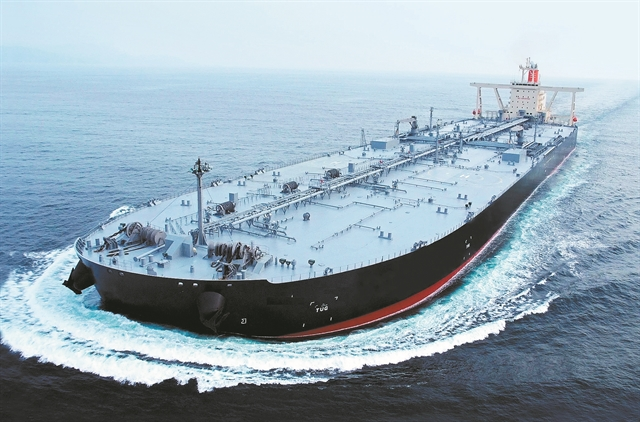
Shipowners operating tankers, liquefied natural gas carriers and car carriers were all gainers in 2023, in contrast to the container and dry bulk sectors, which saw revenues squeezed, shipping broker Clarksons said in an analysis (“Shipping industry has stayed afloat despite turbulent tides“).
Global maritime trade grew by 3% to €12.4bn, The global fleet rose by 3% to 2.3bn dwt, with the new ship order book growing by only 3% year-on-year to 126m. Dat.
The tankers
Specifically by shipping industry, in tankers, the market had another very strong year, with average tanker earnings remaining elevated at $40,775/day (year-on-year constant, 2022: $40,766/day), with continued support from a rise in longer-distance trading after the redistribution of Russian oil flows due to the conflict in Ukraine.
VLCC earnings rose 80% year-on-year to $43,206/d on the back of a recovery in Chinese crude imports and increased Atlantic exports, while earnings in the Suezmax and Aframax sectors remained very strong, outpacing VLCC earnings for a third consecutive year. MR net product tanker earnings eased slightly but remained very strong at $26,948/day.
Bulkers
2023 has not been a great year with average dry bulk carrier earnings down 40% year-on-year to $12,371/day amid reduced fleet inefficiencies (eg congestion) and impact from cumulative growth of the fleet in recent years. Profits in the Capesize spot market averaged $12,429/day in 2023, similar to the weak level of 2022, while profits in the smaller segments declined.
Container ships
Container ship rates fell in 2023 as the market “flattened” from 2021-22 levels, with average container rates down 71% year-on-year and average ship rates to decrease by 68% (but remain above pre-2019 levels). The outlook indicated that prices would “bottom out” in 2024, but with the disruption in the Red Sea (over 300 containerships of 4 million TEU have now been diverted through the Cape of Good Hope) freight rates from Shanghai to Europe have, for now, tripled but are still 65% lower than the peak of the Covid-19 pandemic era.
Gas carriers
VLGC earnings in the spot market were extremely strong, up 69% year-on-year to an all-time high of $91,625/day, on the back of steady US-Asia gas trade, and Panama Canal disruptions.
Liquefied Natural Gas (LNG) Carriers
Prices softened year-on-year (from the 2022 record high) but remained healthy, with spot prices for a DFDE 160k cbm vessel averaging $97,077/day, 34% above the ten-year trend. With a significant order book (52% of the fleet), the fleet is poised to expand strongly in the coming years to help support a record LNG volume during 2025-27.
Car Carriers
Charter rates of Car Carriers remained at all-time record highs, supported by car volumes transported including growing Chinese long-haul exports, mainly electric vehicles (EVs). Since 2019, global seaborne car trade in ceu-miles has grown by 19%, against a 1% expansion in fleet capacity. By the end of 2023, the one-year charter price for a PCTC 6,500 ceu was at a record $115,000/day, having remained above $100,000/day since late 2022.
